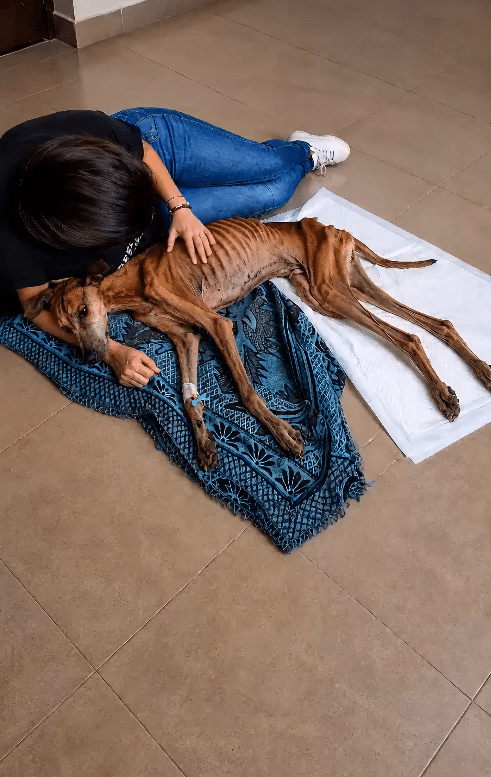
People hurried past him in every direction.
Cars moved through the city.
Footsteps echoed across the pavement.
In the middle of it all, Santa lay almost completely still.
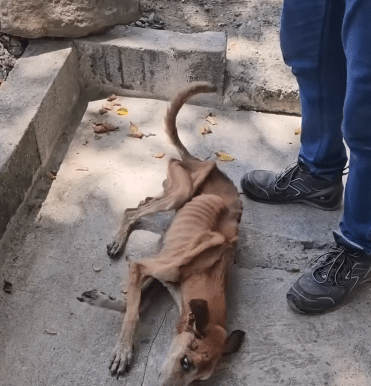
His body was painfully thin, and each breath seemed to demand what little strength remained. Again and again, he tried to push himself up.
His front legs trembled.
His body lifted slightly.
Then he collapsed back onto the sidewalk.
Santa could no longer carry himself.
But he had not stopped trying.
When rescuers finally reached him, that quiet determination told them everything they needed to know.
Somewhere inside his exhausted body, he still wanted to live.
He Had Almost No Strength Left
The rescue team immediately understood that Santa was in critical condition.
His ribs and bones were visible beneath his coat. Dehydration had weakened him, and prolonged hunger had reduced his body to almost nothing.
Even lifting his head required effort.
Still, whenever someone moved nearby, Santa tried to respond.
He attempted to stand once more, only for his legs to fold beneath him.
The rescuers spoke softly and approached without rushing.
Santa did not resist when they carefully lifted him from the pavement.
Perhaps he understood they had come to help.
Perhaps he was simply too exhausted to be afraid.
They placed him inside their vehicle and drove directly to a veterinary clinic.
For the first time in a long while, Santa was no longer surrounded by people passing without stopping.
He was finally in the hands of people determined to stay.
Video: Santa Was Too Weak to Stand—Then Rescuers Fought for the Life Everyone Feared Was Already Lost
The Examination Revealed How Much His Body Had Endured
At the clinic, veterinarians began evaluating Santa immediately.
He was severely malnourished.
Dangerously dehydrated.
And physically depleted after what appeared to be a long period without proper care.
The medical team was also deeply concerned about his kidneys and spleen. His weakened condition meant that every part of treatment had to be handled carefully.
Santa’s body needed fluids and nutrition.
But giving too much too quickly could create additional complications.
Tests were performed.
His breathing and heart rate were monitored.
Medication was prepared to stabilize him and reduce discomfort.
Then came the warning no rescuer wants to hear.
Santa might not survive.
His condition was simply too fragile for anyone to promise a recovery.
The room grew quiet.
But when the rescuers looked at Santa, they remembered the dog who had continued trying to stand even when his legs could no longer support him.
The prognosis was uncertain.
Their decision was not.
They would give him every chance they could.
One Meal Became the First Sign of Hope
Santa began receiving intensive care.
Fluids helped address the dehydration.
Medications supported his struggling body.
Small, carefully prepared meals were offered while the veterinary team watched closely for any reaction.
Then something happened that changed the feeling in the room.
Santa ate.
He did not merely sniff the food and turn away.
He ate with the urgency of a dog who had been hungry for far too long.
Every bite gave the rescuers another reason to believe he had not surrendered.
His body remained weak.
The medical risks had not disappeared.
But Santa was showing them that he was willing to fight if they continued fighting beside him.
The rescue team began raising support for his treatment.
Volunteers organized schedules so he would never be left alone.
Through the difficult nights, someone remained nearby to monitor him, adjust his bedding, and make sure he was comfortable.
Santa had spent too long being overlooked.
Now every breath mattered to someone.
Recovery Came Through Quiet, Uneven Progress
Santa did not transform overnight.
Some days brought encouraging changes.
Other days brought new worries.
His appetite could improve in the morning and weaken again by evening. His energy returned in small amounts, then disappeared after even minor effort.
The caregivers learned to measure progress differently.
A little more food finished.
A brighter look in his eyes.
A steadier breath while sleeping.
The ability to lift his head without immediately lowering it again.
These changes might have appeared insignificant to someone who had not seen him on the sidewalk.
To the people caring for him, they were proof that his body was responding.
Gradually, Santa began gaining weight.
His eyes became more alert when familiar volunteers entered the room.
He started following their movements instead of resting with his gaze fixed on the floor.
The frightened, exhausted dog was still there.
But something stronger was beginning to emerge.
The Day His Legs Finally Held Him
After weeks of treatment, Santa attempted to stand again.
The caregivers remained close, prepared to support him if he fell.
He placed his paws beneath his body.
His legs trembled.
For a moment, it looked as though he would collapse just as he had on the crowded sidewalk.
But this time, Santa stayed upright.
Only for a few seconds.
Still, he was standing.
The people around him barely dared to breathe.
Then Santa moved one paw forward.
He paused.
Took another step.
His balance remained uncertain, and every movement required intense concentration.
But he did not fall.
The dog who had once been unable to lift himself from the pavement was walking.
Those first steps did not mean his recovery was complete.
His muscles were still weak.
His medical condition still required monitoring.
But the moment carried a promise that had once seemed impossible.
Santa was moving toward life again.
Soft Grass Helped Him Grow Stronger
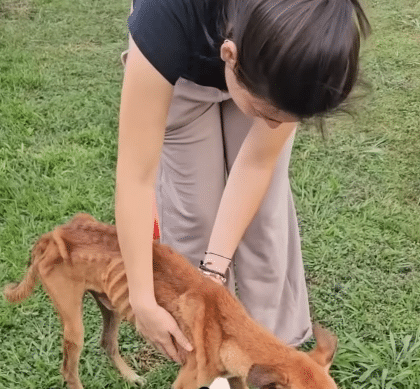
As Santa became more stable, part of his rehabilitation moved outdoors.
Soft grass provided a gentler surface for his weakened legs and paws.
At first, each walk lasted only a short time.
A caregiver remained beside him, ready to offer support whenever his balance shifted.
Santa moved slowly.
He stopped often to rest.
But the outside world seemed to awaken something inside him.
He lifted his head toward new sounds.
He smelled the grass.
He watched the people encouraging him forward.
The distance increased little by little.
A few steps became several yards.
His legs grew stronger.
Healthy weight began returning to his body.
The dog who had once used every ounce of energy simply to stand now showed curiosity about the world around him.
Soon, glimpses of his real personality began appearing.
Santa enjoyed attention.
He responded to gentle voices.
His tail began moving when someone familiar approached.
He was no longer only surviving treatment.
He was beginning to enjoy being alive.
A Future That Once Seemed Impossible
By the later stages of his recovery, Santa looked like a different dog.
His body was fuller.
His eyes were bright.
His movements carried growing confidence rather than exhaustion.
There were still medical appointments and rehabilitation ahead, but the immediate danger had passed.
Santa was preparing for the next chapter.
A permanent home.
A family who would know him not as the helpless dog on the sidewalk, but as the affectionate survivor he had become.
His journey had required far more than one rescue ride.
It took medical care.
Careful feeding.
Long nights of monitoring.
Repeated rehabilitation sessions.
And people who continued believing in him when the outcome remained uncertain.
Rescue began when someone lifted Santa from the pavement.
Healing began when those people refused to stop helping after that first moment.
His Story Did Not End on the Sidewalk
Santa’s recovery is a reminder that saving an animal rarely happens through one dramatic act.
It happens through dozens of small decisions.
A person choosing to stop.
A veterinarian agreeing to try.
A volunteer staying through the night.
A meal prepared carefully.
A hand remaining close while trembling legs attempt another step.
When Santa was first found, he could barely stand.
People had passed him while he lay in the middle of a crowded city.
But one group finally saw more than his broken condition.
They saw the determination behind every failed attempt to rise.
Santa had not given up on life.
They decided not to give up on him.
Because of that choice, his story did not end on cold pavement surrounded by strangers.
It continued on soft grass.
On stronger legs.
And toward a home where he would finally be protected, valued, and loved.
Santa once collapsed every time he tried to stand.
Today, he keeps moving forward—with the people who believed he could beside him.


