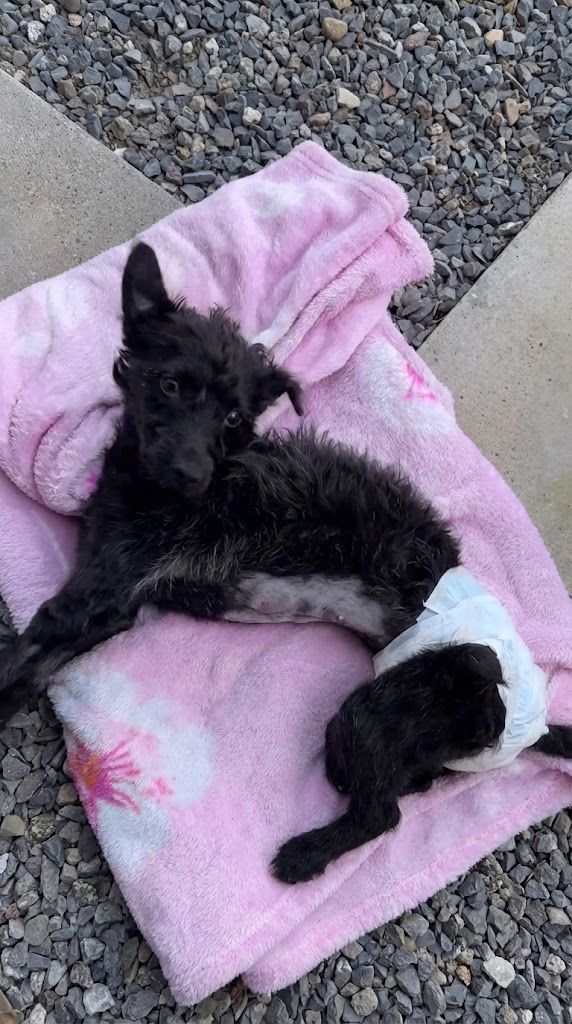
Aurora could see the people walking past her.
She could hear their voices.
She could feel a hand when someone finally stopped to touch her.
But she could not make her legs move.
The young puppy had been found on the street unable to lift herself from the ground. There was no obvious broken bone, no visible wound that immediately explained what was happening, and no clear accident anyone could point to.
Her body simply would not respond the way it should.
Yet Aurora herself remained alert.
Her eyes followed movement.
She reacted when people spoke.
She responded to touch.
That made the situation both hopeful and deeply confusing.
Somewhere inside that motionless little body was a puppy who was very much aware of the world around her.
The question was whether anyone could discover why her body had stopped cooperating.
She Was Lying on the Street With No Way to Get Herself Up
When Aurora was first noticed, she could not simply stand and follow the people trying to help her.
Her limbs remained largely unresponsive.
She could not support her own weight.
She could not walk away from danger.
She could not even reposition herself normally when discomfort set in.
For a puppy, that level of immobility created immediate concerns.
Without help, she would struggle to reach food or water.
She could not move away from traffic, weather, or other animals.
Even remaining in one position for too long could create additional problems.
Rescuers carefully lifted her from the ground and brought her somewhere safe.
At first, they searched for the explanations that would seem most obvious.
Had she been struck by a vehicle?
Was something broken?
Had her spine been injured?
But the initial picture did not provide an easy answer.
There were no obvious fractures explaining the paralysis.
No dramatic external wound told them what had happened.
And yet Aurora’s legs still would not move normally.
What made the case even stranger was that she was not completely unresponsive.
When someone touched her, she reacted.
When a familiar voice came near, her attention shifted.
Her tongue and eyes moved.
Aurora seemed aware of what was happening around her even while much of her body remained still.
The rescuers had saved her from the street.
Now they had to determine what they were actually trying to treat.
VIDEO: She Could Feel Their Hands but Couldn’t Move Her Legs — Aurora’s Search for an Answer Begins
Every Examination Seemed to Create Another Question
Aurora was seen by neurological specialists as the search for an explanation continued.
The rescue team hoped that scans, physical examinations, and specialist experience would reveal one clear problem that could be treated.
Instead, uncertainty remained.
Aurora could feel touch.
She remained mentally alert.
But her limbs showed extremely limited movement.
For the people caring for her, the absence of a straightforward diagnosis was difficult.
A broken bone can often be seen.
An external wound can be cleaned and treated.
Aurora’s problem seemed to be hidden somewhere inside a much more complicated system.
Several specialists evaluated her condition.
According to the rescue account, some believed her prognosis was so poor that euthanasia should be considered.
It was an extraordinarily difficult possibility for the team to hear.
They also understood why quality of life mattered.
A puppy unable to move independently would require extensive daily care, and nobody could yet promise that rehabilitation would restore normal mobility.
But Aurora was still eating.
She responded to voices.
She accepted affection.
She remained engaged with the people around her.
The rescuers were not ready to make a final decision while questions about her condition remained unanswered.
So they did something far less dramatic than a miracle.
They cared for the puppy they had in front of them.
Before There Was a Treatment, There Was Daily Care
Aurora required help with nearly every ordinary part of life.
Because she could not reposition herself normally, caregivers had to make sure she remained clean and comfortable.
Diapers were changed regularly.
Her body was checked carefully.
She was moved to prevent her from remaining in one position for excessive periods.
Food and water were brought within reach.
Her bedding had to stay clean and soft.
None of these tasks solved the neurological mystery.
They simply made Aurora’s days safer while the team continued searching for answers.
And those days revealed something important.
Aurora still participated in life.
She enjoyed treats.
She paid attention when people entered the room.
She relaxed when held or stroked gently.
The rescuers could not know what she was thinking.
They did not need to.
Her behavior gave them enough information to continue.
She was responsive.
She was eating.
She was interacting.
And as long as specialists believed there were still reasonable avenues to explore, the team wanted to explore them.
That meant more consultations.
More questions.
More waiting.
Then eventually, a specialist offered a different possibility.
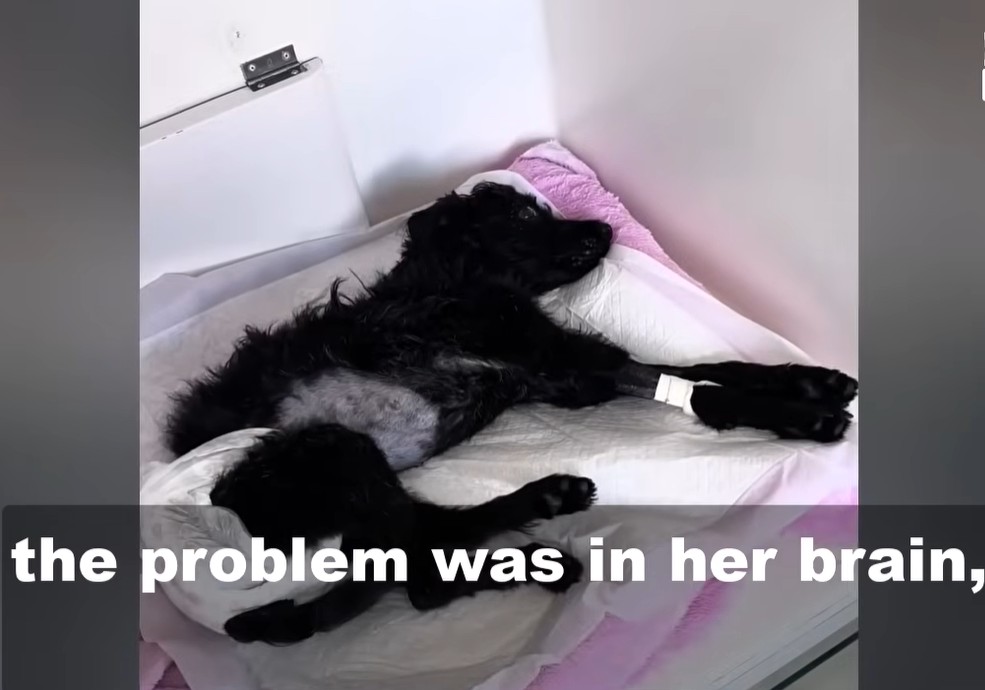
One Neurologist Looked Beyond Her Spine
A neurologist examining Aurora eventually suspected that the main problem might not be a conventional spinal injury at all.
According to the account of her treatment, the specialist believed Aurora could be dealing with a much rarer neurological condition, possibly involving a genetic abnormality affecting the brain.
It was not the simple answer the rescue team had hoped to hear.
But it was an answer that came with something they had been missing.
A possible treatment.
The neurologist proposed a delicate surgical procedure.
It would not be routine.
It would not guarantee that Aurora would walk afterward.
And the reported odds of success were not especially reassuring.
Still, for the first time, the team had been given a medical path forward rather than another unanswered question.
They had to decide whether the risks were justified.
Aurora’s condition made that decision particularly complicated.
She could not understand percentages.
She could not understand why different doctors had reached different conclusions.
She simply continued responding to the world around her.
A treat still interested her.
A familiar voice still caught her attention.
A gentle touch could still help her settle.
The rescuers considered the options and chose to pursue the surgery.
Not because they believed it promised a dramatic recovery.
Because it offered Aurora a chance that had not existed before.
Surgery Was Successful — But Nobody Promised She Would Walk
The procedure required the specialized neurological care the team had been searching for.
Then came the wait.
There was no meaningful action the rescuers could take while Aurora was in surgery.
They could only hope that her small body would tolerate the procedure and that the surgeon would be able to address the suspected problem.
Eventually, the surgeon emerged with encouraging news.
According to Aurora’s rescue story, the operation had been successful.
The immediate goal of the procedure had been achieved.
But the team was careful about what that meant.
Surgery did not automatically restore movement to limbs that had been inactive.
It did not erase muscle weakness.
It could not predict exactly how Aurora’s nervous system would respond over the following weeks and months.
The operation was an important step.
It was not the finish line.
Now came the part that would require repetition, patience, and close observation.
Rehabilitation.
Aurora would have to begin almost from the beginning.
Learning what movements her body could make.
Building strength wherever possible.
And showing her caregivers, one tiny response at a time, what might still be possible.
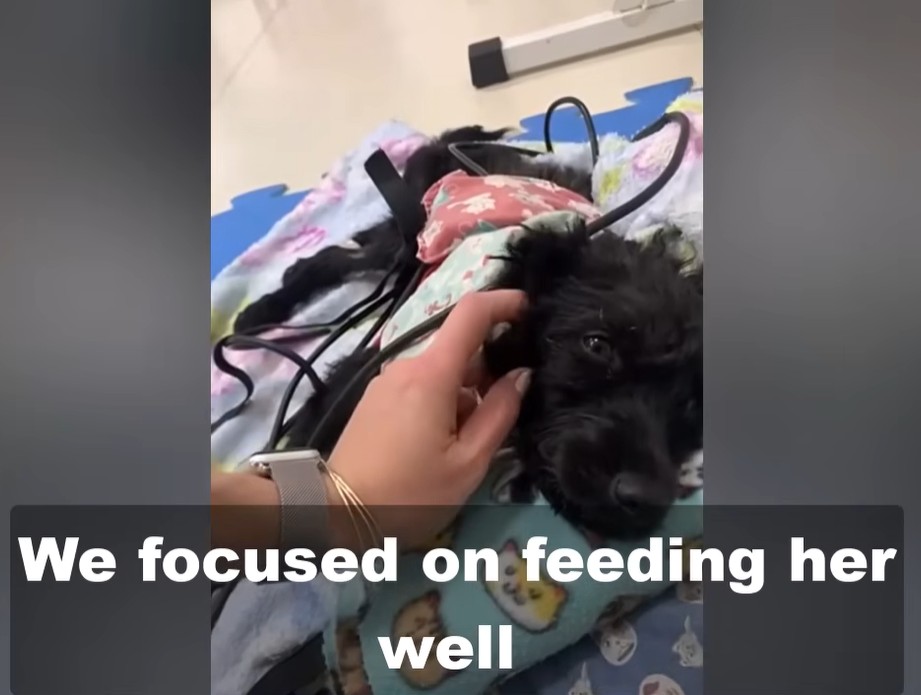
Her First Victories Were Almost Too Small to Notice
Rehabilitation did not turn Aurora into a running puppy overnight.
There was no morning when she suddenly jumped to her feet and raced across the room.
Her progress arrived in movements small enough that someone unfamiliar with her might have missed them entirely.
Caregivers performed gentle passive exercises with her limbs to help maintain flexibility and reduce muscle loss.
They supported her body carefully.
Her nutrition was monitored so that she could rebuild strength.
And they watched.
Closely.
Then Aurora began gaining better control of her head and neck.
Instead of remaining completely dependent on others to reposition her view, she could increasingly lift and turn her head toward the people around her.
That was progress.
Later, tiny movements appeared in her legs.
Small twitches.
Not walking.
Not standing.
Not even necessarily controlled movement every time.
But movement where there had previously been almost none.
The rescue team did not dismiss those changes because they were small.
For Aurora, small was exactly how recovery was happening.
VIDEO: Then Her Leg Moved — The Tiny Signs That Made Aurora’s Caregivers Keep Going
Rehabilitation Became Part of Everyday Life
Once Aurora had entered rehabilitation, consistency mattered more than dramatic moments.
Her limbs were moved gently through exercises intended to preserve their range of motion.
Caregivers watched for discomfort and adjusted accordingly.
She continued receiving help with hygiene and positioning.
Meals were designed to support her weakened body.
And progress was recorded through the details most people would never think to celebrate.
Holding her head up longer.
Turning toward a familiar sound.
Responding more strongly during an exercise.
A small movement in a limb.
Greater comfort while resting.
Aurora still needed significant assistance.
That fact did not disappear simply because surgery had been completed.
Her caregivers also could not know how much function she might eventually regain.
Neurological recovery does not always follow a predictable timetable.
So they avoided making Aurora’s worth depend upon one particular outcome.
Walking would be wonderful.
Standing independently would be wonderful.
But those were not the only measurements that mattered.
Aurora could eat.
She could interact.
She could enjoy attention.
She could experience comfort.
And with assistance, she could continue participating in the life happening around her.
That became an important shift in how her story was understood.
The question was no longer only:
Will Aurora ever walk normally?
There was another question too.
How good can Aurora’s life become while everyone continues helping her?
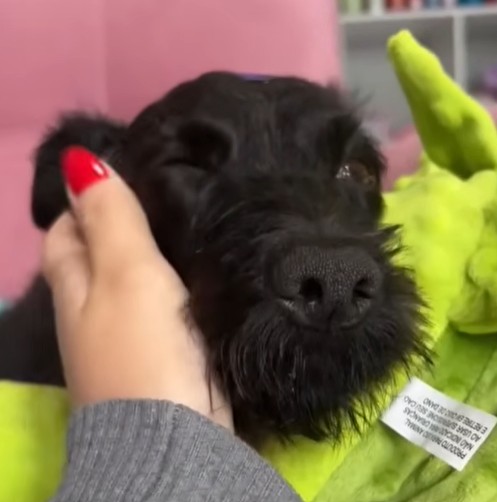
She Was More Than the Legs That Wouldn’t Move
It is easy to look at a disabled animal and focus immediately on what the body cannot do.
Aurora could not run across a yard like most puppies.
She could not simply stand whenever she wanted.
Basic routines required assistance that another dog might never need.
Those limitations were real.
But they were not the entirety of Aurora.
She still showed interest in food and treats.
She recognized voices around her.
She followed people with her eyes.
She accepted affection.
As her condition stabilized, caregivers could focus less exclusively on crisis management and more on giving her enjoyable experiences.
That distinction mattered.
Aurora was not simply a medical case waiting for a dramatic ending.
She was a puppy living each day while recovery continued.
Sometimes she rested.
Sometimes she exercised.
Sometimes she ate something she clearly enjoyed.
Sometimes the most important event of the day was simply that she appeared comfortable.
Her rescuers had begun the journey hoping for a diagnosis.
Then they hoped for a treatment.
After surgery, they hoped for movement.
But Aurora’s daily life reminded them that rehabilitation was not meaningful only if it eventually produced a perfectly able-bodied dog.
Comfort mattered.
Connection mattered.
Quality of life mattered.
And progress could exist even when its final destination remained unknown.
One Tiny Twitch Could Mean More Than a Dramatic Finish
Animal rescue stories often become popular because of striking before-and-after images.
A dog who once could not stand is shown running.
A severely neglected animal becomes almost unrecognizable after recovery.
Aurora’s story did not provide that kind of instant conclusion.
At least not yet.
Her changes were quieter.
She gained better control of her head.
Her body became stronger with care.
Small movements began appearing in limbs that had once seemed completely silent.
And she continued engaging with the people responsible for helping her.
Those details might not look spectacular in a photograph.
To the people who had seen Aurora lying helplessly on the street, they were enormous.
Every new movement gave the rehabilitation team more information.
Every comfortable day mattered on its own.
Aurora did not have to transform overnight for her progress to be real.
She only had to move forward from where she had started.
Sometimes that distance was measured in inches.
Sometimes it was measured in a movement so small that everyone had to look twice.
But it was movement.
Aurora’s Story Is Still Being Written
There is no need to pretend Aurora’s journey has reached a perfect ending.
The puppy found unable to move still faces limitations.
Her long-term neurological recovery remains something that time and rehabilitation must reveal.
No responsible caregiver can promise exactly how far she will progress.
But uncertainty no longer means that nothing has changed.
Aurora has already traveled a remarkable distance from the street where she was first discovered.
She was carried to safety.
Specialists examined her.
When one explanation failed to provide answers, the search continued.
Caregivers handled the unglamorous daily work of keeping her clean, fed, repositioned, and comfortable.
A neurologist eventually proposed a different explanation and a possible surgical option.
The team accepted the risk.
Aurora came through the procedure.
Then rehabilitation began.
First came better control of her head.
Then tiny movements.
Small signs that her body was not entirely silent.
And through every stage, Aurora remained something more than a prognosis written on a medical chart.
She remained a young dog capable of noticing the people around her.
Capable of enjoying food.
Capable of receiving affection.
Capable of having good moments even while facing extraordinary physical limitations.
Perhaps one day Aurora’s story will include the moment everyone initially dreamed about.
Perhaps she will stand.
Perhaps rehabilitation will take her farther than anyone currently expects.
Or perhaps her future will continue requiring assistance.
The people caring for her cannot know that yet.
What they do know is much simpler.
When Aurora was lying on the street unable to move, someone stopped.
When the first answers were discouraging, someone kept asking questions.
When recovery came slowly, someone kept doing the exercises.
And when the first movement was barely more than a twitch, someone noticed.
For Aurora, hope did not arrive as a puppy suddenly running across the grass.
It arrived in smaller pieces.
A safe bed.
A full bowl.
A specialist willing to look again.
A successful procedure.
A head lifted toward a familiar voice.
And one tiny movement in a leg that had once remained completely still.
Her journey is not finished.
That is precisely why every small victory still matters.


