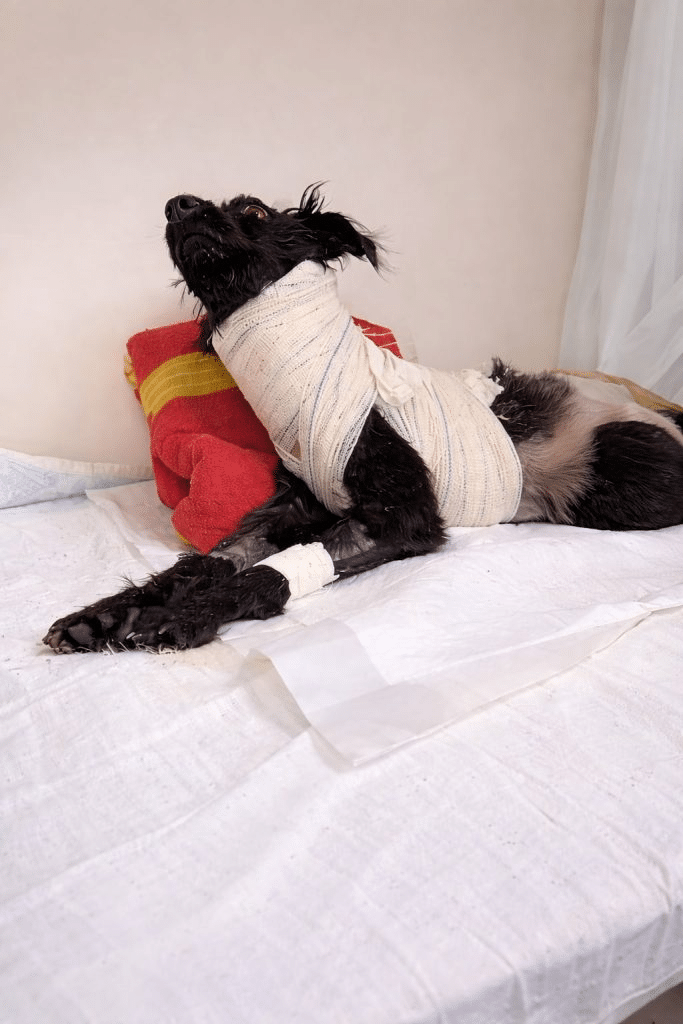
At first glance, she looked like a small dog resting beside a dusty road.
There was no obvious blood.
No broken bone anyone could see.
No dramatic wound explaining why she remained so completely still.
But when rescuers moved closer, they noticed something that changed the entire situation.
Her eyes were following them.
Her body could not move.
But she was still very much aware of the world around her.
Her Eyes Moved, but the Rest of Her Body Wouldn’t
The little dog was unable to stand.
She could not sit upright.
She could not shift herself into a more comfortable position.
All four legs remained motionless beneath her.
Only her head could move slightly, while her eyes continued tracking sounds and people nearby.
That contrast was unsettling.
Her body appeared almost completely powerless, yet her attention remained sharp enough that rescuers knew they were dealing with a conscious animal in serious trouble.
They approached carefully.
There was no way to know how long she had been lying there or what had caused her condition.
What they did know was that leaving her beside the road was not an option.
She was lifted gently and taken for veterinary examination.
Everyone hoped the tests would reveal an obvious explanation.
Instead, they produced more questions.
Video: She Couldn’t Move a Single Leg — But Her Eyes Never Stopped Following the People Who Came to Help
The First Tests Couldn’t Explain the Paralysis
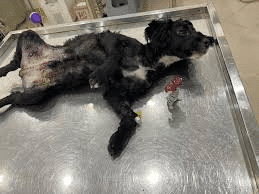
At the clinic, veterinarians began examining her carefully.
They looked for the kinds of injuries that might explain why all four legs had stopped working.
Her spine was checked.
Scans were reviewed.
Her body was examined for fractures or visible trauma.
But the expected answer did not appear.
According to the rescue account, her spine looked normal.
There were no obvious fractures.
No clear physical injury could explain the severity of what rescuers were seeing.
Yet nothing changed.
She remained unable to move her legs.
That uncertainty made her case especially difficult.
When an injury is visible, treatment can often be directed toward something specific.
With this dog, the team knew the symptom.
They did not yet know the cause.
And without that answer, no one could confidently predict what recovery might look like.
Some Began to Question Whether She Could Recover
Days passed without a clear diagnosis.
The dog remained dependent on caregivers for nearly everything.
She needed help staying comfortable.
She needed help with positioning.
She needed close observation because she could not simply stand up or move away when something bothered her.
The uncertainty eventually led to difficult conversations.
If her paralysis could not be explained, could it be treated?
If she never regained movement, what kind of future would be possible?
Those were serious questions.
But the people caring for her kept noticing one thing.
She remained responsive.
Her eyes continued following them.
She reacted to voices and gentle contact.
Whatever was happening inside her body, she was still engaging with the people around her.
For her rescuers, that was enough reason to keep searching for another answer.
Not because recovery was guaranteed.
It wasn’t.
But because they did not believe uncertainty alone should decide her future.
A Specialist Looked Beyond Her Spine
Another specialist reviewed her case.
This time, the investigation moved beyond the possibility of a straightforward spinal injury.
If the spine appeared normal but the dog still could not control her limbs, perhaps the problem was coming from somewhere else in the nervous system.
A different possibility emerged.
Her brain could be involved.
The source material does not provide a detailed neurological diagnosis, so the exact condition remained unclear.
But this new direction offered the veterinary team something they had not had before:
another path to investigate.
A procedure was considered.
It was not presented as a guaranteed cure.
There were risks.
And there was no certainty that her legs would suddenly begin working afterward.
Still, the team decided there was enough reason to proceed.
For a dog whose options had been narrowing, even an uncertain opportunity mattered.
After the Procedure, the First Change Was Not in Her Legs
When she woke after the procedure, she did not suddenly stand.
Her legs did not immediately begin moving.
There was no dramatic moment where paralysis disappeared.
Instead, caregivers noticed a quieter change.
She appeared more comfortable.
Her overall demeanor seemed calmer.
She remained physically limited, but she appeared less distressed than before.
That mattered.
Because recovery does not always begin with the symptom everyone is watching most closely.
Sometimes the first sign is simply that an animal rests more comfortably.
Then other changes began appearing.
She held her head up for longer periods.
Her attention toward familiar voices became stronger.
She reacted more clearly when someone touched or spoke to her.
None of those changes proved that she would eventually walk.
But they showed that she was still responding.
And the team kept working with what they had.
Then One Leg Made the Smallest Movement
The progress was slow enough that caregivers had to pay attention to tiny details.
Then came one of those details.
A leg moved.
Barely.
It was only a faint twitch.
Small enough that someone who had not been following her condition closely might have dismissed it entirely.
For her caregivers, it was impossible to dismiss.
Until then, her legs had remained completely still.
Any deliberate or returning movement represented a meaningful change.
No one treated the twitch as proof of a full recovery.
There was still a long distance between one movement and being able to stand.
But for the first time, there was physical evidence that something might be changing.
The same body that had lain completely motionless beside the road had produced a response.
And that was enough to give the team another reason to continue.
Her Recovery Became About More Than Walking
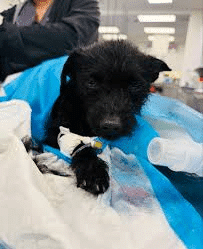
As care continued, the dog became increasingly engaged with her surroundings.
She followed people more readily.
Her expression appeared more relaxed.
Her tail eventually showed slight movement as well.
These were not enormous milestones.
But together, they painted a different picture from the dog rescuers had first found.
At the roadside, she had been almost entirely still except for her eyes.
Now there were more ways for her to respond.
More ways to communicate.
More evidence that she was participating in the world around her.
Her story had begun with one obvious question:
Would she ever walk?
Over time, the people caring for her had to accept that recovery could not be measured by that question alone.
Comfort mattered.
Connection mattered.
The ability to respond mattered.
And giving her a life in which she was cared for mattered, whether or not her body eventually returned to normal.
No One Could Promise a Perfect Ending, but She Was No Longer Alone
This was not a story with an instant transformation.
The source does not establish that she eventually returned to normal movement or achieved a complete neurological recovery.
Her future remained uncertain.
But the situation was no longer the same as the day she was discovered beside the road.
Then, she could not stand.
She could not move her legs.
No one knew why.
And she had no one beside her.
Now, people were watching every change.
Specialists had searched for answers beyond the obvious possibilities.
She had undergone treatment.
And the smallest signs of response were being noticed instead of ignored.
Her story is a reminder that rescue is sometimes less about producing a perfect ending and more about refusing to abandon an animal simply because the answer is difficult.
Her rescuers could not guarantee that she would walk.
They could not know exactly how much function would return.
What they could do was keep her comfortable.
Keep searching.
Keep caring.
And remain beside her while the outcome was still uncertain.
When she was first found, almost nothing in her body could move.
Only her eyes seemed to say that she was still there.
Someone noticed.
And instead of treating that tiny sign of awareness as meaningless, they stayed long enough to see what might come next.


