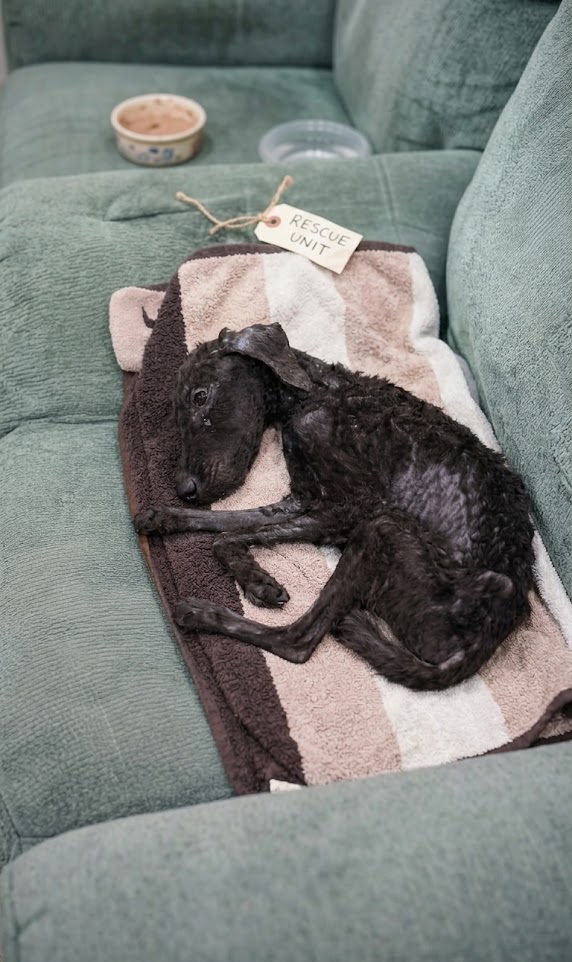
At first, it was difficult to understand what was underneath all the fur.
The small dog was almost completely hidden beneath thick, tangled mats that had formed around her body.
They covered her legs.
Wrapped around her sides.
Hung heavily from places where a normal coat should have moved freely.
Violet barely moved.
Her body trembled, and even shifting her position appeared difficult. The layers surrounding her had become so dense that it was hard to tell where the coat ended and the dog underneath began.
There was no way to know everything that had happened before she was found.
What could be seen was enough.
Violet was weak.
Her coat required urgent attention.
And she was in no condition to care for herself.
Someone had to make the first move for her.
This time, someone did.
Beneath the Mats Was a Dog Much Smaller Than Anyone Expected
Up close, the severity of Violet’s coat became impossible to ignore.
This was not simply fur that needed brushing.
Large sections had twisted together into dense mats that restricted movement and pulled against the skin beneath them.
For a dog already weak, carrying that extra weight made everything harder.
Standing.
Turning.
Finding a comfortable position to rest.
Even assessing Violet’s true physical condition was difficult while so much of her body remained hidden.
The people helping her understood that the coat needed to come off.
But removing mats this severe could not be rushed.
Scissors and clippers would have to work extremely close to the skin, and no one knew what irritation or injuries might be concealed underneath.
So the process began carefully.
One small section.
Then another.
Pause.
Check Violet.
Continue.
She remained quiet through much of it.
Occasionally her body trembled.
When she appeared uncomfortable, the work slowed.
There was no reason to make an already difficult day more frightening than necessary.
Piece by piece, the enormous coat began falling away.
And with every section removed, Violet became a little more visible.
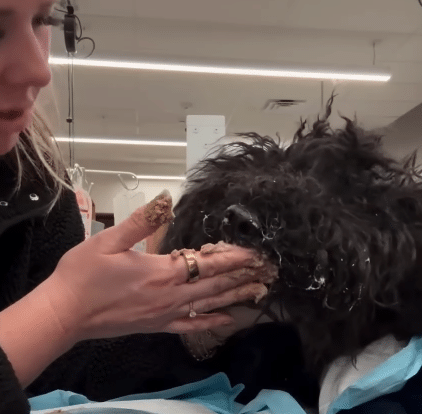
Video: Violet Could Barely Move Beneath the Matted Coat — Then Rescuers Began Carefully Setting Her Free
Removing the Coat Revealed How Fragile She Really Was
The transformation was dramatic, but not in the way grooming transformations usually are.
There was no healthy dog immediately waiting beneath the mats.
There was a very small, weakened body that still needed substantial care.
Without the heavy fur, Violet looked almost delicate.
The coat had made her appear much larger than she actually was.
Now her thin frame could finally be assessed.
Her skin could breathe.
Her legs were no longer buried beneath layers that restricted every movement.
But freedom from the coat did not mean Violet suddenly had the strength to use those legs normally.
She still struggled.
Standing remained difficult.
Her body had spent too long compensating for discomfort and weakness for everything to correct itself immediately.
So after the grooming came the quieter part of rescue.
Rest.
Nutrition.
Monitoring.
Veterinary care where needed.
And patience.
Violet did not need anyone expecting a spectacular recovery by morning.
She needed people willing to accept whatever progress her body could manage.
At first, that progress was extremely small.
For a While, Simply Resting Comfortably Was Progress
Once the mats were gone, Violet could finally lie down without carrying the same heavy shell around her body.
That alone mattered.
She was kept warm.
Food was offered carefully.
Her condition was watched closely.
When she needed help repositioning herself, someone was there.
There were no sudden bursts of energy.
No playful behavior.
No dramatic moment when everyone knew the difficult part was over.
Recovery often looks much less exciting than that.
A little more food than yesterday.
A longer period of comfortable sleep.
Breathing that appears steadier.
A head lifted for a few seconds longer.
For Violet, those details became the milestones.
She had arrived at a point where even ordinary activities required effort.
So no ordinary activity was treated as insignificant.
If she shifted her own weight, it mattered.
If she looked toward someone entering the room, it mattered.
If she became interested in what was happening around her, it mattered.
The people caring for Violet were not trying to pull her toward some imaginary finish line.
They were simply giving her enough support to reach the next small step.
Then another.
One Day, Violet Tried to Stand
The breakthrough did not arrive with any warning.
Violet had already spent days being helped through the simplest parts of daily life.
Then she tried to push herself upward.
At first, her legs did not seem certain about what to do.
Her body shook.
She shifted her weight.
For a moment, it looked as though she might immediately lower herself again.
But Violet remained upright.
Only briefly.
Only unsteadily.
Still, she was standing.
No one pretended that a few seconds on her feet meant she had completely recovered.
She still needed strength.
She still needed time.
But the moment showed that her body was beginning to respond.
The dog who had been almost unable to move beneath the weight of her coat had supported herself.
That changed what came next.
From then on, there were more opportunities to practice.
Stand.
Rest.
Try again later.
Gradually, Violet began spending longer periods on her feet.
Then came steps.
Small ones at first.
Careful and uncertain.
But they belonged to her.
The World Became Interesting Again
As Violet gained strength, her behavior began changing too.
In the beginning, she had little energy to do anything except endure what was happening around her.
Now she started looking.
Listening.
Watching people move through the room.
She became interested in things that had nothing to do with immediate survival.
That curiosity was important.
A dog who feels physically miserable often has little reason to explore.
Violet was beginning to have reasons.
She moved farther.
Investigated unfamiliar scents.
Responded when people approached.
Her steps became more stable as her muscles grew stronger.
She began learning that movement did not have to be uncomfortable anymore.
There was no enormous coat pulling against her skin.
No dense mats limiting how her legs could bend.
Her body was becoming hers again.
The changes continued outside too.
A few hesitant steps became short walks.
Short walks became longer ones.
And every time Violet moved more freely, the contrast with her first day became harder to believe.
The difference could be seen in her posture.
Her head was higher.
Her body looked more relaxed.
Her attention was directed outward rather than only toward conserving energy.
Little by little, Violet was becoming involved with life again.
Her Coat Returned Slowly — This Time the Way It Was Supposed To
Removing Violet’s old coat left much of her body exposed.
For a while, the visual transformation looked almost unfinished.
The heavy mats were gone, but the soft natural coat underneath had not yet had time to return.
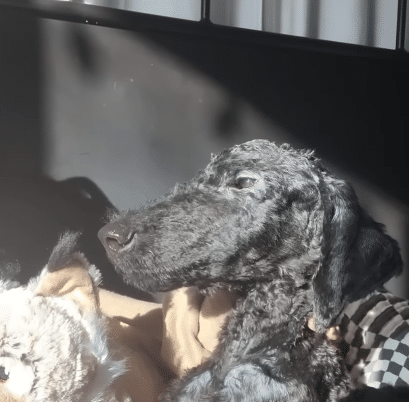
Then new growth began appearing.
At first, it was thin.
A light covering where bare areas had been visible before.
Gradually, it grew thicker.
Soft fur began replacing the dense, restrictive coat that had once surrounded her.
It was another change that could not be rushed.
Hair grows at its own pace.
So did Violet’s recovery.
Weeks passed.
Her body filled out.
Her movement continued improving.
The new coat became fuller.
And for the first time, people could see what Violet looked like when fur was allowed to grow naturally instead of becoming something she had to carry.
The difference was remarkable.
But the most meaningful changes still had nothing to do with appearance.
Violet had energy now.
She could choose where she wanted to go.
She could approach people.
Move away.
Explore.
Rest comfortably.
Those choices had not been available to her when she was first found.
The Dog Who Could Barely Stand Eventually Began to Run
There was a time when watching Violet lift herself from the ground felt like an achievement.
Later, simply walking became ordinary.
Then another change arrived.
She ran.
At first, the movements were not especially fast.
That did not matter.
Her legs carried her freely across open space.
She could change direction.
Follow something interesting.
Move because she wanted to—not because she was struggling to reach food or find somewhere to lie down.
For the people who had seen Violet buried beneath mats, watching her run made the beginning of her story feel almost impossible.
This was the same body.
The same four legs.
The difference was what had been removed and what had been restored.
The coat that restricted her was gone.
Her physical strength had returned.
Her environment no longer demanded that she spend every ounce of energy simply getting through the day.
Now she could play.
She could explore.
She could behave like a dog whose world contained possibilities instead of obstacles.
That was the transformation worth remembering.
Not that Violet looked prettier after grooming.
That she could finally move through her own life.
Freedom Looked Surprisingly Ordinary
Once Violet became stronger, many of her happiest moments looked completely unremarkable.
She walked around without assistance.
Rested comfortably.
Played.
Investigated new places.
Accepted affection.
Her natural coat continued growing.
Nothing about those activities would draw much attention if they belonged to a dog who had always been healthy.
For Violet, they represented an entirely different life.
There was no need for someone to reposition her body.
No dense coat prevented her from moving.
She no longer appeared exhausted by simply standing.
That is one of the quiet rewards of rescue.
The goal is not for an animal to remain extraordinary forever.
The goal is often the opposite.
To make life ordinary.
A comfortable bed becomes normal.
Regular meals become normal.
Walking without pain becomes normal.
Someone noticing when something is wrong becomes normal.
Being cared for becomes expected rather than surprising.
Violet reached that kind of normal.
And considering where she began, there was nothing ordinary about getting there.
Violet’s Story Was Built Between the Before and After
Photographs make transformations like Violet’s easy to understand.
One image shows a dog almost completely buried beneath severe mats.
Another shows a healthy-looking animal with a soft coat and enough strength to run.
Place those photographs beside one another, and the change appears almost instantaneous.
It was not.
Between those images were many quieter moments.
Someone making the first careful cut.
Another mat falling to the floor.
A small body finally appearing underneath.
A meal.
A long rest.
A day with almost no visible progress.
Then another.
A dog shifting herself without assistance.
Her first attempt to stand.
A few seconds upright.
The first steps.
More food.
More strength.
New fur.
A longer walk.
Then eventually, running.
That is where Violet’s recovery actually happened.
Not in one miracle.
In repetition.
Her story does not require us to know every detail of what happened before rescue.
We cannot know from her condition alone exactly how every mat formed or what she experienced before someone intervened.
What happened afterward is clear enough.
Someone saw a dog who could barely move.
They did not decide she was too difficult.
They began with the problem directly in front of them.
Remove the weight carefully.
Help the body underneath recover.
Then give Violet enough time to show what she could still do.
She showed them.
First by standing.
Then walking.
Then exploring.
Eventually, running.
When Violet was first found, her own coat had become something that restricted the simplest movement.
Later, her legs carried her wherever curiosity led.
That distance was not traveled in a single day.
But Violet never needed a single dramatic miracle.
She needed the heavy layers removed.
She needed care.
She needed time.
And most of all, she needed someone to look at a dog who could barely lift herself and decide that her condition was not a reason to give up.
It was a reason to begin.


