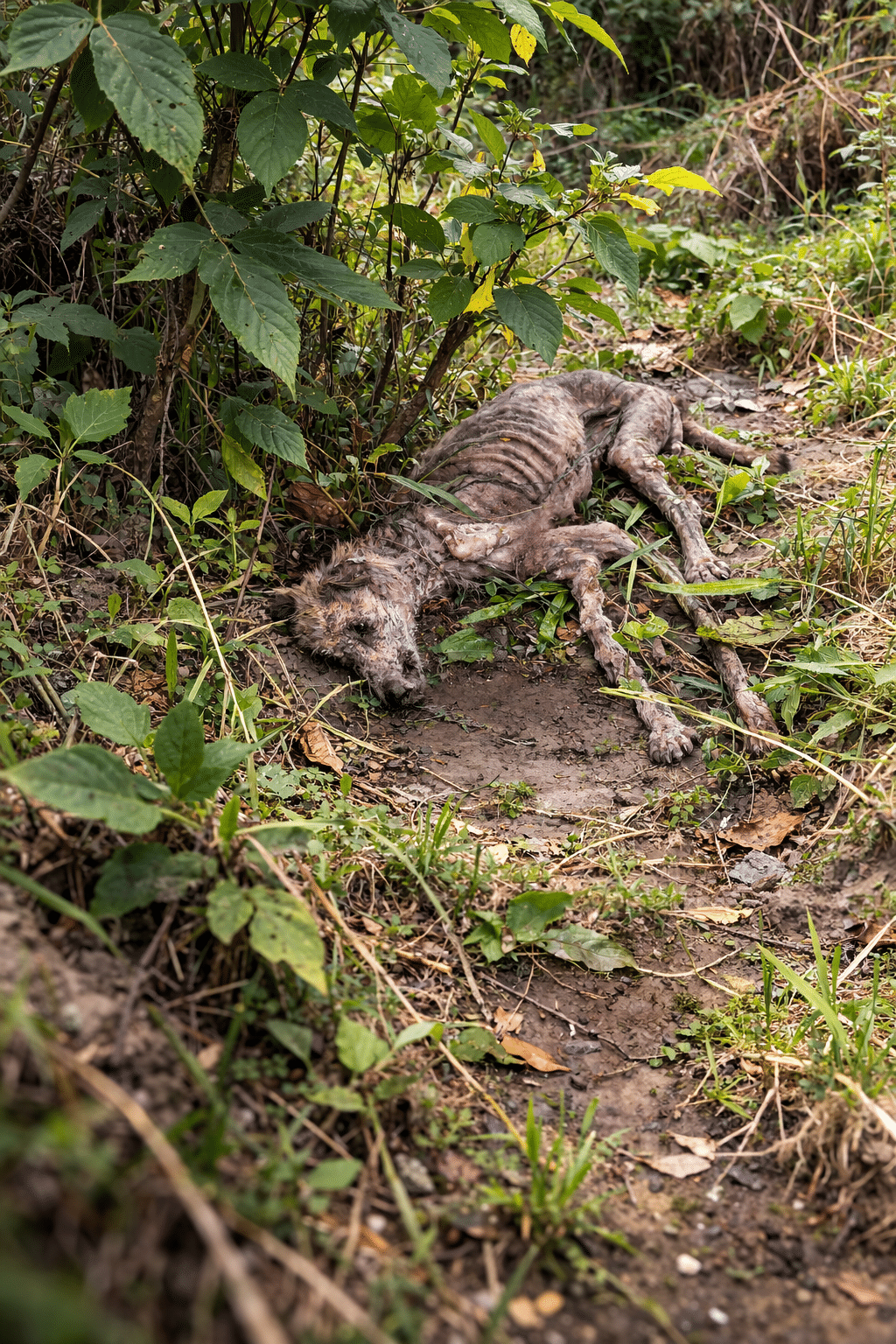
At first, the rescuers thought they were looking at something already lost.
A small dog lay almost completely still beneath tall grass and scattered debris. Her body blended into the ground so well that she was easy to miss.
There was no barking.
No attempt to move away.
Only the faint rise and fall of her chest showed that she was still alive.
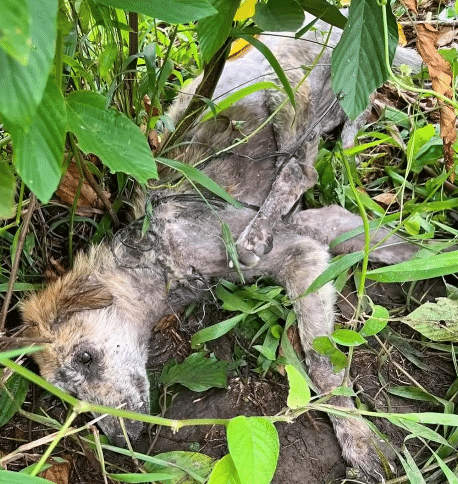
Then the rescuers noticed something around her body.
Thin copper wires had become tightly tangled around her legs and torso.
She was trapped.
Weak.
And no longer able to free herself.
Whatever had brought her into that patch of debris, she now needed someone else to get her out.
The Wires Had Turned the Ground Around Her Into a Trap
The team approached carefully.
The wires were not simply lying over her coat.
Several sections had tightened against her body, making sudden pulling too risky.
The dog barely reacted as rescuers moved closer.
That worried them more than resistance would have.
She seemed almost completely exhausted.
So instead of trying to lift her immediately, they began with the wires.
One piece was cut.
Then another.
Every movement was deliberate.
The rescuers watched her breathing closely while working, knowing that the goal was not simply to free her quickly.
It was to free her without causing more harm.
Video: She Was Barely Moving Beneath the Wires—Then Rescuers Began Cutting Her Free
The Final Wire Came Off—But She Still Couldn’t Stand
Eventually, the last section was removed.
For a moment, the dog remained exactly where she was.
Then she moved slightly.
It was one of the first clear responses the rescuers had seen.
She tried to push herself upward.
Her legs could not support her.
She collapsed almost immediately.
There was no reason to ask her to try again.
Her body had already done enough.
The rescuers lifted her carefully and carried her toward the vehicle.
The physical trap was gone.
Now they needed to understand what condition she was actually in.
Her Body Showed More Than One Difficult Day
At the clinic, the team could examine her properly.
The wire-related injuries were only part of the picture.
Her body was thin and weak.
Her skin showed areas that needed care.
There were older marks as well as more recent injuries, suggesting that her difficulties had not begun that afternoon.
She also appeared exhausted from prolonged exposure and inadequate nutrition.
The team focused first on stabilization.
Fluids were provided.
She was kept warm.
Her wounds were cleaned and treated carefully.
The dog spent much of the early period resting.
No one expected an immediate transformation.
For now, simply remaining stable was progress.
Her First Real Progress Came From a Small Bite of Food
Eating became one of the first important goals.
The caregivers offered manageable amounts rather than expecting her to finish a full meal.
At first, she showed little interest.
So they waited.
Then they offered food again.
Small pieces.
A little at a time.
Eventually, she took a bite.
It was a simple action, but it gave the team something encouraging to work with.
Food meant energy.
Energy meant her body had more resources for recovery.
Over the following days, eating became more consistent.
Her breathing appeared steadier.
She began reacting more clearly when someone touched or approached her.
The changes were small.
But they were changes.
Rest Began Looking Different Once She Felt Secure
During the early days, much of her recovery happened while she was lying down.
But gradually, the way she rested began to change.
Her body appeared less tense.
She could sleep for longer periods without constantly reacting to the movement around her.
Warm bedding replaced the rough ground where she had been found.
Food and water arrived without searching.
People approached gently.
That consistency mattered.
The dog did not need to understand every part of her new environment immediately.
She only needed enough repeated experiences to learn that nothing was asking her to fight for survival anymore.
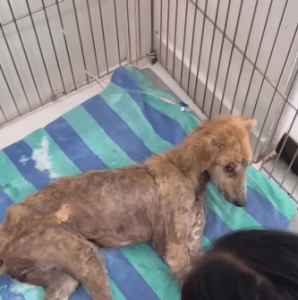
She Still Had a Long Recovery Ahead
There was no sudden moment when she became completely well.
Her body had been through too much for that.
She still needed continued care.
Her strength had to return gradually.
Her wounds needed time.
And after being found nearly motionless, even small improvements deserved patience.
The rescuers did not rush to give her a dramatic ending.
They simply continued doing what she needed.
Clean bedding.
Appropriate food.
Medical care.
Quiet interaction.
Another safe night.
Then another.
She had not even been given a permanent name yet.
For the moment, caregivers simply called her their “little girl.”
There was time for everything else later.
Her Story Changed the Moment Someone Looked Closely Enough
The place where she was found could easily have been ignored.
Tall grass.
Debris.
Discarded wire.
Nothing that naturally draws attention.
And inside all of it was a living animal too weak to call loudly for help.
That is what makes her rescue so easy to remember.
She did not attract attention by running into the road.
She did not bark until someone came.
She was almost completely still.
Someone simply noticed that something in the grass did not look right.
Then they looked closer.
That small decision led to the wires being cut, the trip to the clinic, the first bite of food, and the warm blanket she now rests beneath.
She Is No Longer Lying Alone Where No One Can See Her
Her recovery is still continuing.
She is not yet at the end of the story.
But the most dangerous part of her situation has changed.
The wires are gone.
She is no longer lying exposed among debris.
She no longer has to search for scraps while her body is too weak to keep moving.
Now there are people monitoring her.
People who notice whether she eats.
Whether she rests comfortably.
Whether her strength is beginning to return.
Her story does not need a perfect ending yet.
For now, something much simpler is enough.
She was found.
She was freed.
And when she was too weak to stand on her own, someone carried her the rest of the way.


