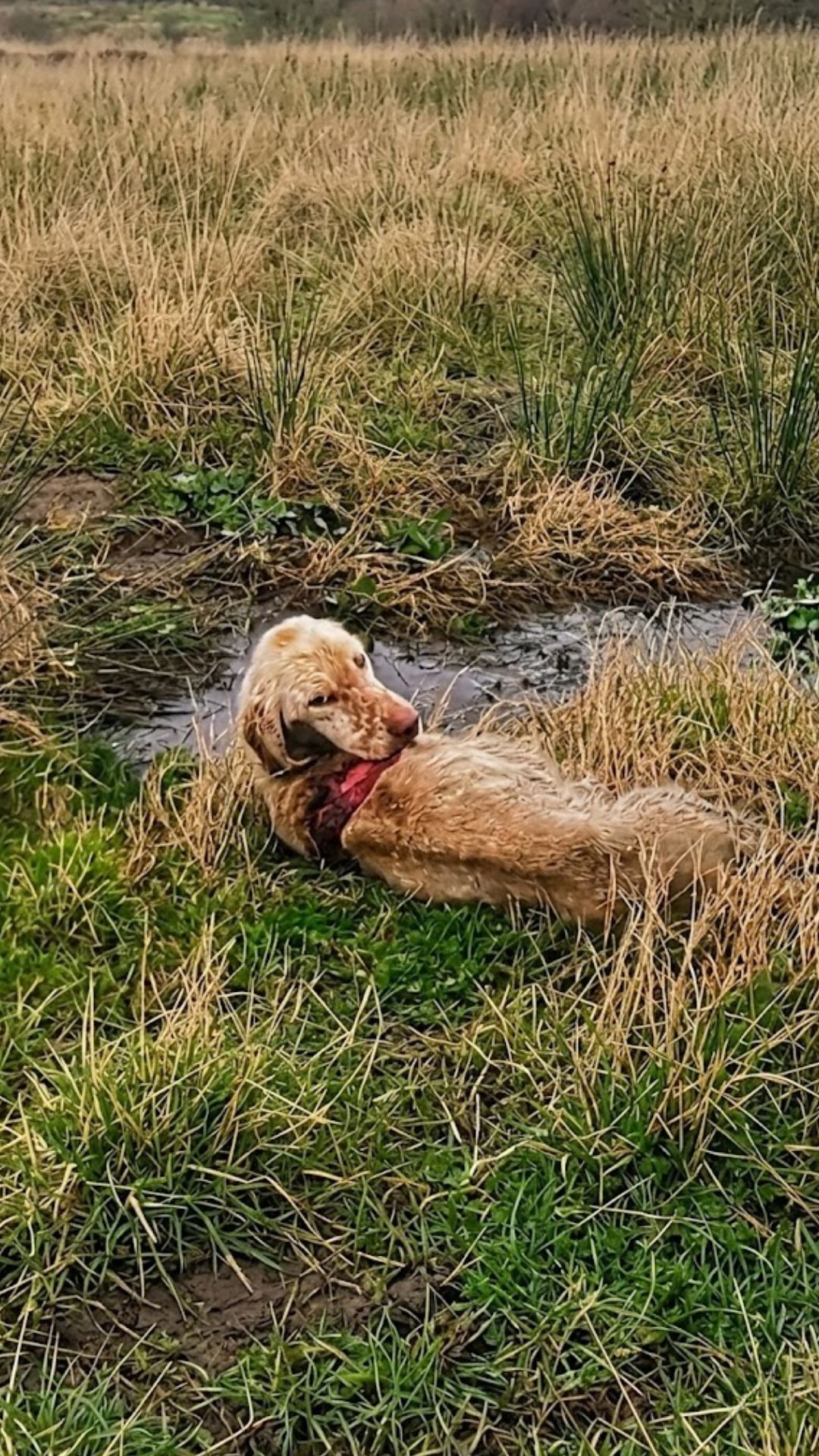
For three days, people in the village saw the young dog moving slowly along the roads.
She was painfully thin.
One hind leg hung uselessly beneath her.
A large wound stretched across her back.
And yet she kept appearing in different places, somehow forcing herself forward despite injuries that should have made every step difficult.
Her name would later be Lydia.
She was a Setter and not even a year old.
Still a puppy.
But by the time rescuers finally reached her, her body looked as though it had already endured far more than any young dog should.
She passed homes.
She crossed dusty streets.
She moved through places where people came and went every day.
For nearly three days, no one had managed to get her the medical help she desperately needed.
Then a call finally reached a rescue team.
“There’s a dog here,” the caller explained.
“She looks like a skeleton. She can barely stand.”
When the rescuers found Lydia, they immediately understood that the broken leg was only part of the problem.
And shortly afterward, a small electronic beep would add an unexpected mystery to her story.
Lydia Was Barely a Year Old, but Her Body Was Already Failing
The rescue team from DAR approached carefully.
Lydia’s condition was obvious even from a distance.
Her ribs stood out beneath her dirty coat.
She had lost significant weight.
One rear leg was badly injured and could not support her normally.
Across her back was another serious problem.
A large wound had deteriorated badly and showed signs of damaged tissue and infection.
Whatever had happened to Lydia had not occurred moments earlier.
She had already been living with these injuries while trying to survive outside.
Despite that, she was still moving through the village.
Slowly.
Unevenly.
Putting most of her weight on the legs that could still carry her.
The rescuers did not need to know Lydia’s entire history to understand the immediate priority.
She needed a veterinarian.
But before leaving, they performed one routine check.
They scanned her for a microchip.
The scanner responded.
Beep.
A number appeared.
For a moment, that seemed like good news.
A microchip could potentially lead them to someone who knew Lydia.
Perhaps her family was searching for her.
Perhaps there was an explanation for how such a young dog had ended up wandering in this condition.
The rescuers checked the registration information.
What they found was almost nothing.
VIDEO: She Walked for Three Days on a Broken Leg—Then Doctors Faced a Crisis During Surgery
She Had a Microchip—but No Registered Owner Could Be Found
The chip was real.
The identifying number could be read.
But the registration information the rescuers expected to find was missing.
There was no usable owner name attached to it.
No address that could immediately lead them to a home.
No straightforward way to identify the person who had once arranged for the dog to be chipped.
The discovery raised more questions than it answered.
At some point, someone had taken Lydia far enough into the pet-care system for a microchip to be implanted.
But the registration trail available to the rescuers did not tell them how she had ended up injured and alone in the village.
It would have been easy to assume she had simply been abandoned.
But the chip alone could not establish exactly what happened.
Had she escaped?
Had ownership changed?
Had someone failed to complete the registration?
Had she been deliberately left behind?
The rescue account did not provide enough information to answer those questions with certainty.
What the team did know was right in front of them.
Lydia was severely underweight.
Her leg was broken.
Her back wound needed urgent attention.
And she was far too weak to remain on the street while anyone tried to reconstruct her past.
The microchip mystery could wait.
Her medical condition could not.
At the Clinic, Her Broken Leg Was Only One of Several Serious Problems
Once Lydia reached the veterinary clinic, the team began evaluating the full extent of her condition.
The findings were concerning.
She was dehydrated.
She was severely malnourished.
The wound on her back had become badly infected and contained damaged tissue that would need to be cleaned and treated.
And her injured hind leg required surgical attention.
For Dr. Panagiotis and the rest of the veterinary team, Lydia presented a difficult balance.
She needed procedures that could help save her leg and control the infection.
But her body was also extremely weak.
Anesthesia is never taken lightly.
For a patient as depleted as Lydia, the risks were even greater.
The team first worked to stabilize her as much as possible.
Fluids.
Supportive care.
Careful monitoring.
They needed her body to be strong enough to tolerate what came next.
But delaying too long also carried risks.
The damaged tissue on her back could not simply be ignored.
The leg could not heal properly without intervention.
Eventually, the veterinarians determined that surgery had to go ahead.
The goal was to address the injuries while giving Lydia the best chance possible of surviving the procedure.
Everyone understood that it would not be routine.
What no one expected was how close the operation would come to ending very differently.
During Surgery, Lydia’s Heart Stopped
The procedure began.
The veterinary team worked on Lydia’s injuries while carefully monitoring her vital signs.
For a time, the operation progressed as planned.
Then the monitors changed.
Lydia’s heart stopped.
The situation became an immediate emergency.
The team shifted from surgery to resuscitation.
For several tense moments, the focus was no longer on repairing a leg or cleaning a wound.
It was on getting Lydia’s heart beating again.
The young dog who had somehow continued walking through a village for three days was now completely dependent on the people standing around the operating table.
The team worked.
They monitored.
They responded.
Then came the sign everyone had been waiting for.
A heartbeat.
Then another.
Lydia’s circulation returned.
The crisis had passed, although her condition remained fragile.
For everyone involved, there was no room for celebration yet.
A cardiac arrest during surgery meant Lydia would need extremely close observation.
Her body had already been under enormous strain before the procedure began.
The next hours would reveal whether she could recover from both the operation and the emergency that occurred during it.
But one fact mattered immediately.
Lydia was alive.
The Next Morning, She Lifted Her Head and Drank
The first hours after surgery passed cautiously.
Lydia was weak from anesthesia.
Her body had undergone a major medical event.
Her leg had been treated.
The damaged area on her back had been cleaned and managed.
Now the veterinary staff could do little except provide supportive care and watch how she responded.
One of the rescuers, Ermioni, had been waiting anxiously for news.
Then Lydia began waking more fully.
She lifted her head.
Water was offered.
Lydia drank.
That simple action carried far more meaning than it normally would.
She was alert enough to respond to her surroundings.
Her body was beginning to function after the operation.
Soon she showed interest in food as well.
She ate.
Not a dramatic amount.
Not enough to declare the crisis over.
But she ate.
For a severely malnourished young dog recovering from surgery, those small behaviors were important markers.
Drink.
Eat.
Rest.
Stay stable.
The recovery would be built from ordinary actions repeated again and again.
Lydia had survived the most dramatic moment.
Now came the slower work.
Her Back Wound Needed Daily Care While Her Leg Began to Heal
Surgery did not make Lydia healthy overnight.
The wound across her back still required ongoing attention.
Damaged tissue and infection can take time to resolve, especially in an animal whose nutritional condition has already been compromised.
The area needed regular cleaning.
The veterinary team monitored it carefully for further infection.
Her injured leg also needed protection while healing.
Movement had to be managed.
Her body required nutrition to rebuild both muscle and damaged tissue.
Every day became part of the process.
Medication.
Wound care.
Food.
Rest.
Veterinary checks.
Then the same routine again.
As the days passed, Lydia began showing more interest in what happened around her.
Her eyes followed the people entering the room.
She watched the rescue team during visits.
She appeared more alert than she had been when first found.
There was no reason to pretend the change happened instantly.
A dog recovering from severe malnutrition, infection, orthopedic trauma, surgery, and a cardiac emergency needs time.
But Lydia was beginning to have that time.
And with it came visible changes.
Her body slowly started receiving the nutrition it had been missing.
The wound could finally heal in a clean environment.
Her leg no longer had to carry her down village roads without treatment.
For the first time since rescuers encountered her, Lydia did not need to keep moving simply to survive.
She could rest.
The Dog Who Had Been Barely Standing Began Watching Everything Around Her
The rescuers noticed Lydia becoming increasingly curious.
During her first examination, pain and exhaustion had dominated nearly everything she did.
Now, when someone entered the room, she paid attention.
Her head lifted more often.
Her eyes followed movement.
People no longer saw only the depleted dog they had rushed into emergency treatment.
They could begin seeing the puppy underneath.
That distinction was important.
Lydia was less than a year old.
If her recovery continued, she potentially had many years ahead of her.
She had simply reached rescue in such poor condition that her age was easy to forget.
As her strength improved, the next stage of recovery became possible.
A veterinary clinic had saved her during the most dangerous period.
But a clinic was not meant to be a permanent home.
Lydia needed somewhere quieter.
Somewhere she could continue healing while becoming accustomed to ordinary household life.
That meant foster care.
When the medical team decided she was stable enough to leave, arrangements were made.
Gianna and other members of the rescue team prepared to transport her.
This trip would be very different from the one that had brought her into the clinic.
Then, Lydia had arrived dehydrated, injured, infected, and dangerously weak.
Now she was leaving alive, treated, and beginning to recover.
For the First Time, Lydia Entered a Home Instead of Another Treatment Room
Lydia’s foster home represented another major transition.
There were no village roads to cross.
No need to search for somewhere to lie down.
No operating room.
No constant clinic activity.
There was a house.
A safe place to rest.
Food arriving regularly.
People watching her recovery.
Foster care would give Lydia a chance to experience routines that had little to do with medical procedures.
Sleeping comfortably.
Eating in the same place each day.
Learning the sounds of a household.
Seeing familiar people return.
Continuing to heal without needing to survive outside.
Her leg still required time.
Her back wound still needed monitoring.
Her body still had weight and muscle to regain.
But the direction of her story had changed.
The question was no longer whether someone would finally notice the injured dog moving through the village.
People were noticing everything now.
Her appetite.
Her wound.
Her mobility.
Her comfort.
Her progress.
And something else was beginning to happen.
The foster family was becoming attached to her.
Her Foster Home Might Become Something More
Rescuers are familiar with the idea of a foster home becoming a permanent one.
Sometimes a dog arrives only for recovery.
Then days turn into weeks.
Routines develop.
A bed finds a permanent corner.
The dog begins recognizing the people in the house.
And suddenly the word “temporary” becomes harder to imagine.
According to Lydia’s rescue story, there was hope that something similar might happen for her.
Her foster caregivers were growing fond of the young Setter.
At the time of the account, however, a permanent adoption was not yet presented as a confirmed outcome.
That part of Lydia’s future was still unfolding.
And perhaps that made the moment even more meaningful.
Only a short time earlier, her future had been measured in far smaller questions.
Would she survive the street?
Would infection overwhelm her?
Could she tolerate surgery?
Would her heart begin beating again?
Now people were discussing where she might spend the rest of her life.
That alone revealed how far Lydia had come.
Three Days of Limping No Longer Define the Life Ahead of Her
There will always be unanswered questions in Lydia’s story.
Why was her microchip never properly connected to usable owner information?
How did her leg become so badly injured?
How long had the wound on her back been deteriorating?
What happened before she appeared in that village?
The rescue account does not provide definitive answers to all of them.
But it tells us what happened afterward.
Someone finally called.
DAR responded.
A scanner revealed a chip but no clear path home.
Veterinarians treated a broken leg and a dangerous wound.
Lydia’s heart stopped during surgery.
The team brought her back.
The following day, she drank.
Then she ate.
Her wound began receiving the care it had gone without.
Her leg began healing.
And eventually, the puppy who had spent three days struggling along village roads was carried into a foster home.
Lydia is still young.
Her life should not be reduced to the worst days anyone happened to witness.
The broken leg is part of her story.
The infection is part of her story.
The silent microchip and the operating-room emergency are part of it too.
But none of them have to be the ending.
For three days, Lydia kept moving despite a body that desperately needed help.
Today, she no longer has to search the village hoping someone will finally stop.
People have already stopped.
They have already seen her.
And now, while her body continues to heal, Lydia finally has something she did not have on those lonely roads:
a safe place from which to begin again.


