Alicia Edrington had already driven past when the image began to make sense.
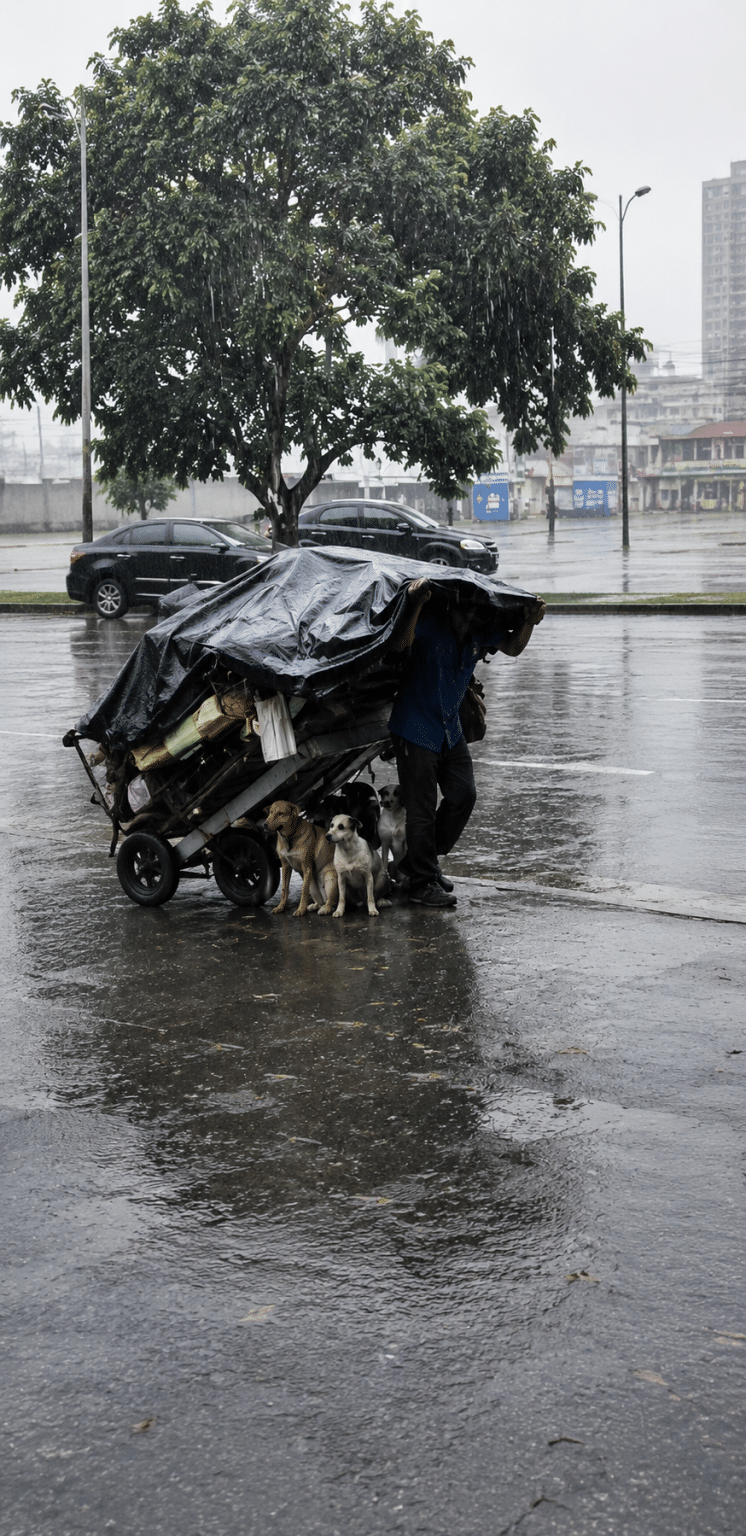
Along the edge of an Arkansas highway, a man was pedaling an old bicycle through the noise of passing traffic. Attached behind him was a small trailer loaded with blankets, bags, and several dogs pressed closely together.
The bicycle moved slowly.
The trailer rattled behind it.
Cars continued rushing past.
For a few seconds, Alicia watched the unusual group disappear in her mirror. She could have continued driving and carried the memory with her for the rest of the day.
Instead, she found a place to turn around.
The Dogs Riding Beside a Dangerous Highway
When Alicia first noticed the bicycle, she was not certain what she had seen.
The man riding it appeared tired, and every push of the pedals seemed to require effort. Behind him, the homemade trailer rolled dangerously close to the highway traffic.
Then she saw movement beneath the blankets.
Dogs.
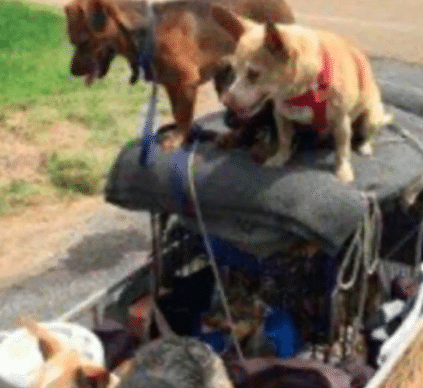
Several of them were riding together among the man’s possessions. They were not running loose or being dragged behind the bicycle. They had been carefully placed inside the cart, where they remained close to one another during the journey.
The arrangement was far from ideal.
The trailer offered little protection from passing vehicles, changing weather, or rough pavement. One careless driver or sudden movement could have placed everyone in danger.
But one detail was immediately clear.
The man had not left the dogs behind.
Whatever he owned was traveling inside that small cart, and the animals were part of it.
Alicia slowed down, turned her vehicle around, and returned to speak with him.
That decision transformed an easily overlooked roadside moment into a story that would soon reach far beyond Arkansas.
Video: Woman Turns Around After Seeing a Man Pulling His Dogs Beside a Busy Highway
Steve Had Been Traveling Without a Permanent Home
The man introduced himself as Steve.
As Alicia spoke with him, she began to understand why the dogs were riding in the trailer and why he was attempting such a difficult journey by bicycle.
Steve explained that he had lived without a permanent home for many years.
His days had been shaped by uncertainty—finding somewhere to sleep, protecting his belongings, and continuing toward the next place that might offer an opportunity.
During that time, dogs began entering his life.
Some had reportedly been abandoned.
Others had been wandering without anyone caring for them.
Steve said that when he encountered an animal in need, he struggled to walk away. He shared what food he had and allowed the dogs to remain with him.
Over time, they became a traveling family.
Caring for several animals while experiencing homelessness created obvious challenges. Food had to be divided. Every new destination needed to accommodate the dogs. Transportation became slower and more complicated.
Yet Steve continued keeping them together.
When Alicia met him, he was traveling toward Indiana, hoping to reconnect with someone who might help him establish a more stable life.
The journey was already difficult for one person.
With a bicycle, a cart, personal belongings, and multiple dogs, it had become exhausting—and increasingly unsafe.
Still, Steve had apparently made one condition nonnegotiable.
He would not reach safety by abandoning the animals that had depended on him along the way.
Alicia Could Not Forget What She Had Seen
After their roadside conversation ended, Alicia continued on her way.
But the scene stayed with her.
She kept thinking about the slow-moving bicycle beside the highway, the cart filled with dogs, and the distance Steve was still attempting to travel.
Offering a few kind words would not make the road safer.
Steve and the dogs needed transportation, food, shelter, and a place where they could pause without worrying about traffic passing only feet away.
Alicia decided to share their story online.
She described the man she had met, the animals traveling with him, and the conditions they were facing. She also created a fundraising campaign intended to help cover immediate needs and move the group toward safety.
The response arrived quickly.
People who had never met Steve began sharing the story. Some contributed small amounts. Others offered supplies, transportation, or help for the dogs.
The attention was not based on a polished organization or a carefully planned appeal.
It began with one photograph and a simple account of what Alicia had witnessed beside the highway.
Many readers appeared moved by the same detail that had caused her to turn around.
Steve had very little stability of his own, yet the dogs were still traveling with him.
Strangers Helped Move the Family Off the Road
As more people learned about the situation, offers of practical assistance began replacing the uncertainty of the journey.
Kelly Seaton, an animal rescue volunteer, reportedly offered to meet Steve and help transport him and the dogs.
That meant the family would no longer need to continue traveling beside fast-moving vehicles.
For perhaps the first time in many miles, Steve could stop concentrating on every passing car, every uneven stretch of pavement, and every sound coming from the trailer behind him.
The dogs could ride inside a safer vehicle.
They could rest without the cart bouncing over the roadside.
They could be protected from the wind and changing weather.
The difference was more than convenience.
It reduced the immediate risk faced by everyone in the group.
Other people contributed along the route as well. A pet-friendly motel reportedly allowed Steve to stay with the dogs instead of requiring him to separate from them.
Animal welfare volunteers helped provide food and check the condition of the animals after the long journey.
What had begun with one driver turning around became a growing network of people addressing one need at a time.
Transportation.
Shelter.
Meals.
Care for the dogs.
No single person solved every part of Steve’s situation. But each person made the next stage more manageable.
Help Did Not Require Him to Leave the Dogs Behind
For someone traveling with several animals, receiving assistance can come with a painful complication.
Many temporary shelters do not accept pets.
Some transportation options cannot accommodate multiple dogs.
A person may be offered a bed but told that the animals must go somewhere else.
For Steve, separation would have meant leaving behind the same dogs he had continued protecting through years of instability.
The support he received was meaningful because it attempted to keep the group together.
The motel accepted the animals.
The transportation included them.
The donations helped meet both human and canine needs.
This approach acknowledged something important about the roadside scene Alicia had witnessed.
The dogs were not simply cargo inside Steve’s cart.
They appeared to be his companions and his responsibility.
Steve may not have had a conventional home to offer them, but he had continued giving them what protection he could. In return, they had remained beside him throughout an uncertain life on the road.
Helping only Steve—or only the dogs—would have ignored the bond holding the group together.
Instead, the people who stepped forward worked around that bond rather than trying to break it.
One Decision Interrupted an Otherwise Ordinary Drive
Alicia did not begin the day expecting to launch a fundraiser or become involved in a stranger’s journey.
She was simply driving when something unusual appeared beside the road.
Her most important action was also the simplest.
She looked again.
Then she turned around.
That pause allowed her to learn the difference between what the scene appeared to be from a distance and what was actually happening.
At first glance, people might have seen only a homeless man struggling with an overloaded bicycle.
A closer look revealed several animals being carried beside him because he would not continue without them.
That did not make the conditions safe.
It did not remove the need for proper shelter, veterinary attention, or more stable care.
But it changed the way the situation was understood.
Steve was not discarding responsibility because his own life was difficult.
He was attempting to carry that responsibility with him, even when doing so made every mile harder.

Compassion Moved in Both Directions
The story reached people because it contained more than one act of kindness.
Steve had reportedly helped dogs he encountered while living on the road.
Alicia noticed Steve and chose not to drive away.
Kelly and other volunteers offered practical support.
People online contributed even though they had never met anyone involved.
Each action led to another.
None required the person helping to have a perfect life or unlimited resources.
Steve shared food and space while possessing very little.
Alicia used her voice and the reach of social media.
Others offered money, transportation, temporary lodging, or animal care.
Together, those contributions accomplished something that no individual gesture could have achieved alone.
They moved a man and his dogs away from a dangerous highway.
They gave the group a chance to rest.
And they showed that assistance can be offered without dismissing the relationships that helped someone survive hardship.
The Cart That Made People Stop and Look
The bicycle and trailer became the most memorable image from the story.
They showed how difficult the journey had become.
But they also revealed what Steve was determined to carry with him.
Blankets.
A few belongings.
And the dogs that had become part of his life.
Without Alicia’s decision to return, the group might have remained one more strange sight briefly noticed through a car window.
Instead, she stopped long enough to ask questions.
What followed was not a single dramatic rescue.
It was a chain of practical choices made by people who recognized that the journey could not safely continue as it had.
A ride replaced the bicycle.
A room replaced the roadside.
Food and care replaced immediate uncertainty.
The future may still have required difficult decisions, but Steve and the dogs no longer had to face those decisions while moving beside highway traffic.
Sometimes a turning point does not begin with a large organization or a perfectly prepared plan.
Sometimes it begins when one person looks into the rearview mirror and decides that continuing forward does not feel right.
Alicia turned around.
And because she did, others finally saw the man and the dogs who had been traveling together all along.


