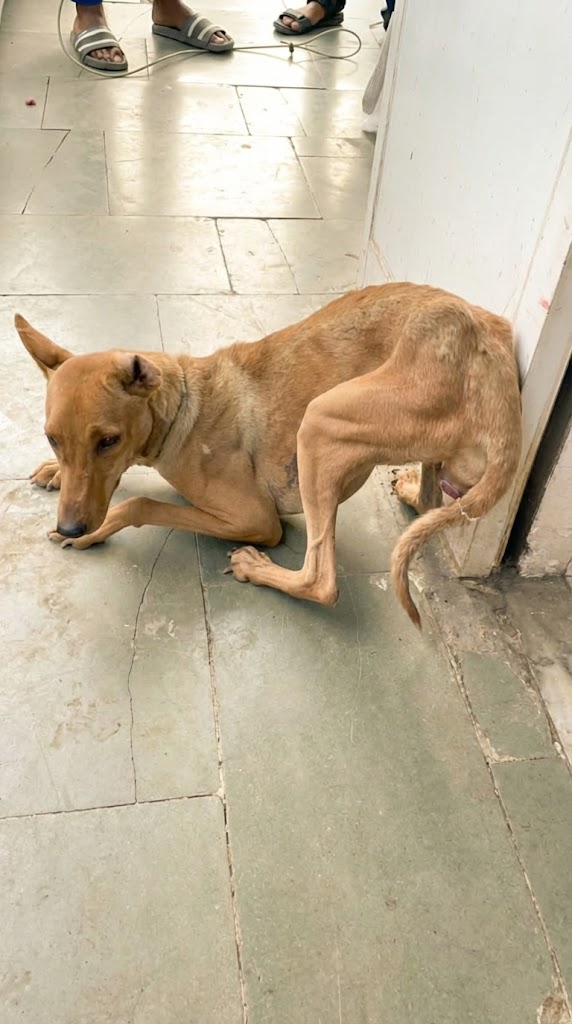
Juli could not see the traffic around her.
She could not watch a vehicle approaching.
She could not look for an open gate, scan the road before crossing, or see the person placing food nearby.
Yet somehow, the little stray dog kept surviving.
Day after day, Juli moved through crowded streets using sound, scent, memory, and touch to understand a world she could no longer see.
Her blindness had reportedly followed a serious accident.
But losing her vision was only part of what she was facing.
As local residents began paying closer attention to her, they noticed another problem becoming increasingly difficult to ignore.
Juli was growing thinner.
Her body was weakening.
And a tumor associated with CTVT — canine transmissible venereal tumor — continued progressing.
For a dog already navigating street life without sight, the illness placed even more pressure on a body that had learned to survive under extraordinary limitations.
People nearby occasionally left food for her.
But food alone could not solve what was happening.
Juli needed veterinary treatment.
She also needed someone patient enough to reach a blind dog who had learned that unfamiliar footsteps could mean danger.
Juli Had Learned to Navigate a World She Couldn’t See
Blindness changed almost everything about street survival.
Sighted dogs can react quickly to approaching vehicles, people, other animals, and obstacles.
Juli could not.
Instead, she relied on the information available to her.
Sounds helped her understand movement nearby.
Smells helped her locate food.
Familiar routes may have helped her move between places she had learned were relatively safe.
Every step required caution.
Residents who saw Juli regularly began recognizing her routines.
They also saw how vulnerable she was.
A sudden horn could startle her.
An unfamiliar obstacle could block a path she remembered.
Traffic remained dangerous even when she appeared to know the area.
And as her health declined, navigating those risks became more difficult.
Her tumor continued growing.
Her body became thinner.
She moved with less energy.
That was when word of Juli eventually reached RRSA India.
The rescue team understood that getting close to her would require more than simply approaching with a leash.
A dog who cannot see the person coming toward her experiences every sound differently.
So the team decided not to rush.
VIDEO: Juli Couldn’t See the Rescuers Approaching — They Had to Earn Her Trust Without Chasing Her
Finding Her Was Only the First Challenge
Juli did not stay in one predictable place.
She moved between locations as she searched for food and somewhere to rest.
That made the rescue more complicated.
The team reportedly spent days trying to locate her consistently enough to make a safe approach.
When they finally found her, they resisted the temptation to move quickly.
There was no chasing.
No shouting.
No sudden attempt to grab her from behind.
Instead, food was placed where Juli could detect it.
Then the rescuers waited.
For a sighted dog, watching a person’s body language can provide information about whether an approach is safe.
Juli did not have that advantage.
She had voices.
Footsteps.
Scent.
The sound of someone shifting nearby.
The rescuers needed those signals to become predictable rather than frightening.
So they stayed quiet.
They allowed Juli to investigate on her own terms.
Food helped create the first connection.
Their patience did the rest.
Trust Came Through Sound, Scent, and Repetition
At first, Juli remained cautious.
An unfamiliar sound could make her pause.
Movement nearby drew her attention immediately.
The rescuers did not interpret that caution as rejection.
It was exactly what they expected from a blind stray who had survived by being careful.
They continued sitting nearby.
They spoke softly.
They allowed Juli to learn their scent.
Nothing was forced.
Over time, she began moving closer.
The distance narrowed.
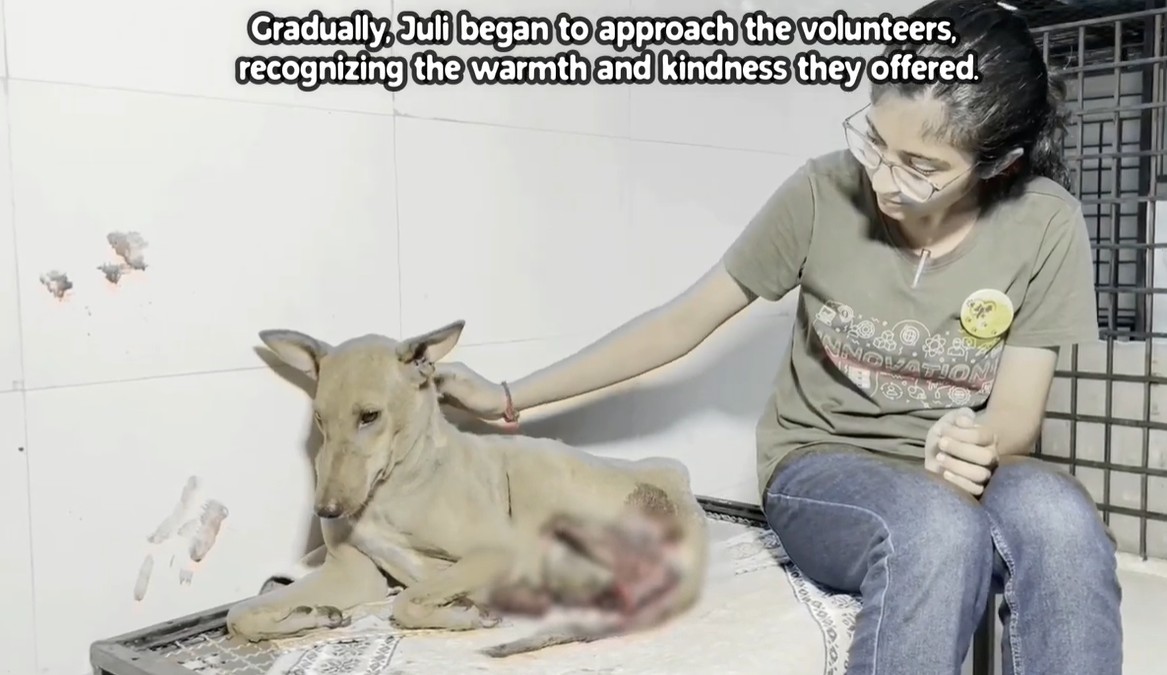
Eventually, Juli allowed a rescuer’s hand to touch her.
There was no need for a dramatic moment.
The important part was simply that she did not immediately retreat.
Another touch followed later.
Then another.
The rescuers had become something familiar enough for Juli to tolerate their presence.
That was the opening they needed.
Once they could handle her safely, they were finally able to remove her from the streets and bring her to veterinary care.
For Juli, the world changed again.
The sounds were unfamiliar.
The smells were different.
But she was no longer navigating traffic.
And for the first time, people could properly address the illness weakening her body.
The Clinic Revealed What Could Be Treated — And What Could Not
Veterinarians evaluated both Juli’s tumor and her blindness.
The diagnosis confirmed that she was suffering from CTVT, a transmissible tumor affecting dogs.
Treatment could address that disease.
Her loss of sight was different.
The blindness was considered permanent.
There was no procedure that could simply return her vision.
For the rescue team, that news was difficult.
But permanent blindness did not mean Juli had no future.
The more urgent issue was the tumor.
According to the original rescue account, veterinarians successfully removed the affected tissue through surgery and continued medical treatment afterward.
That gave Juli something she had not had on the street:
A chance for her body to recover without simultaneously fighting for food and avoiding traffic.
She could sleep.
Eat.
Receive medication.
And learn the layout of a protected environment instead of constantly adjusting to unpredictable streets.
Her eyes would not recover.
But the rest of her body still could.
Two Months of Care Changed Her Physical Condition
Juli’s improvement was gradual.
The thin dog brought in from the streets did not become healthy overnight.
Her body needed nutrition.
Her surgical recovery needed monitoring.
Continued treatment was necessary.
Days became weeks.
And over roughly two months, the changes became increasingly visible.
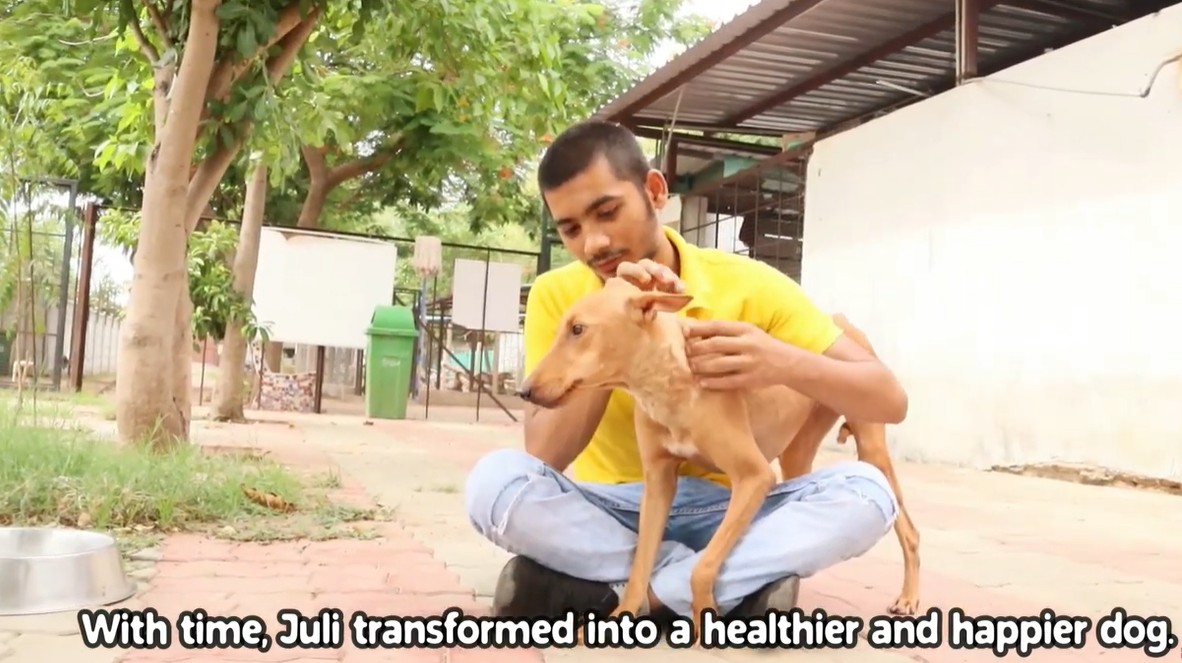
Juli began regaining strength.
Her body condition improved.
She became more comfortable moving through her surroundings.
According to the rescue account, the CTVT did not return during that period.
For the team, that was an encouraging milestone.
But another transformation was happening at the same time.
Juli was learning the shelter.
Blind dogs often become remarkably capable of navigating consistent spaces.
They can remember where objects are located.
They can follow voices.
They can identify people through scent.
They can learn where food and water appear.
That seemed to become Juli’s new world.
Instead of streets that changed without warning, she now had routines.
The same pathways.
Familiar voices.
Known resting places.
A bowl where she expected it to be.
Predictability gave her something vision could not.
Confidence.
Blindness Did Not Stop Her From Learning a Safe Routine
Once Juli’s physical condition improved, her abilities became easier to see.
She did not need sight to recognize familiar people.
She could respond to voices.
She could orient herself through smell and sound.
She began moving with greater assurance through areas she knew.
There were still limitations.
Objects needed to remain reasonably consistent.
Caregivers had to consider her blindness when approaching or guiding her.
Unexpected changes could confuse her.
But Juli adapted.
The dog who had once navigated moving vehicles and unfamiliar streets was now learning a much safer environment.
No traffic rushed past her.
She did not need to find scraps.
She did not have to relocate every time a resting place became unsafe.
When a person called, Juli could move toward a familiar voice rather than away from an unknown sound.
That difference mattered.
She had spent so much time adapting to danger.
Now the same ability to learn through sound and scent was helping her adapt to safety.
The Shelter Became the Place Where She Could Stay
Juli eventually remained under the protection of RRSA India.
The original account described the shelter as her permanent safe place because of her blindness.
For some rescue dogs, the final chapter is adoption into a private home.
For Juli, safety took another form.
She had caregivers who understood her limitations.
She had a familiar environment.
She had regular meals.
She had protection from traffic.
And she no longer needed to solve every problem alone.
That was especially important for a blind dog.
A familiar layout can become a mental map.
Voices can become landmarks.
Daily routines can replace the visual cues Juli no longer has.
What once made her dangerously vulnerable on the street became far more manageable in a controlled environment.
She could move without having to predict passing vehicles.
She could rest without wondering whether someone would force her from the spot.
She could follow voices she recognized.
The shelter was not simply somewhere Juli was kept.
It became a world she could learn.
Juli’s Life Was Never Defined Only by What She Lost
It would be easy to tell Juli’s story entirely through blindness.
The accident.
The dark world afterward.
The danger of the streets.
But that would miss much of what made her recovery meaningful.
Juli lost her sight.
She did not lose her ability to learn.
She did not lose her ability to recognize voices.
She did not lose her ability to respond to patient human contact.
And when illness placed another obstacle in front of her, treatment gave her body an opportunity to recover.
Her rescue worked because the people approaching her adapted to her needs.
They did not chase a dog who could not see where they were coming from.
They waited.
They used food.
They allowed scent and sound to become familiar.
Then, when Juli was ready to be handled, they brought her somewhere the streets could no longer threaten her.
Today, she still cannot see the people around her.
But she can hear them approaching.
She can recognize familiar voices.
She can feel a hand guiding her.
She can move through spaces she has learned are safe.
Juli’s eyes never regained their vision.
Her life still changed completely.
Once, every careful step carried her through traffic and uncertainty.
Now those same steps lead through a place where food, shelter, treatment, and familiar people are waiting.
She may never see the safe world created around her.
She no longer has to see it to know where she belongs.


