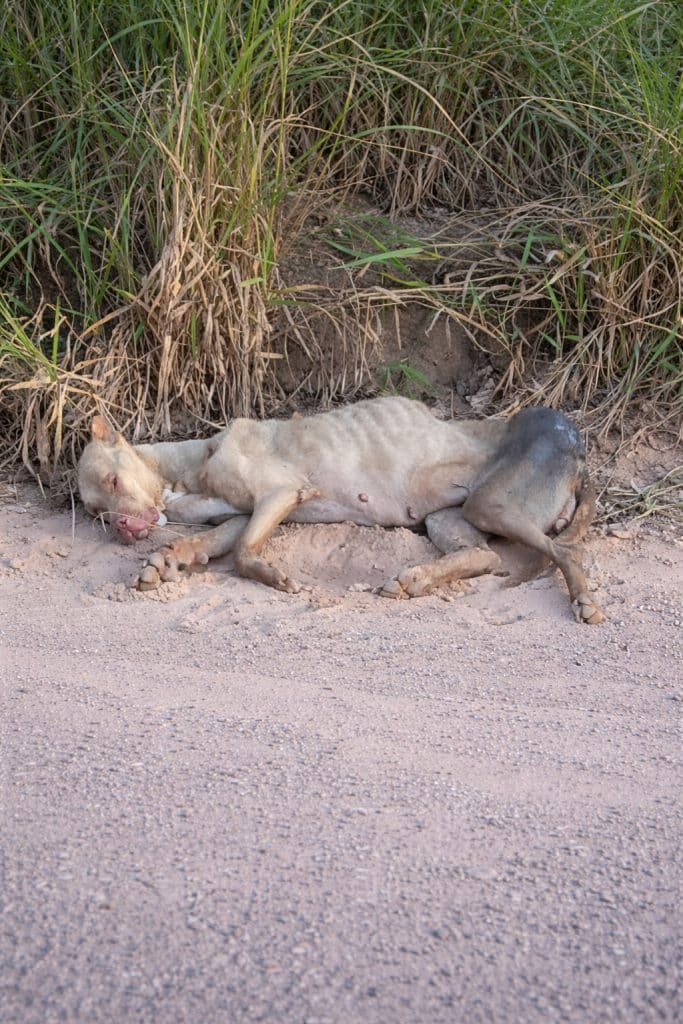
Late one night, Alessandro Desco noticed something lying near the edge of an otherwise empty road.
At first, the shape almost disappeared into the darkness.
Then he looked again.
A dog was stretched across the ground, dangerously thin and almost completely motionless. Her breathing was shallow. Her body felt cold, and she appeared to have so little strength left that even lifting her head seemed impossible.
There was no one standing nearby.
No owner calling for her.
No indication that help was already coming.
The dog, later named Elena, had been left alone at the precise moment when her body could no longer continue without intervention.
Alessandro could have assumed she was already beyond saving.
Instead, he stopped his car.
That decision gave Elena the chance to survive the night.
The Dog Almost Hidden by the Roadside
As Alessandro approached, the seriousness of Elena’s condition became impossible to ignore.
Her body was severely underweight. Beneath her coat, the outline of her ribs and hips showed how much strength she had already lost.
She barely responded when he came closer.
There was no attempt to stand.
No bark.
No defensive movement.
Only weak breathing from a dog who appeared to have been struggling for a long time.
Alessandro did not know how long she had been beside the road or what had happened before he found her. He could only see that waiting until morning was not an option.
He lifted Elena as carefully as possible and placed her inside his vehicle.
Minutes later, the lonely roadside disappeared behind them as he drove toward a veterinary clinic.
For Elena, the journey marked an immediate change.
She was still critically ill.
She was still barely responsive.
But she was no longer alone in the darkness.
At the clinic, the medical team began examining her the moment she arrived.
Her body temperature was dangerously low.
Her blood pressure was weak.
She showed little response to touch or movement.
The veterinarians also found infected wounds that would eventually need surgical treatment. However, Elena was in no condition to undergo an operation that night.
Before they could repair the damage inside her body, they first had to keep that body alive.
She was placed on warming support while the team began urgent tests and stabilization.
The first hours would be critical.
No one could promise that Elena would survive them.
Video: Elena Arrives at the Clinic Barely Responsive After Being Found Alone Beside the Road
The First Days Became a Fight for Stability
Elena required help with nearly every basic function her weakened body could no longer manage effectively.
She was dehydrated and profoundly undernourished. Her circulation was poor, and the infection affecting her wounds had already placed additional stress on an animal with almost no reserves left.
The veterinary team worked continuously.
Fluids were administered carefully.
Her temperature was monitored.
Medication was used to support her fragile condition.
Warm blankets surrounded her body while staff watched for even the smallest change.
One of the most urgent treatments was a blood transfusion.
Elena needed it to improve her chances of surviving the next stage of care. Without stronger blood values and better overall stability, surgery could become even more dangerous.
The transfusion was not a cure.
It was a bridge.
It gave her body additional support while the team tried to determine the full extent of her condition.
During those first days, Elena remained quiet for long periods.
She did not show the energetic response people often hope to see after a rescue. She was simply too weak.
Progress appeared through much smaller signs.
Her heartbeat became steadier.
Her breathing looked slightly less strained.
Her eyes showed brief moments of greater awareness.
The staff measured improvement in details that might have seemed insignificant to anyone else.
A slight change in posture.
A more stable temperature.
A response when someone adjusted her blanket.
Each sign suggested that Elena’s body was still trying.
But on the third day, examinations revealed another serious problem.
She was suffering from a dangerous internal infection.
It could not be managed through observation alone. Without urgent treatment, the infection could continue spreading and overwhelm her already fragile body.
The discovery created a difficult balance.
Elena needed surgery.
But she was still weak enough that surgery itself carried considerable risk.
The veterinary team continued stabilizing her while preparing for the procedure that might determine whether her recovery could truly begin.
Surgery Became Her Only Real Chance
On the fourth day after her rescue, Elena was taken into surgery.
The procedure was necessary to address the source of the infection and properly treat the wounds placing so much pressure on her body.
By then, she had already survived several critical stages.
She had made it through the cold night beside the road.
She had endured the journey to the clinic.
She had responded to warming support, fluids, medication, and the blood transfusion.
But the operation would place new demands on a body that was still profoundly weak.
The veterinary team worked carefully to remove infected material and clean the affected areas.
Outside the treatment room, there was little anyone could do except wait.
Elena had arrived with almost none of the physical strength normally needed for a major medical procedure. Even after stabilization, the outcome remained uncertain.
Eventually, the surgery was completed.
But the danger had not passed.
The following 48 hours were considered especially important.
Elena’s body now had to cope with the effects of surgery while also responding to strong antibiotics and continued supportive treatment.
The clinic monitored her closely for signs that the infection was being brought under control.
Her temperature.
Her blood values.
Her breathing.
The appearance of the surgical area.
Her ability to tolerate food and medication.
Every detail mattered.
There was no sudden moment when the team could declare that everything would be fine.
Recovery came through cautious improvements.
The infection was no longer being left untreated.
The wounds had been properly addressed.
And Elena had survived the operation her doctors once feared she might be too weak to endure.
For the first time, the possibility of a future beyond emergency care began to feel real.
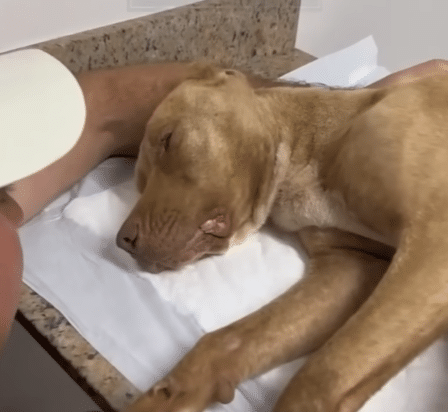
One Careful Step Changed the Mood of the Clinic
Elena’s recovery did not move quickly.
In the days after surgery, much of her time was still spent resting.
Her body had been depleted by hunger, infection, blood loss, and the stress of the operation. Healing required energy she was only beginning to regain.
The veterinary staff continued caring for her wounds and repeating blood tests.
They watched the surgical area improve.
They saw signs that the medication was working.
Her appetite gradually became more reliable.
Strength returned in small amounts.
Then, one day, Elena shifted her body and attempted to stand.
At first, her legs looked uncertain beneath her.
The staff remained close, ready to support her if she lost balance.
Elena steadied herself.
Then she took a few slow steps.
There was nothing graceful about the movement. She was still weak, and each step required visible effort.
But the dog who had arrived almost completely unresponsive was now standing under her own power.
The moment became even more meaningful when her tail began to move.
It was a small wag.
Brief and gentle.
Yet everyone in the room noticed.
Until then, most of Elena’s progress had been recorded through clinical signs: stronger blood results, improved temperature, better wound healing, and more stable breathing.
The tail wag revealed something different.
Elena was beginning to respond to the people around her.
She was not simply remaining alive while treatment happened to her.
She was becoming engaged with her surroundings again.
That small movement did not mean the recovery was complete.
Elena still had wounds to heal.
She still needed to regain weight and muscle.
Her medical team would continue monitoring her closely.
But for the people who had cared for her since the first night, the wag marked a turning point.
The roadside dog who could barely breathe was beginning to interact with life again.
Familiar Hands Slowly Became a Source of Comfort
As Elena’s physical condition improved, her personality began to emerge.
During the earliest days, she had been too ill to show much reaction to the world around her. Later, even as she became stronger, she remained quiet and cautious.
The clinic staff did not rush her.
They approached gently.
They spoke before touching her.
They allowed her to become familiar with their voices and routines.
Medicine arrived at predictable times.
Meals continued appearing.
Bandages were changed with care.
The same people returned each day.
Through those repeated experiences, Elena began learning that the hands reaching toward her were there to help.
She relaxed more easily when familiar caregivers entered.
Gentle touch no longer seemed to create the same uncertainty.
She began accepting affection and showing interest in the people nearby.
The changes were gradual, but they mattered.
Treating Elena’s infection and wounds had saved her body. Helping her feel secure required a different kind of consistency.
She needed to experience safety repeatedly before she could rely on it.
No one at the clinic knew exactly what had happened before Alessandro found her. They could not know whether she had been abandoned, had wandered away, or had been living without care for an extended period.
What they could observe was the way Elena responded to her new environment.
Her eyes became more attentive.
Her body appeared less tense.
She began resting without remaining completely withdrawn.
As her strength improved, she walked with more confidence.
She ate more reliably.
And she increasingly welcomed the attention of the people caring for her.
Each day placed another safe experience between Elena and the night she had been found beside the road.
By Day Forty, She Was Almost Unrecognizable
Forty days after Elena’s rescue, the difference was extraordinary.
The dog who had arrived cold, dangerously thin, and barely responsive now moved through the clinic with visible energy.
Her wounds had continued healing.
Her body had regained strength.
She could walk without the same uncertainty that marked her first attempts to stand.
But her behavior revealed the transformation most clearly.
Elena had become affectionate around the people she trusted.
She welcomed attention.
She allowed caregivers to hold and comfort her.
She rested peacefully instead of lying rigid and unresponsive.
The dog who once showed almost no reaction now actively engaged with those around her.
For the veterinary team, the change represented the result of dozens of connected decisions.
Alessandro had chosen to stop.
The clinic had responded immediately.
The team had warmed and stabilized her.
A blood transfusion had supported her through the most dangerous period.
Veterinarians had recognized the internal infection and operated despite the risks.
Staff had remained beside her during the uncertain days that followed.
No single treatment created the transformation alone.
Elena survived because each part of her care arrived when she needed it.
By day forty, she was no longer living from one emergency hour to the next.
She could eat, walk, rest, and seek affection.
Her recovery was still part of an ongoing process, but she had clearly moved beyond the fragile condition in which she had been found.
She was no longer merely a patient fighting to remain alive.
She was becoming a companion.
The Man Who Stopped Became Someone She Trusted
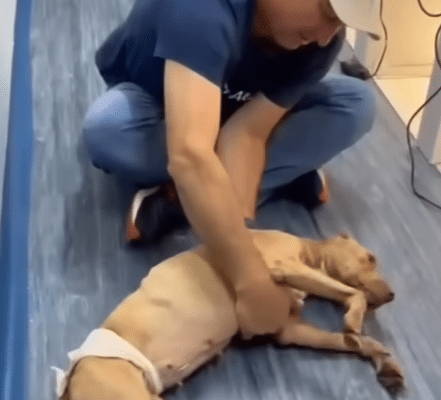
One of the most moving moments of Elena’s recovery came when she spent time again with Alessandro.
This was the man who had seen her beside the road when she was almost hidden by darkness.
He had known nothing about her history.
He had no guarantee that she could survive.
Still, he had lifted her into his vehicle and driven toward help.
Now Elena was able to respond to him in a completely different way.
She rolled onto her back beside him, relaxed and comfortable enough to expose the most vulnerable part of her body.
There was no cold roadside.
No urgent drive.
No team preparing emergency support.
Only a recovering dog resting beside the person whose decision had allowed every later moment to happen.
Her posture showed how much had changed.
On the night of the rescue, Elena had been unable to stand or meaningfully respond.
Now she could seek contact and relax around someone she recognized as safe.
For Alessandro, the reunion offered visible proof that stopping had mattered.
He had not needed special equipment or time to form a complicated plan.
He had simply noticed an animal in danger and refused to drive away.
That first choice connected Elena to every resource that followed.
Without it, the transfusion, surgery, antibiotics, careful monitoring, and weeks of recovery may never have happened.
Her Story Continued Because Someone Looked Again
Elena’s rescue did not begin with a large operation.
It began beside an empty road, with one driver noticing a shape in the darkness.
She was cold.
Dangerously underweight.
Affected by infected wounds and a serious internal infection.
Her blood pressure was weak, and her body appeared close to its limit.
Nothing about her condition promised an easy outcome.
Even after she reached the clinic, each stage carried new uncertainty.
Would she respond to stabilization?
Could she survive the blood transfusion?
Was she strong enough for surgery?
Would her body respond during the crucial 48 hours afterward?
Elena answered those questions gradually.
A steadier breath.
An improved test result.
A carefully completed operation.
A few slow steps.
One small movement of her tail.
By the fortieth day, the dog who had once been almost motionless was walking confidently and accepting affection from the people around her.
Her story is not proof that every medical emergency will have the same outcome.
It is a reminder that an animal cannot receive a chance unless someone first chooses to act.
Alessandro did not know how Elena’s story would end when he picked her up.
The veterinarians did not know whether their efforts would be enough when she arrived.
They helped anyway.
That is what transformed a dark roadside into the beginning of Elena’s recovery.
She is no longer defined only by the place where she was found.
Her life now carries other memories.
Warm blankets.
The people who monitored her through the night.
The first time she stood.
The first wag of her tail.
And the quiet moment she rolled onto her back beside the man who refused to leave her there.
Sometimes a second chance begins with medicine.
Sometimes it begins with shelter, food, or a safe place to sleep.
For Elena, it began when headlights passed over a lonely roadside—and one person cared enough to stop.


