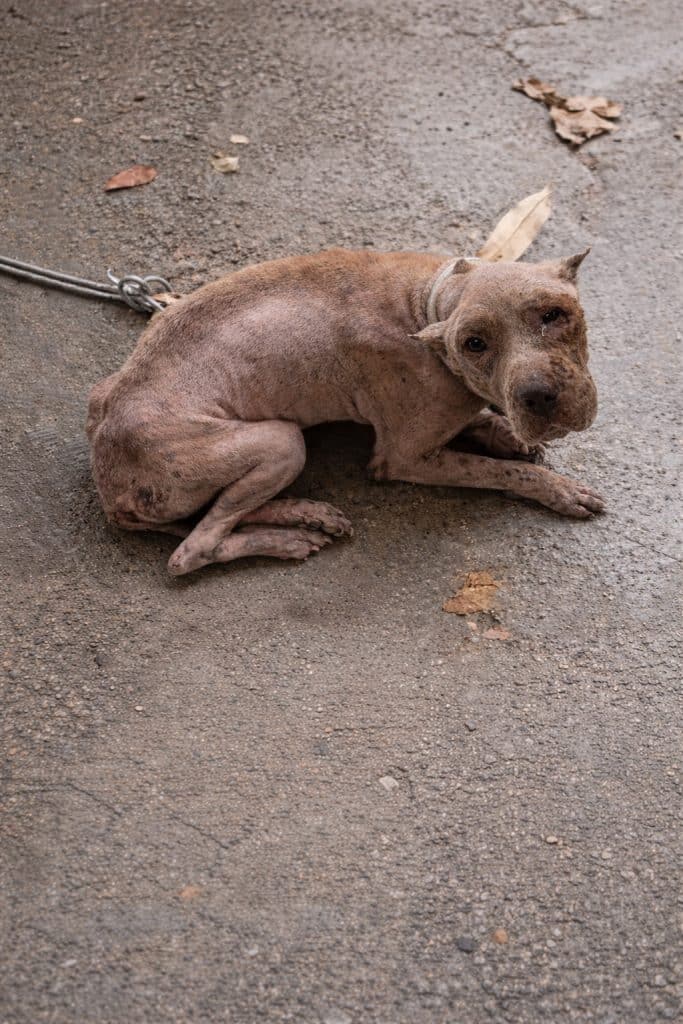
The car stopped beneath the bright lights of an almost empty parking lot.
A door opened.
A dog was left behind.
Then the vehicle pulled away.
She did not chase after it.
She did not bark or try to follow.
Within moments, her weakened body gave way, and she collapsed onto the hard concrete where she had been abandoned.
Later, rescuers would call her Greta.
But before she could have a name, someone had to realize that the dog lying beneath those cold white lights was still alive—and still needed someone to come back for her.
She Collapsed Almost Where She Had Been Left
Footage of Greta’s abandonment began circulating online.
The scene was difficult to misunderstand.
A vehicle arrived.
Greta was left in the parking lot.
Then the car disappeared.
What happened afterward made her condition even more concerning.
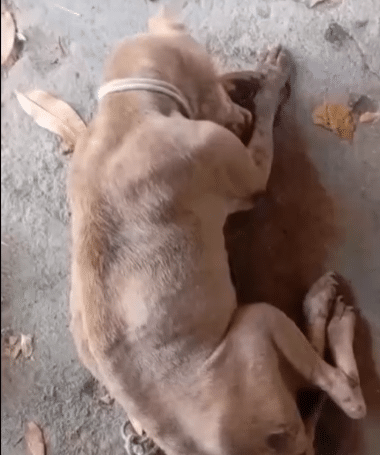
She barely moved.
There was no attempt to run after the vehicle or search the parking lot for the people who had left.
Instead, Greta remained on the ground.
Her body appeared extremely weak.
She seemed unable to support herself for more than a moment, eventually settling onto the concrete beneath the lights.
For some time, people could see what had happened without Greta receiving the help she urgently needed.
Then someone decided that watching was not enough.
Help was organized.
And when rescuers finally reached the parking lot, Greta was still there.
Video: Greta Was Left Beneath the Parking Lot Lights — And Didn’t Have the Strength to Follow
Up Close, Her Condition Was Far Worse Than the Video Revealed
Greta had barely changed position by the time rescuers approached.
She could not stand normally.
Even attempting to rise appeared beyond what her body could manage at that moment.
But her eyes still moved.
She watched the people coming toward her.
That small response was important.
Whatever had happened before she was abandoned, Greta was still alert enough to notice that someone was finally beside her.
Once rescuers could examine her more closely, additional problems became visible.
Her face had several damaged areas.
Her eyes appeared swollen and irritated.
Her skin showed multiple untreated sores.
Her legs were inflamed and sensitive.
Greta was also running a dangerously high temperature.
The combination of weakness, skin problems, inflammation, and fever made it clear that this was not simply an exhausted dog needing a meal and a night of sleep.
She required veterinary care immediately.
The rescuers lifted her carefully and transported her away from the parking lot.
For Greta, the place where someone had left her behind would not be the place where everyone else did the same.
The Tests Confirmed This Would Not Be a Quick Recovery
At the veterinary clinic, Greta underwent examinations and testing.
The results showed that her medical problems were serious.
According to the rescue account, veterinarians identified a condition that would not simply disappear after a short course of treatment.
It would require continued management and ongoing care.
The available account does not provide enough detail to responsibly name the exact diagnosis, but it makes one thing clear:
Greta’s recovery would not be simple.
Her body was unstable when she arrived.
She had a high fever.
Her skin and legs needed treatment.
Her overall strength was extremely poor.
The veterinary team therefore focused first on supporting her through the immediate crisis.
There could be questions about the future later.
For now, Greta needed to make it through the next hours and days.
And amid all the uncertainty, she gave her caregivers one small reason to keep hoping.
Food was placed near her.
Greta tried to eat.
Weakly.
Slowly.
But she tried.
The First Days Were About Keeping Her Stable
There was no dramatic turnaround after Greta reached the clinic.
Her first days were about basic survival.
She received fluids and supportive treatment.
Her wounds were cleaned.
Caregivers worked to keep her warm and comfortable while monitoring how her body responded.
Because Greta was so weak, even ordinary tasks required attention.
Resting comfortably mattered.
Hydration mattered.
Taking a little food mattered.
Keeping her skin clean mattered.
Someone remained close to her during the difficult periods.
There was no expectation that Greta should immediately become affectionate or energetic simply because she had been rescued.
Her body needed time.
So did she.
The people around her spoke gently and handled her carefully.
When she needed to rest, they let her rest.
When treatment was necessary, they moved patiently.
The goal was not to force a visible transformation.
It was to give Greta enough consistent care that her body finally had the chance to respond.
Her Progress First Appeared in the Quietest Ways
Recovery began almost invisibly.
Greta’s breathing became steadier.
Her body appeared less distressed.
Her eyes began looking less tense.
She tolerated gentle contact more comfortably than she had when she first arrived.
These were not dramatic milestones.
Greta did not suddenly jump to her feet.
She did not transform overnight into the healthy dog everyone hoped she might eventually become.
Instead, the changes arrived in details.
A little more interest in food.
Longer periods of peaceful rest.
A calmer response when familiar caregivers came near.
For an animal who had arrived unable to stand and struggling with several medical problems, those small signs mattered.
Each one suggested that the care surrounding her was beginning to make a difference.
And something else began changing.
Greta no longer had to watch every person from the ground of a parking lot and wonder what would happen next.
The same people kept returning.
Meals returned.
Treatment returned.
Gentle voices returned.
Day after day, her world became more predictable.
She Was Finally Able to Rest Without Being Left Behind
One of the most meaningful changes in Greta was not something easily measured on a medical chart.
She began to relax.
At first, much of her stillness had come from physical weakness.
She simply did not have the strength to do much else.
But later, caregivers noticed a different kind of rest.
Her body appeared less guarded.
She accepted gentle handling more easily.
She could settle into her bedding while people moved around her without reacting to every touch.
No one could know exactly what Greta understood about her changing circumstances.
What they could observe was that she seemed increasingly comfortable in the environment around her.
That distinction matters.
A motionless dog is not necessarily a peaceful dog.
When Greta was lying on the concrete after being abandoned, her stillness reflected a body in serious trouble.
Now, surrounded by warmth and care, resting meant something different.
She had somewhere clean to lie down.
People were monitoring her.
Food and water did not depend on what she could find for herself.
And if her condition worsened, someone would notice.
For the first time since her story became visible, Greta no longer had to face every difficult moment alone.
Her Story Wasn’t Finished With a Perfect Ending — It Was Continuing With Care
Greta still had a difficult road ahead.
The condition identified by her veterinary team required ongoing management.
There would be more treatment.
More monitoring.
Possibly more difficult days.
Her rescuers could not promise that every medical problem would disappear.
And her story did not need that promise to matter.
What had already changed was enormous.
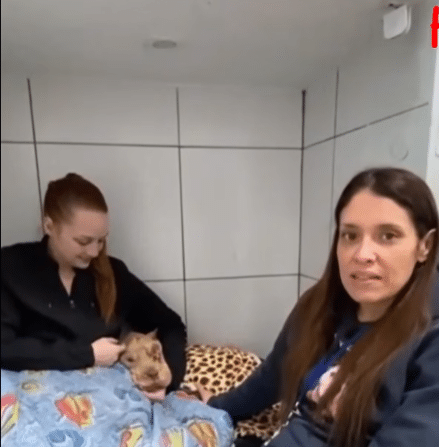
Greta went from lying beneath parking lot lights with no one beside her to being surrounded by people paying attention to every part of her recovery.
Her wounds were being treated.
Her fever and weakness were being addressed.
Her meals were provided.
Her body had a warm place to rest.
And someone was there to notice the smallest changes.
When Greta first appeared in the parking lot, the most painful part of the scene was not simply that a dog had been left behind.
It was how little strength she had left when it happened.
She could not chase the departing car.
She could barely move at all.
Her body simply collapsed where the people who had brought her decided to leave her.
But that moment did not become her ending.
Someone watched what happened and chose to act.
Then others continued what that first decision started.
They carried her away.
Got her medical help.
Stayed through the uncertain days.
And gave her something she had not received beneath those parking lot lights:
continuity.
Greta’s future may still require patience.
It may require treatment for a long time.
But she is no longer a dog lying alone on concrete while the world decides whether to notice.
She has people around her now.
People who know her name.
People who understand that keeping an animal alive sometimes means far more than one dramatic rescue.
Sometimes it means returning the next morning.
Giving another treatment.
Cleaning another wound.
Offering another meal.
And staying long enough for a frightened, exhausted animal to understand that this time, no one is driving away.


