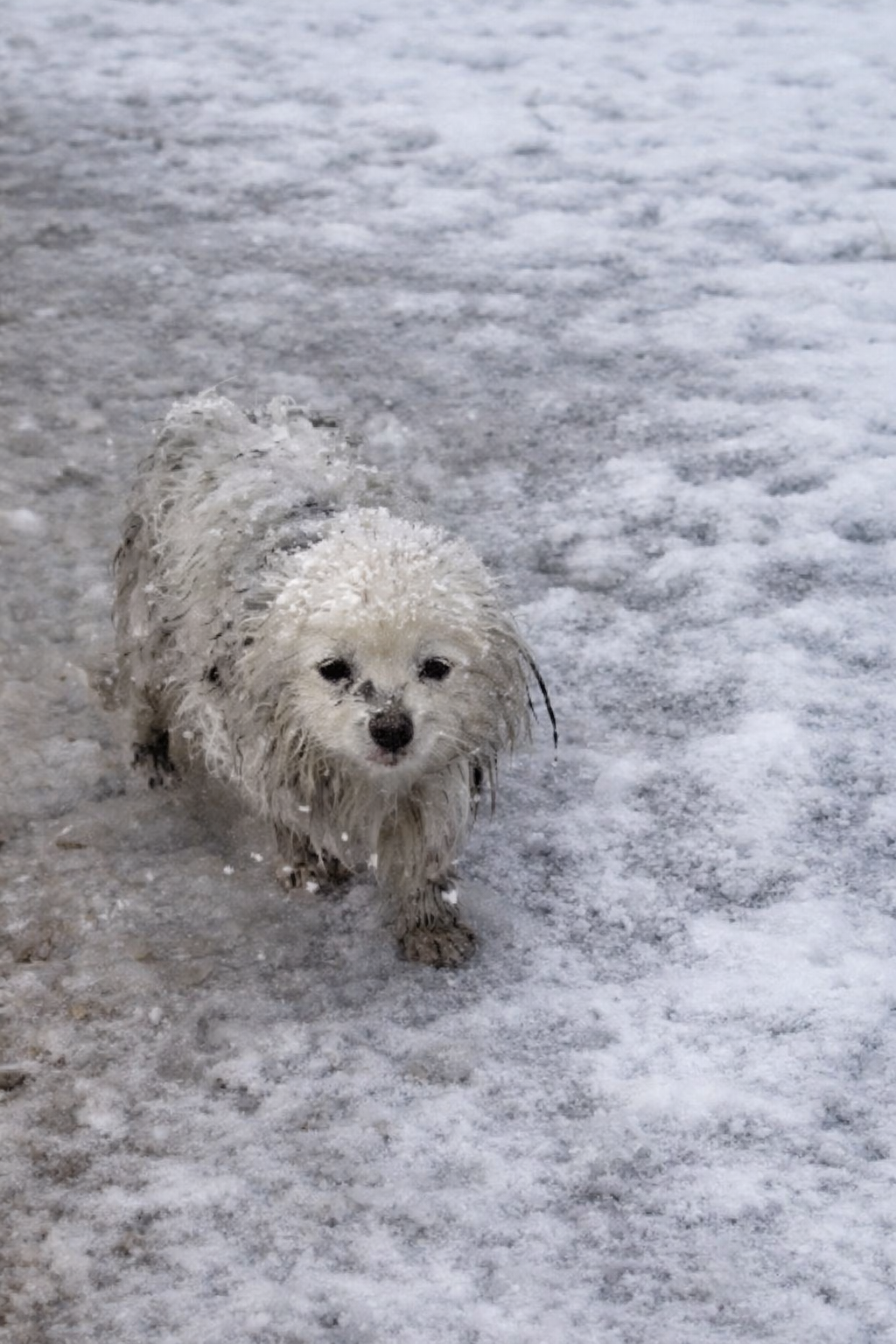
At first, she was almost impossible to see.
The road ahead was covered in white, the trees were heavy with snow, and another layer was falling steadily across the landscape.
Then something moved.
A tiny white dog was running alone along the frozen road.
There was no leash trailing behind her.
No person following.
No familiar voice calling her name.
She simply kept moving through the cold as though stopping was not an option.
From a distance, her white body nearly disappeared into the winter landscape. But when someone finally came close enough to see her properly, the details told a different story.
Her coat was dirty and severely tangled.
Snow and bits of frozen debris had become trapped in the long fur around her legs and body.
She looked like a little companion dog who should have been sleeping somewhere warm.
Instead, she was alone in the middle of a snow-covered road.
And one person decided not to keep walking.
A Little White Dog With Nowhere to Run
The stranger stopped and watched her.
The dog noticed immediately.
She did not approach.
Instead, she maintained her distance, moving nervously through the snow and watching every step the person made.
There was no way to know how she had ended up there.
Perhaps she had become lost.
Perhaps someone had left her behind.
The rescuer could not know her history simply by looking at her, and the empty winter road offered no answers.
What mattered was what could be seen.
She was outside in worsening weather.
Her coat was in poor condition.
She appeared hungry.
And she was frightened enough that walking directly toward her would almost certainly make her run.
So the rescuer tried something much smaller.
Food.
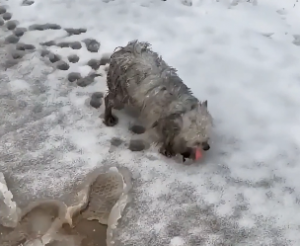
A piece of sausage was placed on the snow between them.
The dog froze.
For several seconds, she seemed caught between two instincts.
Stay away from the stranger.
Move toward the food.
Hunger eventually won.
She hurried forward, grabbed the sausage, and backed away again.
Another piece followed.
Then another.
The distance between them slowly became smaller.
Not because she had suddenly stopped being afraid.
Because someone was willing to wait.
VIDEO: A Tiny White Dog Was Running Alone Through the Snow — Then Someone Finally Stopped
Trust Began With Pieces of Sausage in the Snow
There was no dramatic moment when the little dog suddenly decided that everything was safe.
Trust came in inches.
The rescuer remained nearby without chasing her.
When the dog retreated, he did not corner her.
When she came forward for food, he allowed her to step back again.
Another piece of sausage landed in the snow.
She returned.
Her movements were quick and cautious.
She ate immediately, then lifted her head to watch him.
The pattern repeated.
Food.
Distance.
Another cautious approach.
Each time she returned, she remained slightly closer than before.
For a frightened dog outdoors, forcing contact could have undone all of that progress in seconds.
So the rescuer continued letting her make the decisions.
Eventually, something changed.
After finishing the food, the little dog did not immediately disappear down the road.
She lingered.
Then the rescuer began walking.
To his surprise, she followed.
Not directly beside him at first.
She remained a short distance away, still careful, still watching.
But she was following.
The snowfall continued around them.
Their footprints stretched behind them across the white road—one set human, another much smaller.
Every few moments, the dog paused.
The rescuer paused too.
When she moved again, he continued.
It was a quiet negotiation between two strangers.
He would not chase.
She would not run.
And step by step, they began leaving the empty road together.
Then She Allowed Him to Pick Her Up
Eventually, the rescuer stopped and reached toward her.
For a moment, the little dog hesitated.
She had been willing to accept food.
She had been willing to follow.
Being touched was another decision entirely.
The rescuer did not grab her suddenly.
He lowered himself and gave her time.
The dog remained close.
A hand reached beneath her body.
She tensed briefly.
Then she allowed herself to be lifted.
There was no frantic twisting.
No attempt to bite.
No desperate struggle to escape.
Instead, the little dog remained in his arms while the snow continued falling around them.
Up close, the condition of her coat was even easier to see.
Long sections had tangled together into thick mats.
Dirt and moisture were trapped close to her body.
Frozen material clung to the fur around her paws and lower legs.
Whatever her life had been before that winter road, she needed somewhere warm now.
With the weather worsening, staying outside was no longer reasonable.
The rescuer turned back.
This time, the little dog did not have to walk through the snow.
She was carried.
Beneath the Matted Coat Was a Dog in Need of Care
Reaching shelter solved the immediate problem of the cold.
But it revealed another.
Her coat required serious attention.
Long-haired dogs can develop mats when grooming is neglected for extended periods. Once those tangles tighten, they can pull against the skin, collect moisture and debris, restrict movement, and make brushing uncomfortable.
The little dog’s fur had reached the point where ordinary brushing was not enough.
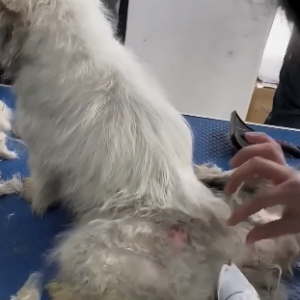
She was taken for professional grooming.
The process needed patience.
Sections of fur were carefully examined.
Where tangles could be safely worked apart, they were handled gently.
Where the mats had become too tight, portions of the coat had to be clipped or shaved rather than pulled painfully against the skin.
The little dog stood quietly while unfamiliar hands worked around her.
Only hours earlier, she had been avoiding a stranger on a frozen road.
Now she was indoors, surrounded by people trying to undo the physical evidence of however long she had been outside without proper grooming.
Warm water washed away dirt from beneath the coat.
Snow and roadside debris disappeared.
The heavy tangles that had pulled against her small body were gradually removed.
Piece by piece, the dog underneath began to emerge.
The Warm Bath Revealed a Completely Different Little Dog
The difference was striking.
Before grooming, it had been difficult to see the natural shape of her face beneath the neglected fur.
Afterward, her features became clear.
Her eyes seemed larger without dirty strands hanging around them.
Her body looked smaller once the heavy mats were gone.
Her coat, though shortened in some areas, was finally clean and free from the frozen debris that had accompanied her down the road.
But appearance was only part of the change.
The little dog had entered the grooming space uncertain about the people around her.
As time passed, she became easier to handle.
Gentle touch no longer caused the same hesitation.
She began looking around the room instead of concentrating entirely on keeping distance from everyone.
No one could know exactly what she was thinking.
But her behavior was beginning to show something important.
She was becoming comfortable enough to investigate her surroundings.
A few hours earlier, her world had consisted of snow, hunger, and keeping strangers at a safe distance.
Now there was warmth beneath her paws.
Food nearby.
People moving calmly around her.
And no need to keep running.
Her First Hours Indoors Were Filled With Small Discoveries
For dogs accustomed to outdoor survival, safety can look surprisingly ordinary.
A bowl that remains full.
A floor that is dry.
A room without freezing wind.
A person who approaches gently and then moves away again.
The little white dog began experiencing those things one by one.
At first, she remained cautious.
New rooms were inspected carefully.
Unexpected movement caught her attention.
When someone reached toward her, she watched the hand before deciding whether to accept the touch.
But the frantic energy from the snowy road began to disappear.
She did not need to search for the next piece of food scattered across the ground.
Meals arrived without negotiation.
She did not need to find a place protected from falling snow.
There was somewhere warm to rest.
The changes were subtle but meaningful.
Her body appeared more relaxed while resting.
She allowed petting.
She began remaining near people voluntarily instead of automatically creating distance.
And curiosity—the quality fear had pushed aside on the road—started to return.
She walked around the room.
She sniffed unfamiliar objects.
She looked toward voices.
For perhaps the first time anyone observing her could know for certain, she had enough safety to simply behave like a small dog again.
The Face Hidden Beneath Winter Finally Appeared
After grooming and rest, photographs made the transformation especially clear.
It was the same dog.
The same eyes.
The same little body that had been moving through the snow.
Yet she looked almost unrecognizable.
The tangled exterior that made her appear rough and neglected had disappeared.
Her white coat was cleaner and softer.
Her face could finally be seen properly.
Most striking was the difference in the way she carried herself.
On the road, her movements had been built around distance.
Move away.
Watch.
Approach the food.
Move away again.
Indoors, she gradually stopped behaving as though every interaction required an escape plan.
She could remain close.
She could rest.
She could accept a hand on her back and discover that nothing unpleasant followed.
That kind of progress does not need a dramatic interpretation.
Her behavior said enough.
The little dog was beginning to feel safer.
No One Knew Exactly How She Reached That Road
There is always a temptation to fill in the missing chapters of a rescue story.
Was she abandoned?
Did she slip through an open gate?
Had she wandered for hours—or for days?
Was someone somewhere searching for her?
The road itself could not answer those questions.
There had been no person beside her when she was spotted.
No leash.
No one calling after her.
And her coat suggested that proper grooming had been absent for some time.
Beyond those observations, her past remained uncertain.
But rescue does not always require knowing every detail of what came before.
Sometimes the animal in front of you tells you everything necessary.
She was cold.
She was hungry enough to repeatedly return for food despite her fear.
Her fur needed immediate care.
And she was alone during heavy snowfall.
That was enough reason to help.
The stranger did not need a complete history before stopping.
He did not need proof that the dog had been abandoned before offering food.
He simply saw an animal who might be in trouble and chose to remain there long enough to find out.
That decision changed everything that followed.
Safety Was Built From Very Ordinary Things
People often imagine rescue as one heroic moment.
Someone finds an animal.
Someone lifts it into a vehicle.
The danger ends.
But for frightened dogs, being removed from danger is only the first part.
Afterward comes the quieter work.
Feeding.
Cleaning.
Watching.
Learning what frightens them.
Allowing them to approach instead of constantly reaching for them.
Creating predictable routines.
Giving them somewhere comfortable to sleep.
The little white dog’s rescue followed exactly that pattern.
The most important moments were not spectacular.
A sausage landing gently on the snow.
A dog deciding to come closer.
A person refusing to chase her when she backed away.
The first touch.
Being lifted.
A warm bath.
A quiet room afterward.
Each event by itself seemed small.
Together, they moved her from uncertainty toward security.
This is often how trust is created.
Not through one enormous gesture.
Through repeated evidence that the next moment will be safe too.
The Snowy Road Became Part of Her Past
Later, the little dog could finally rest indoors.
There was no snow collecting against her coat.
No frozen debris tangled around her paws.
No empty road stretching ahead with nowhere obvious to go.
She had food.
Warmth.
A clean place to sleep.
And people willing to care for her.
The contrast with that first image was difficult to forget.
A tiny white figure had once been moving alone through an almost completely white landscape.
Had the stranger continued walking, she might simply have disappeared farther down the road.
Instead, he stopped.
Then he stayed.
Long enough to offer one piece of food.
Long enough for her to return for another.
Long enough for fear to become manageable.
Long enough for a frightened little dog to decide that walking beside a human might be safer than continuing alone.
That is what changed her story.
Not a dramatic rescue operation.
Not expensive equipment.
Not some extraordinary act requiring special training.
Attention.
Patience.
Food.
And the willingness to remain when it would have been easier to keep moving.
Sometimes Rescue Begins With Simply Not Walking Away
There were no crowds watching when the dog was found.
No applause when she took the first piece of sausage.
No one knew at that moment whether she would ever come close enough to be helped.
The rescuer simply kept trying without frightening her.
That patience created the opportunity for everything that came next.
By the time she was resting safely indoors, the little dog looked very different from the snowy figure first spotted on the road.
But her transformation was about more than clean fur.
She no longer needed to search an empty winter landscape for food.
She no longer needed to decide whether every approaching person was a threat.
She had somewhere to stop moving.
Somewhere warm enough to sleep.
Somewhere a meal would arrive again tomorrow.
For an animal found alone in a snowstorm, those ordinary promises can mean everything.
Perhaps that is why her story is so easy to remember.
It began with a scene most people could have passed without noticing—a tiny shape moving through an enormous white world.
One person noticed.
One person stopped.
And instead of forcing the frightened dog to trust him immediately, he gave her the time to make that choice herself.
One piece of food became another.
Distance became companionship.
The snowy road became a warm room.
And the little white dog who had been running with nowhere obvious to go finally reached a place where she no longer had to run at all.


