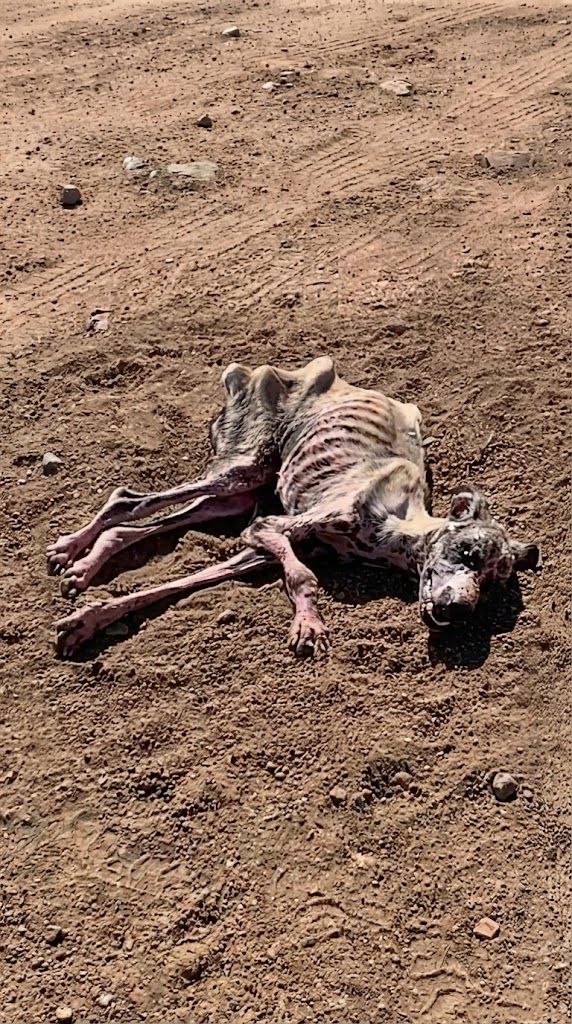
There are moments in rescue when silence feels more frightening than crying.
When Delilah was found, she did not bark.
She did not struggle.
She did not even try to pull away from the people reaching toward her.
Her body was painfully thin, with bones visible beneath fragile skin. She trembled almost constantly, yet she seemed too exhausted to react to anything happening around her.
When someone carefully lifted her from the ground, Delilah simply allowed herself to be carried.
Then, as she was placed gently into the car, a tiny sound escaped her.
It was barely a cry.
Soft. Weak. Almost lost beneath the noise around her.
But it was enough to tell the rescuers something important.
Delilah was still there.
Somewhere beneath the exhaustion, illness, and neglect, a small part of her had not given up.
The Dog Who Had Almost Run Out of Strength
The first close look at Delilah was difficult.
Her body had lost much of the healthy weight a dog of her size should have carried. Her coat was patchy, her skin irritated, and her movements were slow and uncertain.
Even keeping herself upright seemed exhausting.
Her eyes looked distant.
When people approached, she did not respond with obvious fear or excitement. She simply watched—or sometimes seemed to look past them entirely.
That lack of reaction concerned the rescuers almost as much as her physical condition.
A frightened dog may run.
A defensive dog may growl.
A hopeful dog may reach toward someone.
Delilah seemed to have very little energy left for any of those things.
So no one demanded a response from her.
They wrapped her carefully, kept her warm, and focused on getting her to veterinary care as quickly as possible.
The ride to the clinic was quiet.
Every so often, someone checked to make sure she was still breathing comfortably.
No one knew yet how serious her condition would be.
They only knew that she needed help immediately.
VIDEO: Delilah Was Too Weak to Resist — Then Her Quiet Cry Changed Everything
The Examination Revealed More Than Anyone Expected
At the veterinary clinic, Delilah was examined from head to tail.
The list of concerns grew quickly.
She was severely malnourished.
She was dehydrated.
Her skin showed signs of mange.
Testing also revealed heartworm disease and pneumonia.
Any one of those conditions could have placed enormous stress on a weakened dog.
Delilah was facing several at once.
The veterinary team now understood why she had seemed so distant when she was found. Her body had been using nearly everything it had simply to continue functioning.
Treatment therefore had to be thoughtful.
A dog in such a fragile condition cannot always be rushed through recovery.
Food needed to return carefully.
Hydration needed to be restored.
Medication needed time to work.
And above all, Delilah needed rest.
For the first time in an unknown amount of time, she was given something simple but important:
A quiet place where nothing was being demanded of her.
No searching for food.
No need to find shelter.
No need to remain alert to whatever might happen next.
She could simply lie down and sleep.
Healing Began With the Smallest Changes
Recovery did not arrive dramatically.
There was no single morning when Delilah suddenly became healthy again.
Instead, improvement appeared in details so small they could easily have been overlooked.
Her eyes began following people as they entered the room.
She became more interested in the smell of food.
When a bowl was placed nearby, she started eating with greater enthusiasm.
Her breathing gradually became steadier as treatment continued.
And little by little, the vacant expression rescuers had first seen began to change.
There was awareness again.
Curiosity.
A quiet interest in the world around her.
Her caregivers learned to celebrate those moments.
A finished meal mattered.
Standing for a little longer mattered.
Looking toward someone when they called her name mattered.
Recovery from severe neglect is rarely built from one enormous breakthrough.
It is built from hundreds of ordinary moments repeated consistently.
Another meal.
Another dose of medication.
Another clean blanket.
Another peaceful night.
Another gentle hand that asks for nothing in return.
For Delilah, those small things began adding up.

Her Body Slowly Began to Change
As treatment continued, the physical transformation became easier to see.
Her irritated skin began to settle.
Areas that had once looked bare started showing signs of new fur.
Her face looked fuller.
Her posture became stronger.
Most encouraging of all was her appetite.
Delilah no longer needed to be persuaded to eat.
Mealtime became something she noticed.
Then something she anticipated.
Good nutrition was finally giving her body the resources it had been missing.
Within approximately one month, Delilah had gained around four kilograms.
The number mattered medically, but the visible changes meant even more.
She no longer looked as though standing required all her strength.
She began moving around with greater confidence.
Her eyes became brighter.
She started noticing sounds, people, and activity around her.
The fragile dog who had once remained almost motionless was beginning to participate in life again.
Still, the people caring for her understood that gaining weight was only one part of recovery.
The next question was whether Delilah would begin feeling safe enough to enjoy being a dog.
The First Time She Ran, Everyone Stopped to Watch
That answer came outside.
Until then, so much of Delilah’s life in rescue had revolved around veterinary appointments, medication, meals, and rest.
Those things were necessary.
But healing eventually needed room for something else.
Joy.
One day, Delilah was taken into a secure yard.
At first, she simply looked around.
The open space seemed different from the controlled rooms where she had spent much of her recovery.
Then she began walking.
Her pace quickened.
A few steps became more.
And suddenly, Delilah ran.
Not far.
Not perfectly.
But she ran.
She moved across the yard with an energy that would have been almost impossible to imagine when she was first carried into the car.
Her tail moved constantly behind her.
She investigated the ground.
She followed scents.
She turned toward the people watching her and then hurried away again, apparently fascinated by the freedom of having space around her.
There are medical measurements for recovery.
Weight.
Temperature.
Blood tests.
Respiratory function.
But there is no laboratory number for the moment a once-exhausted dog discovers that she has enough strength to run.
Everyone watching understood what they were seeing.
Delilah was not merely surviving anymore.
She was beginning to enjoy being alive.
The Dog Behind the Illness Finally Appeared
As Delilah grew stronger, her personality became clearer.
She was curious.
She enjoyed attention.
She wanted to be near the people caring for her.
The quiet dog who had barely reacted to being lifted now noticed when familiar caregivers entered.
She accepted affection more readily.
Her body no longer remained tense through every interaction.
The transformation was especially striking because no one had forced it.
Her caregivers had not demanded that she become affectionate.
They had simply given her enough safe experiences for affection to become possible.
Food appeared regularly.
Hands touched her gently.
People came back after leaving.
Warm places remained warm.
Nothing disappeared simply because she relaxed.
Over time, those repeated experiences taught Delilah something her earlier life may not have allowed her to learn:
She could lower her guard.
She could rest.
She could expect tomorrow to contain another meal and another familiar face.
That kind of security changed her almost as much as the medicine did.

Then Came the Family She Had Been Waiting For
Eventually, Delilah reached a point in recovery where another possibility could be considered.
A permanent home.
The idea would have seemed almost impossible when she was first found.
Back then, the immediate goal had simply been keeping her stable and giving her body a chance to respond to treatment.
Now people were thinking beyond survival.
They were thinking about the rest of her life.
A family came forward willing to welcome her.
What mattered was not whether Delilah arrived as a perfectly healed dog with no history.
What mattered was that they were prepared to continue giving her the safety and care she needed.
Delilah would no longer be known only as the severely underweight dog who arrived at the clinic battling multiple illnesses.
She would have a bed that belonged to her.
People who expected her at mealtime.
A yard to explore.
Hands that reached toward her with affection rather than uncertainty.
The next chapter would not erase what had happened before rescue.
It did not need to.
The goal was simply to make sure her future looked different.
From Trembling in Silence to Running Toward Life
Looking at Delilah after her recovery, it was difficult to connect the energetic dog in the yard with the fragile figure rescuers had first lifted from the ground.
Yet they were the same dog.
That is what made her transformation so powerful.
Nothing magical happened.
There was no shortcut.
Delilah recovered because people continued showing up.
Veterinary professionals treated the illnesses threatening her body.
Caregivers made sure she ate.
Someone cleaned her bedding.
Someone remembered her medication.
Someone stayed close when she was weak.
Someone gave her time when she was tired.
And day after day, her body answered that care.
The trembling eased.
Her appetite returned.
Four kilograms came back.
Her coat began growing.
Her strength improved.
Then one day, she ran.
That first quiet cry in the car could easily have been overlooked.
But perhaps it was the earliest sign of what rescuers would later see so clearly.
Delilah had not stopped fighting.
She simply needed someone else to fight beside her.
Some Animals Do Not Ask Loudly for Help
Delilah’s story carries a lesson that extends beyond one dog.
Animals in serious distress do not always cry loudly.
They do not always approach people.
They do not always behave in ways that make suffering obvious.
Sometimes the animal who needs help most is the one lying quietly.
The one who no longer runs.
The one who barely reacts when someone comes close.
The one whose body has learned to conserve every remaining bit of energy.
That was Delilah.
Her rescue began because someone noticed that quietness and understood it was not peace.
It was exhaustion.
Today, the images from her earliest days tell only the beginning of her story.
They do not show the dog she became.
The dog who ate eagerly.
The dog whose coat returned.
The dog who discovered a backyard.
The dog who ran.
The dog who finally had a family waiting for her.
Once, Delilah could barely summon enough strength to make a sound.
Now her life is filled with movement, warmth, and the ordinary comforts every dog deserves.
And perhaps that is the most beautiful part of rescue.
Sometimes saving a life does not begin with a dramatic moment.
Sometimes it begins with hearing a very quiet cry—and choosing not to walk away.


