By the time anyone noticed her, the little dog had almost stopped moving.
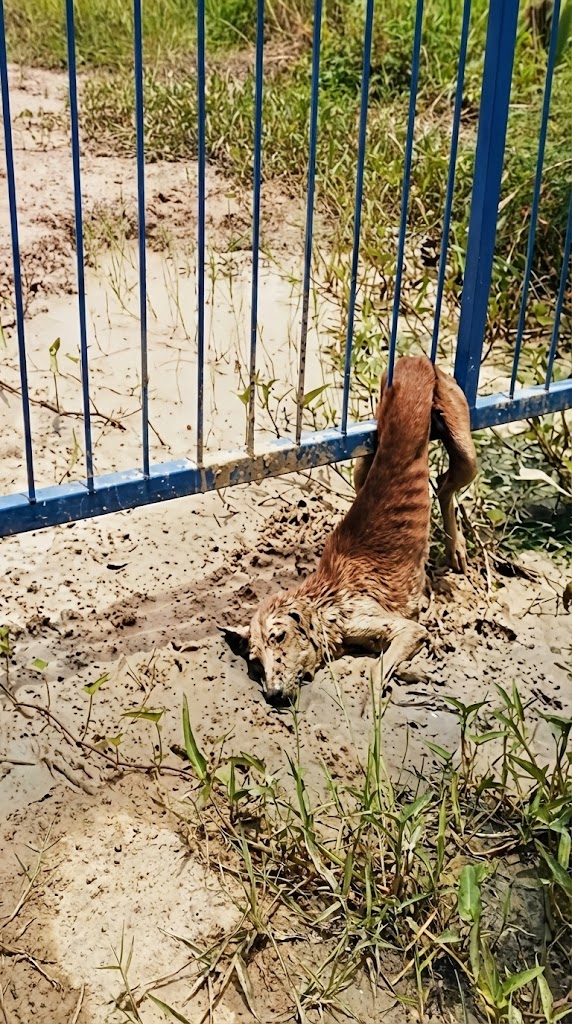
Her body was wedged tightly inside a narrow opening in a metal fence, ribs and abdomen pressed painfully between the bars.
Dust covered her coat.
Her frame was painfully thin.
And the scratches in the dirt around her paws showed that she had already spent whatever strength she had trying to escape.
The dog would later be named PaiPai.
Before that, she was simply a hungry stray who had apparently tried to squeeze through the fence while searching for food.
Now she could neither move forward nor pull herself back.
The sun continued beating down.
Her struggling became weaker.
Then it almost stopped completely.
People who found her feared they had arrived too late.
But they refused to leave her there.
Hunger Had Led Her Into a Trap She Couldn’t Escape
PaiPai had already been struggling before the fence ever became part of her story.
She was severely underweight.
Her ribs stood out beneath her skin, and her body appeared depleted from a prolonged lack of adequate nutrition.
For a stray dog living from one uncertain meal to the next, searching for food was part of survival.
That morning, PaiPai apparently noticed something beyond a metal barrier.
There was a narrow opening.
For a healthy dog, it might already have been difficult to pass through.
PaiPai tried anyway.
She pushed her head and shoulders forward.
Then more of her body.
But partway through, she became stuck.
The metal closed tightly around her ribs and abdomen.
Instinct told her to pull back.
It did not work.
She twisted.
Pushed.
Scraped her paws against the ground.
Each attempt consumed more of the little energy she had left without creating enough space to escape.
Eventually, exhaustion began winning.
The frantic movements became smaller.
Her cries softened.
And the dog who had entered the gap looking for food could do little more than remain trapped beneath the heat.
VIDEO: PaiPai Was Found Wedged Inside a Metal Fence — Too Weak to Free Herself
When Villagers Found Her, She Barely Responded
The sight was difficult to process.
PaiPai’s body was locked awkwardly between the bars.
Her bones were clearly visible beneath her thin skin.
Dirt covered her.
Her expression appeared distant, and she no longer had the energy for the frantic struggling that had left marks in the ground around her.
The villagers called for assistance.
According to the rescue account, they were initially told that PaiPai’s condition appeared so poor that there was little hope of saving her.
The people standing beside the fence were not willing to accept that as the end.
Whatever her prognosis might eventually be, PaiPai was still alive.
And while she remained alive, they could at least get her out of the metal trapping her body.
They approached cautiously.
A frightened animal in pain may panic when handled, and pulling her carelessly could cause further injury.
But PaiPai barely reacted.
She did not snap.
She did not try to flee.
She seemed to have almost no strength left for either.
So the villagers began working together.
One person supported her body.
Others carefully created enough space to ease her through.
Slowly, the pressure around her abdomen released.
Then PaiPai was finally free.
Getting Her Out of the Fence Was Only the Beginning
Once the metal no longer held her, PaiPai did not stand up and walk away.
Her body simply could not.
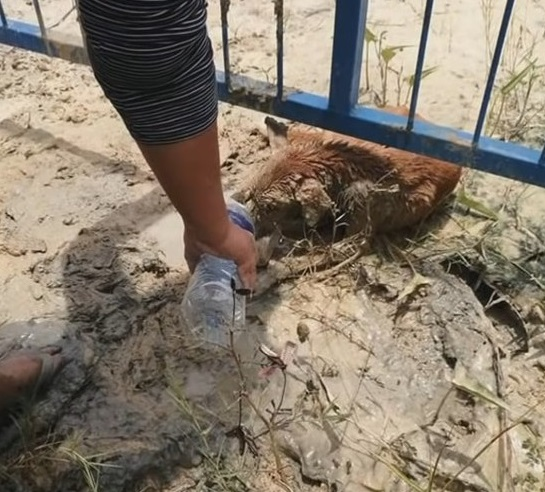
The villagers carried her into the shade.
For the first time since becoming trapped, she was no longer lying beneath direct sun with steel pressing against her body.
They gently cleaned some of the dirt away.
Water was offered.
Then food.
PaiPai turned her head aside.
That reaction concerned everyone.
A starving dog refusing food can be a sign that the body is struggling with far more than ordinary hunger.
She was profoundly weak.
Even lifting her required care.
The villagers had accomplished the immediate rescue, but it was now obvious that PaiPai needed medical support they could not provide beside the road.
She was transported to a veterinary clinic.
There, the question changed.
It was no longer whether she could be freed from the fence.
It was whether her body could recover from everything that had happened before and during it.
The Clinic Revealed How Close Her Body Was to the Edge
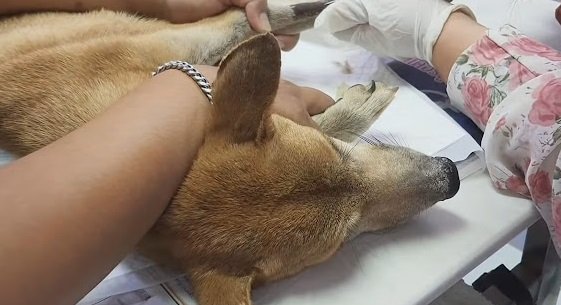
Veterinary evaluation confirmed that PaiPai’s condition was serious.
She was suffering from severe anemia.
Her body was also showing signs of organ distress.
Prolonged starvation had weakened her digestive system, and the trauma of becoming trapped had added even more stress to an already fragile body.
There was no single treatment that could instantly reverse all of that.
PaiPai needed stabilization first.
An IV line was started to replace fluids and support her depleted system.
Medication was introduced.
According to the rescue account, her treatment included antibiotics, iron supplementation, and other supportive care.
For the veterinary team, the goal was simple but urgent:
give PaiPai’s body enough support to keep functioning.
There were no guarantees.
She had been without adequate nutrition for too long.
Her blood values were poor.
Her organs had been placed under enormous strain.
The fence had been dramatic.
The starvation was the deeper battle.
At First, Recovery Was Almost Too Small to See
PaiPai remained quiet during the early stage of treatment.
She did not suddenly become energetic after receiving fluids.
There was no dramatic transformation overnight.
Her body had too much rebuilding to do.
So caregivers watched for small changes.
Her breathing became more regular.
Her eyes started following movement in the room.
When someone approached, she appeared slightly more aware.
Those details mattered.
Earlier, PaiPai had seemed almost disconnected from what was happening around her.
Now she was beginning to notice.
The people caring for her kept their interactions calm.
No one demanded affection.
No one expected her to stand before her body was ready.
She needed fluids.
Medication.
Nutrition when she could tolerate it.
Warmth.
Rest.
And time.
Somewhere during those fragile early days, she received a name.
PaiPai.
Until then, she had been an anonymous stray caught between pieces of metal.
Now people knew who they were checking on.
Who they were feeding.
Who they hoped would still be there the following morning.
Safety Gave Her Body Something the Street Never Could
PaiPai’s recovery could not be rushed.
Severe malnutrition develops over time, and rebuilding a depleted body must also happen gradually.
Her caregivers continued supportive treatment while watching how she responded.
Each day she remained stable was meaningful.
Each small improvement created the possibility of another.
The difference in PaiPai’s environment was enormous.
There was no need to wander in search of food.
No burning sun overhead.
No fence to squeeze through because hunger made the risk seem worthwhile.
Water was available.
Medical treatment was available.
And people were watching closely enough to notice if her condition changed.
That consistency did not erase what her body had endured.
But it finally gave her something survival on the street had never guaranteed:
the opportunity to use her energy for healing instead of searching for the next meal.
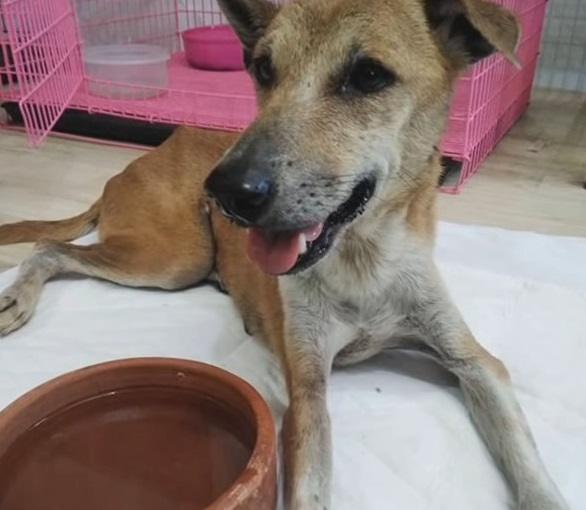
Gradually, the almost-empty gaze seen at the fence began changing.
PaiPai became more alert.
More responsive.
Still fragile.
Still recovering.
But present.
The People Who Found Her Changed the Part of the Story They Could
No one could undo PaiPai’s time as a severely undernourished stray.
They could not prevent the moment she tried to squeeze through the fence.
They could not give back the strength she had spent struggling beneath the sun.
What they could change was what happened once she was found.
The villagers could have looked at her condition and concluded that someone else needed to decide what to do.
Instead, they stayed.
They freed her.
Moved her into shade.
Offered water.
Then made sure she reached veterinary care when it became clear that simple food and rest would not be enough.
That sequence mattered.
PaiPai’s story was not transformed through one dramatic act.
One decision created the next possibility.
Getting her out of the fence allowed her to reach the shade.
Transporting her allowed veterinarians to start fluids.
Medical stabilization gave her body time.
And time gave those first subtle signs of recovery a chance to appear.
PaiPai’s Story Did Not End Between Those Metal Bars
The strongest image from PaiPai’s rescue may always be the dog trapped inside the fence.
A skeletal body pressed between metal.
Paws scraping at dry ground.
Movement slowly fading.
It looked like a place where her story could have ended without most people ever knowing she had been there.
Instead, someone noticed.
Then several people decided that “too late” was not something they were willing to assume while she was still breathing.
PaiPai’s future was not guaranteed when she reached the clinic.
The source account does not provide a completed adoption story or a dramatic final transformation.
Her recovery was still unfolding.
But that uncertainty does not make the rescue less meaningful.
Sometimes a second chance begins long before anyone knows whether there will be a perfect ending.
It begins when a frightened animal is lifted out of danger.
When fluids begin running through an IV line.
When a pair of exhausted eyes finally starts following the people in the room.
PaiPai had spent much of her life trying to survive without anyone responsible for her.
Then, on the day her strength was almost gone, people became responsible anyway.
She could not free herself from the fence.
She could not ask for medical care.
She could not promise anyone that their effort would succeed.
All she could do was remain alive long enough for someone to choose her.
They did.
And for PaiPai, that choice became the beginning of whatever comes next.


