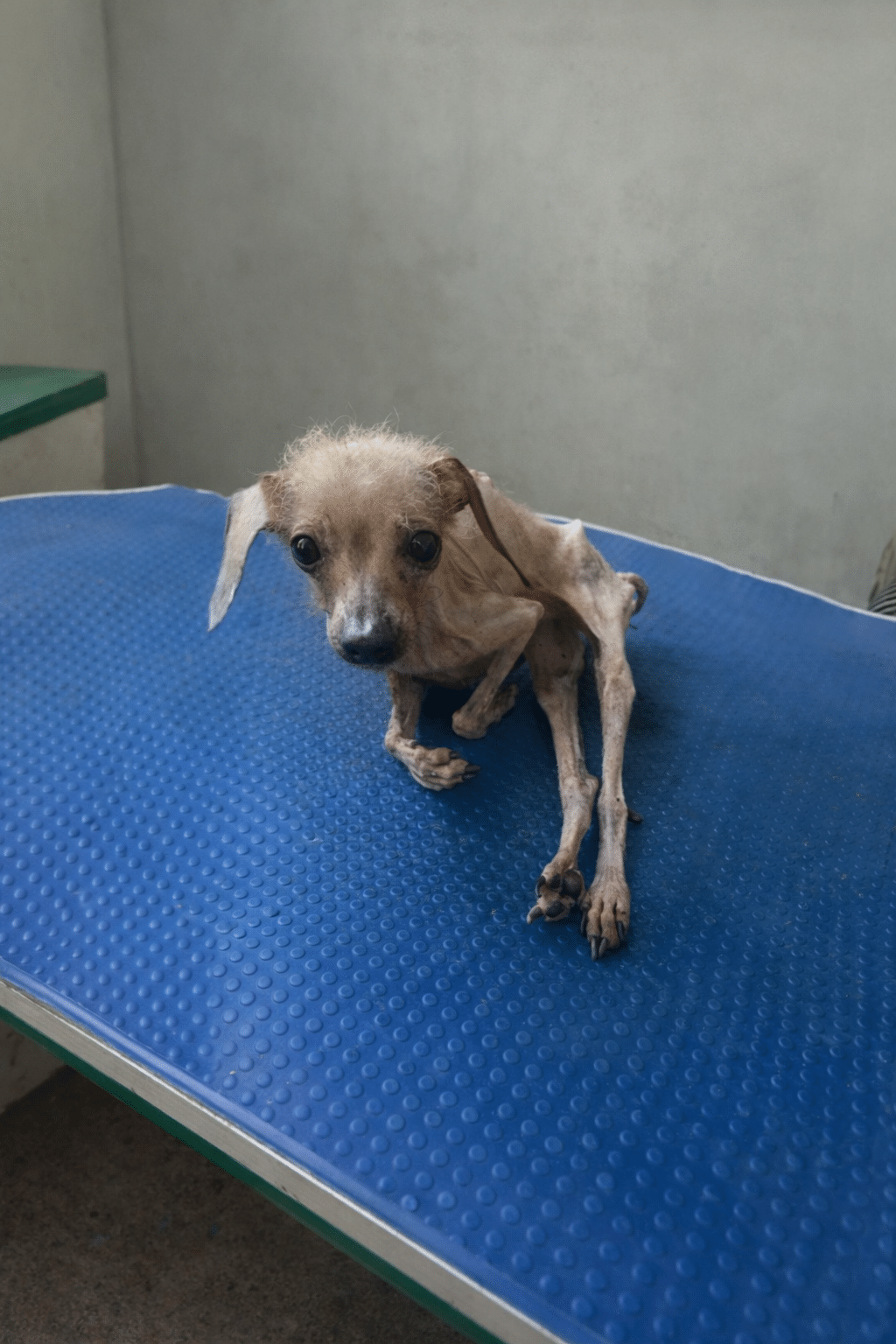
Tootsie was so small that rescuers could lift her without effort.
Just 2.5 kilograms.
Yet almost everything about her condition suggested that survival had required enormous effort.
She had been removed from a truck transporting animals toward slaughter, but reaching safety did not mean the danger was over.
Her body was painfully thin. Inflamed skin showed through a sparse, unhealthy coat. Both ears were badly infected, and exhaustion seemed to follow every movement she attempted.
Most concerning were her back legs.
They remained stiff beneath her.
Tootsie could not simply stand up and walk away from what had happened to her.
She could barely support herself at all.
At first, even eating required help.
The rescuers had succeeded in getting her off the truck.
Now came the far more difficult question:
Could this tiny dog learn how to live again?
At 2.5 Kilograms, Her Body Was Fighting More Than Hunger
Once Tootsie reached veterinary care, the team began trying to understand why she was so weak.
Her weight alone was alarming.
She had almost no physical reserve, and her irritated skin and infected ears showed that several problems had been developing at the same time.
Then testing revealed something even more serious.
Tootsie had distemper.
For an already weakened dog, the viral infection added another major challenge to an immune system that was struggling to cope.
But it still did not completely explain what rescuers were seeing in her legs.
X-rays provided another part of the answer.
There were degenerative changes in Tootsie’s spine, including bone spurs. These changes were associated with significant stiffness and discomfort, and her hind legs were too weak and rigid to support her body normally.
Standing was not simply a matter of encouraging her to try harder.
Her body was physically struggling to perform the movement.
At night, caregivers sometimes heard her crying softly when her discomfort became worse.
They could not undo everything at once.
So they concentrated on what could be done immediately.
Medication.
Clean surroundings.
Careful handling.
Rest.
And a person nearby when the night became difficult.
For Tootsie, recovery would have to begin at the smallest possible level.
Video: Tootsie’s First Attempts to Stand After Being Rescued From the Truck
Before She Could Walk, She Had to Learn How to Eat Again
There are things most healthy dogs do without anyone noticing.
Walking toward a bowl.
Lowering their head.
Eating.
For Tootsie, even that simple routine was initially beyond her strength.
Her body needed nutrition badly, yet she was not ready to eat normally.
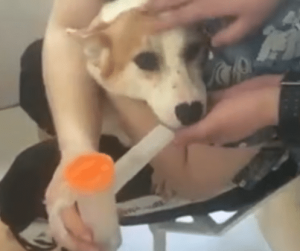
Caregivers began feeding her from a bottle.
It was slow work.
Small amounts had to be offered carefully while her medical treatment continued. No one expected her weakened body to recover simply because food was suddenly available.
At the same time, attention turned toward her skin.
Her damaged coat was shaved so caregivers could properly clean and treat the irritated areas beneath it. Medication was used to address the infections affecting her body, and her painful ears were cleaned carefully.
Every procedure had to take her condition into account.
Tootsie was not a dog with one isolated injury.
She was a tiny patient dealing with multiple problems at once.
That meant progress could not be measured only by whether she was walking.
Sometimes progress meant sleeping more comfortably.
Sometimes it meant tolerating treatment.
Sometimes it meant accepting another small feeding.
Then, after several days, something changed.
A bowl was placed in front of her.
Tootsie lowered her head.
And she ate by herself.
No bottle.
No one feeding her mouthful by mouthful.
She simply ate.
It was an ordinary act performed by millions of dogs every day.
In Tootsie’s recovery, it was a milestone.
Her body was beginning to participate in its own healing.
Her Legs Would Not Cooperate — So They Started With Support
Eating independently was encouraging.
Walking remained far more complicated.
Tootsie’s back legs were still stiff and weak, and the damage affecting her spine meant that movement had to be approached carefully.
The rescue team introduced therapies intended to support her body rather than force it beyond its limits.
Acupuncture became part of her care.
Support equipment was also used to help lift her body so that some of her weight could be taken off the weakened legs.
With assistance, her paws could be placed properly.
Her legs could be guided through movement.
Her muscles could begin practicing something they had struggled to do for a long time.
There was nothing dramatic about the exercises.
Tootsie did not suddenly rise and sprint across the room.
She shook.
She hesitated.
At times, her legs barely seemed to understand what was being asked of them.
The people supporting her remained close.
They helped hold her body upright.
Then they encouraged movement.
A little weight on one leg.
A small adjustment.
Another attempt.
Rest.
Then try again.
For a dog whose body had become accustomed to weakness and stiffness, standing required both strength and coordination.
Neither could be rebuilt in a single session.
So they repeated the process.
Again and again.
Not demanding a miracle.
Only giving Tootsie another opportunity to try.
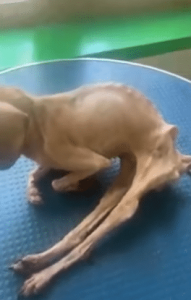
The First Steps Were Small Enough to Miss
Eventually, Tootsie pushed herself upward with support.
Her legs trembled beneath her.
Her stance was uncertain.
For a moment, it seemed as though gravity might win immediately.
But she remained upright.
Then came movement.
Not much.
A shaky shift forward.
Then another.
Every step looked awkward because her body was still learning how to distribute weight again.
Yet each movement mattered.
Days earlier, she had needed help simply to eat.
Now she was trying to move her own body across the floor.
Her progress came in fragments.
There were better days.
There were harder days.
Sometimes the stiffness seemed to dominate again.
But Tootsie continued participating whenever her caregivers helped her practice.
No one could promise that her gait would become perfect.
That was not the goal.
The goal was to help her become stronger, more comfortable, and more independent than she had been before.
That made every attempt meaningful.
One step did not erase the degenerative changes in her spine.
But one step proved she could move.
Another step proved she could try again.
Slowly, the dog who had arrived unable to support herself was beginning to discover what her body could still do.
Safety Gave Her Something Treatment Alone Could Not Provide
Medical care addressed Tootsie’s infections, pain, skin problems, and mobility.
But healing was also shaped by her surroundings.
For perhaps the first time in a long while, she no longer had to wonder what would happen next.
Meals came regularly.
Her bedding stayed clean.
Hands approached her to help rather than hurt.
Medication arrived on schedule.
If she struggled to stand, someone supported her.
If she became tired, she was allowed to rest.
That consistency mattered.
After completing the necessary treatment and isolation period, Tootsie was moved into a shared rescue environment.
There she was no longer the only dog in the room.
Other rescued animals moved around her.
Some were stronger.
Some were still recovering.
Tootsie could observe them while continuing her own rehabilitation.
The change gave her something that cannot be measured on an X-ray.
A more normal environment.
There were sounds of other dogs nearby.
Movement.
Companionship.
A daily routine that was no longer centered entirely around illness.
She was still receiving care.
Her legs still required attention.
Her health still mattered.
But Tootsie was beginning to experience life as more than a patient.
She was simply becoming a dog again.
The Dog Beneath the Illness Slowly Began to Appear
As treatment continued, the visual change became easier to see.
Her skin had been given time to heal.
Her body received consistent nutrition.
The extreme frailty that had defined her first days gradually became less overwhelming.
But some of the most meaningful changes were found in her behavior.
Tootsie was participating.
She ate.
She tried to stand.
She attempted steps when supported.
She responded to the people caring for her.
These developments were not dramatic enough to fit neatly into a single “before and after” moment.
Her recovery was built from repetition.
Another meal finished.
Another treatment completed.
Another carefully supported standing exercise.
Another night in a safe place.
For animals recovering from severe neglect and illness, that kind of repetition can become the foundation of everything that follows.
Tootsie did not wake one morning completely transformed.
She accumulated strength.
Little by little.
The same body that had been too weak to manage a bowl of food eventually helped carry her forward.
Not quickly.
Not perfectly.
But forward.
And perhaps that was the most important difference between the Tootsie rescued from the truck and the dog she was becoming.
In the beginning, nearly everything had to be done for her.
Eventually, she began doing things for herself.
Her Recovery Was Never About Becoming Perfect
It would be easy to tell Tootsie’s story as though rescue erased every problem.
It did not.
The changes in her spine were real.
Her legs required continued care.
The effects of everything her small body had experienced could not simply be removed by kindness.
But rescue changed something equally important.
It gave her options.
Before, weakness controlled almost every part of her life.
She could not eat normally.
She could not support her own weight.
She lived with untreated infections and discomfort.
Once she entered care, each problem could finally be addressed rather than ignored.
Her ears could be cleaned.
Her skin could be treated.
Her nutrition could be rebuilt.
Her pain could be managed.
Her legs could be supported through rehabilitation.
And she could recover without having to fight for survival at the same time.
That difference allowed Tootsie to begin rebuilding a life from almost nothing.
A dog does not understand medical charts or rehabilitation plans.
Tootsie did not know why someone was holding her body upright or why another treatment was being given.
She only experienced the result.
Less discomfort.
More strength.
Food that arrived every day.
People who returned.
A safe place to sleep.
And eventually, legs that could begin carrying her again.
From the Truck to a Life Where She Could Finally Keep Trying
The image of Tootsie at the beginning is difficult to forget.
A 2.5-kilogram dog.
Extremely thin.
Skin inflamed.
Ears infected.
Her body fighting distemper while degenerative spinal problems left her hind legs stiff and weak.
She had been removed from a truck carrying animals toward slaughter, but she was still far from safe medically.
Everything had to begin almost from the start.
First, help her eat.
Then treat the infections.
Manage the discomfort.
Support her body.
Encourage the legs.
Wait.
Try again.
And celebrate progress that might look insignificant to anyone who had not seen where she began.
A bowl emptied without assistance.
A body held upright.
A trembling paw moving forward.
One step.
Then another.
Tootsie’s story was never a story about suddenly becoming strong.
It was about being given enough time and care to discover whatever strength was still there.
She did not need to run for her rescue to matter.
She did not need a perfect recovery.
She only needed the opportunity to live without being discarded.
When rescuers first saw her, almost everything about Tootsie’s body seemed to be failing at once.
Yet beneath all of those medical problems was still a dog capable of responding to care.
That dog ate from a bowl again.
She stood with help.
She moved forward on legs that had once been unable to support her.
And slowly, the tiny animal who had arrived weighing just 2.5 kilograms began building a life measured not by how quickly she recovered, but by something much simpler.
The fact that she was finally allowed to keep trying.


