At 10:27 that night, the street outside the closed store was almost empty.
Security footage showed a woman approaching the entrance with a worn cardboard box in her hands. She placed it near the door, paused briefly, and then walked away into the darkness.
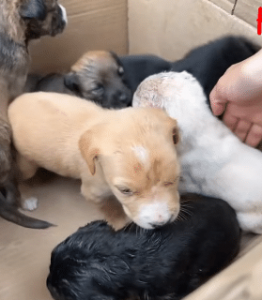
Inside the box were six young puppies.
They had no blankets thick enough to protect them.
No mother nearby to keep them warm.
No way to leave the box or search for help.
For the rest of the night, traffic continued passing the storefront. Headlights moved across the pavement, and occasional pedestrians walked nearby without realizing what had been left in the shadows.
The puppies remained outside until employees arrived at approximately 8 a.m.
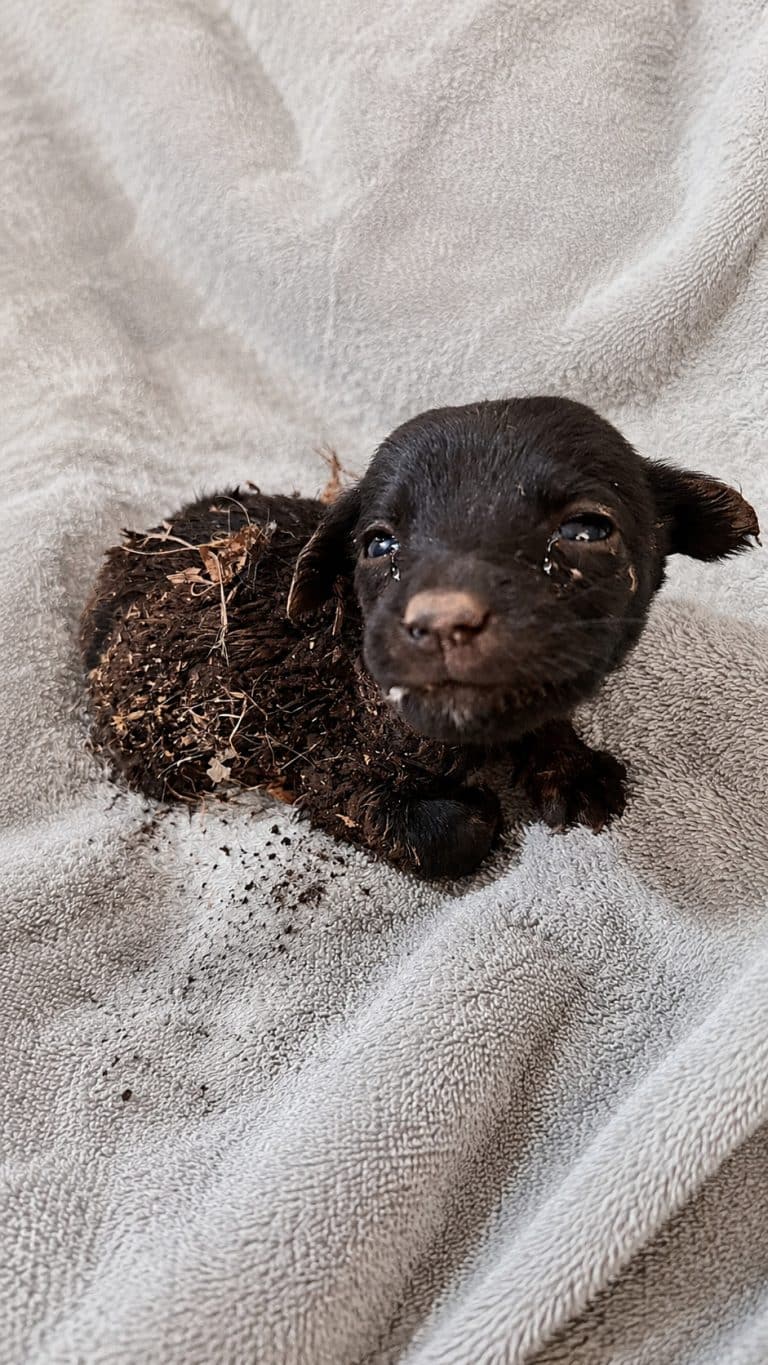
When the box was finally opened, several of the tiny dogs were barely moving.
The Box Looked Like Ordinary Trash in the Darkness
The security recording captured the moment clearly enough to establish when the puppies were left outside.
The store had already closed.
The entrance was dark.
And the cardboard box blended easily into the other objects near the building.
Anyone passing at a distance could have assumed it contained discarded merchandise or trash.
Inside, however, six vulnerable animals were spending the night exposed to the cold.
They appeared to be only a few weeks old—young enough to depend heavily on warmth, frequent feeding, and supervision.
At that stage, puppies cannot protect themselves effectively from low temperatures. Their small bodies lose heat quickly, especially when they are hungry, frightened, or lying against cold surfaces.
They also had no way to understand why they had been left there.
The box offered limited space.
If one puppy moved, the others were forced to adjust around it. Pressing together may have helped them conserve some warmth, but it could not replace proper bedding or the body heat of their mother.
As the hours passed, the air became colder.
The concrete beneath the box remained hard and unforgiving.
The puppies could cry, but their voices were too faint to carry far across the empty street.
Cars passed.
Lights appeared and disappeared.
No one opened the box.
By morning, their condition had worsened significantly.
Some puppies were still moving weakly when employees arrived.
Others remained nearly motionless.
The discovery quickly changed an ordinary opening shift into an emergency.
Video: Security Camera Captures Six Puppies Being Left Outside a Closed Store at 10:27 P.M.
Morning Revealed How Much the Night Had Taken From Them
When employees looked inside, they immediately understood that the puppies needed professional help.
Their bodies appeared cold and depleted.
Several struggled to raise their heads.
They did not behave like energetic puppies ready to explore their surroundings. Their movements were slow, and the group seemed too weak to respond normally to the people gathering around them.
One puppy had a visible injury on the head.
The cause could not be confirmed from the footage alone.
It may have happened before the box was left outside, during the night, or while the puppies moved against one another inside the confined space.
Another puppy also showed concerning signs that required further evaluation.
The injuries added urgency to a situation already made dangerous by prolonged cold and lack of food.
The employees did not attempt to solve everything at the storefront.
They moved the puppies away from the concrete and contacted people capable of providing emergency care.
Each puppy had to be lifted carefully.
A weak animal can become distressed by rough handling, and injuries may be more serious than they first appear.
Warm blankets were brought in.
The small bodies were supported during transport.
For the first time since the box had been left outside, the puppies were entering a warm environment.
But removing them from the cold did not mean they were immediately safe.
Hours of exposure can affect circulation, hydration, blood sugar, breathing, and the ability to regulate body temperature.
The injured puppies also needed imaging and neurological assessment.
The rescue team could only hope they had been found before the damage became irreversible.
Emergency Care Began With Warmth and Careful Examinations
At the veterinary clinic, the puppies were evaluated one at a time.
The medical team checked their temperatures, hydration, breathing, and responsiveness. They looked for wounds hidden beneath the fur and examined each puppy for signs of infection or trauma.
The warming process had to be handled carefully.
Placing a severely chilled animal against intense heat can create additional problems. Instead, the puppies were wrapped in dry material and warmed gradually while their vital signs were monitored.
Appropriate fluids and nutrition were introduced based on their age and condition.
The goal was not to fill their stomachs as quickly as possible.
Weak puppies may need small, controlled amounts to reduce the risk of choking, digestive stress, or other complications.
The puppy with the head wound received particular attention.
The visible injury looked alarming, and the rescue team feared it might involve damage beneath the surface.
Veterinarians examined the puppy closely and performed the tests needed to assess the skull and brain.
Then came encouraging news.
Despite the seriousness of the wound, the examination reportedly found no evidence of brain damage.
The puppy was not completely out of danger.
The injury still required cleaning, treatment, and careful observation.
But the result gave the team reason to believe recovery was possible.
The other puppies also remained under close watch.
Their temperatures had to stabilize.
They needed to begin eating reliably.
The staff monitored whether each puppy could lift its head, swallow, respond to touch, and rest comfortably.
During those first hours, the changes were small.
One puppy became more alert.
Another accepted food.
A third shifted closer to the warmth instead of remaining completely still.
To someone watching briefly, these actions might not seem remarkable.
For the rescuers, they were signs that the puppies’ bodies were beginning to respond.
Recovery Happened Through Many Small Acts
The puppies did not transform overnight.
Their bodies needed time to recover from the cold, hunger, and stress of being left outside.
The rescue team developed a routine around their needs.
Meals were offered at regular intervals.
Bedding was kept warm and clean.
The injured areas were treated.
Each puppy was monitored to make sure the stronger ones were not preventing weaker siblings from reaching food or comfortable resting places.
At first, much of their time was spent sleeping.
Rest allowed their bodies to conserve energy while recovering.
Caregivers watched them closely, noticing details that could indicate improvement or decline.
Was a puppy breathing normally?
Did it wake for food?
Could it remain warm between feedings?
Was the head injury healing without swelling or infection?
Did the smallest puppy continue gaining strength?
Progress was measured through these practical questions.
Then the puppies began showing more awareness of the room around them.
Their eyes followed movement.
They raised their heads when people approached.
Some began crawling away from the bedding before tiring and returning to the group.
As their strength increased, they started interacting with one another.
A paw reached toward a sibling.
One puppy attempted to climb over another.
A brief, unsteady game began before both fell asleep again.
These moments marked an important shift.
During the first morning, their energy had been devoted almost entirely to staying alive.
Now their bodies had enough strength for curiosity.
That did not mean every medical concern had disappeared.
The puppies still required treatment, nutrition, and observation.
But they were beginning to behave more like young dogs and less like six silent bodies inside a discarded box.
The Quiet Puppies Began Filling the Room With Movement
Over the following days, the change became easier to see.
The puppies’ posture improved.
Their eyes appeared brighter.
They became more interested in voices, food, blankets, and each other.
Walking remained clumsy at first.
Tiny paws slipped across the floor.
One puppy would take several steps before tumbling gently into a sibling.
Another would investigate the edge of a blanket, pull at it for a moment, and then fall asleep on top of it.
The rescue space gradually became noisier.
The puppies began making themselves heard when food arrived.
They wrestled with one another.
They explored every safe object placed nearby.
The same six animals who had been nearly motionless inside the cardboard box were now creating the ordinary disorder of a growing litter.
For the caregivers, that energy was deeply encouraging.
It showed that warmth and nutrition were reaching more than their bodies.
The puppies were beginning to feel secure enough to engage with their surroundings.
They no longer spent every moment pressed together against the cold.
They had room to move.
They had clean bedding.
They had people who noticed when one of them needed help.
Their individual personalities also started becoming visible.
One puppy might approach a caregiver first.
Another remained cautious but watched from nearby.
Some preferred playing with their siblings, while others quickly discovered the comfort of being held.
These differences had always existed.
The puppies simply needed enough strength and safety to reveal them.
The injured puppy continued healing as well.
The wound that had caused such fear on the first morning became part of a recovery being monitored rather than a hidden danger no one had noticed.
The transformation was not the result of one dramatic procedure.
It came from repeated care.
One meal.
One clean blanket.
One medication dose.
One examination.
Then the same things again the following day.
Their Rescue Was Only Complete When a Future Became Possible
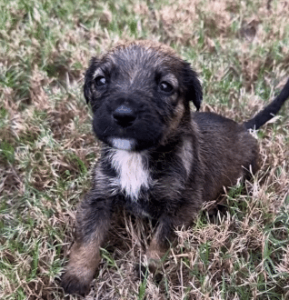
By the end of the visible recovery, the six puppies looked very different from the animals first discovered outside the store.
Their fur appeared cleaner.
Their bodies were stronger.
They moved with the curiosity and playful energy expected from young dogs.
Most importantly, they were no longer anonymous lives hidden inside a box.
They had become patients, individuals, and eventually candidates for responsible homes.
Before adoption, the puppies would still need age-appropriate veterinary care.
Vaccinations.
Parasite treatment.
Healthy nutrition.
Socialization.
And enough time to develop outside the emergency conditions in which they were found.
Potential families would also need to understand that adopting a puppy involves far more than responding emotionally to a rescue story.
Young dogs require training, patience, regular veterinary care, safe exercise, and a commitment that lasts long after they stop being small.
The rescue team had already carried the puppies through the most dangerous stage.
Responsible adopters would need to continue the work by giving them stable lives.
The footage does not need to claim that all six immediately found permanent homes.
What it shows is that they were finally healthy enough for a future to become possible.
That alone represented an extraordinary change.
One night earlier, they had been confined inside cardboard with no one aware they were there.
Now they were surrounded by people planning what came next.
Someone Opened the Box Before It Was Too Late
The most difficult part of the story is how easily the puppies could have remained unnoticed.
The box was small.
The street was dark.
The store was closed.
Their cries were not loud enough to reach everyone who passed nearby.
Had employees arrived later, the outcome might have been very different.
But they arrived.
They looked inside.
And instead of treating the box as someone else’s problem, they acted.
That decision connected every moment that followed.
The warm blankets.
The emergency transport.
The examination of the head wound.
The first successful meals.
The gradual return of movement.
The playful puppies climbing over one another days later.
None of it could have happened until someone opened the box and recognized that the lives inside still had a chance.
The security footage documented how the puppies came to be there.
Their recovery revealed what happened because other people refused to leave them there.
Someone carried them inside.
Someone stayed awake to monitor them.
Someone cleaned their injuries.
Someone made sure the smallest puppy received enough food.
Compassion was not a single emotional reaction.
It became a series of practical decisions repeated until six fragile animals were strong enough to play again.
The cardboard box could have remained the final place anyone saw them.
Instead, it became the beginning of their rescue.
Once, the puppies spent an entire cold night hidden beside a closed storefront, too young to understand why no one came.
By morning, they could barely lift their heads.
But the door eventually opened.
The box was noticed.
And six tiny lives that had been left in the darkness were finally carried toward warmth, treatment, and the possibility of homes where they would never be abandoned outside again.


