In the early months of 1942, with the United States still reeling from the attack on Pearl Harbor, a dental surgeon from Irwin, Pennsylvania submitted an unusual proposal to the White House. His idea did not involve a new aircraft, a faster torpedo, or an improved rifle. It involved bats — millions of them — each carrying a small timed incendiary device into the wooden and paper structures of Japanese cities.
The plan was not dismissed outright. It landed on the desk of military planners who forwarded it to the Army, which eventually directed it toward the National Defense Research Committee. Within months, federal funding followed. A coordinated research effort was underway, guided by the belief that nature could be recruited as a delivery mechanism for fire.
The experiment was Project X-Ray, better known today as the bat-bomb program. It remains one of the strangest documented weapons programs in American military history — not because it failed in theory, but because a field test accidentally proved the concept worked, by setting part of a U.S. military installation ablaze.
The Weapon Proposal Built Around Bats
The man behind the proposal was Dr. Lytle S. Adams, a surgeon who had recently visited Carlsbad Caverns in New Mexico and witnessed firsthand the massive colonies of Mexican free-tailed bats that roosted there. The bats — Tadarida brasiliensis — numbered in the millions at that single location. Adams reasoned that if each bat could carry a small incendiary capsule and be released over a target city, the animals would naturally seek confined, dark spaces in which to roost: the attics, wall cavities, and structural joints of buildings.
When the timed devices ignited, they would start fires in locations nearly impossible for firefighters to reach quickly. Unlike a conventional bomb, which concentrated destruction in a single blast radius, thousands of roosting bats would distribute small ignition points across an entire urban area.
President Franklin D. Roosevelt received the written proposal and reportedly found it worth pursuing. The program was transferred first to the Army Air Forces and then, as it developed, to the Marine Corps and the Naval Air Station at Fort Worth. The National Defense Research Committee provided scientific oversight. The choice of the Mexican free-tailed bat was deliberate — the species was abundant, migratory, capable of carrying more than its own body weight in cargo, and accustomed to living in tight clusters under cold-induced torpor, which made transport and handling more practical.
How the Timed Incendiaries Were Supposed to Work
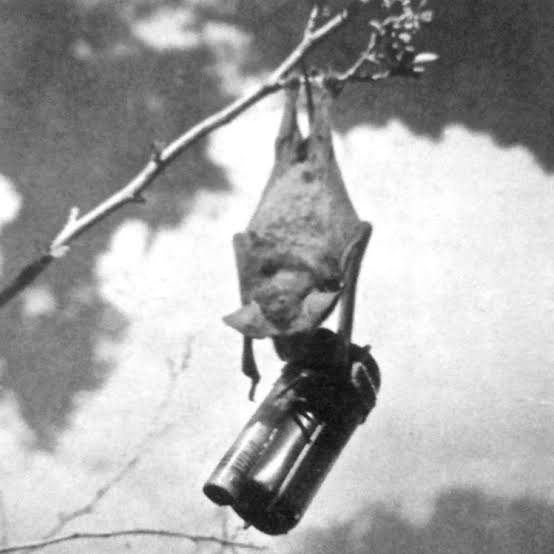
The incendiary unit developed for the program was a small cellulose capsule roughly the size of a finger, filled with napalm — a then-new incendiary gel that the military had begun deploying. Each capsule included a timed trigger mechanism designed to ignite after a set delay.
The operational concept called for bats to be placed into a state of hibernation by chilling them, then loaded by the thousands into specially designed cardboard canisters. The canisters would be dropped from high altitude over a target. As the canister descended and the temperature rose, the bats would revive, the canister would open, and the animals would disperse and seek shelter in structures below — carrying their small devices with them.
Each capsule was attached with a small surgical clip near the bat’s chest. The attachment was designed to be lightweight enough not to ground the animal but secure enough to remain in place through flight. In controlled conditions, the approach appeared workable. The devices were small, the bats were strong relative to their size, and the timing mechanism functioned reliably in laboratory settings.
The first live tests used bats without active incendiary loads to study release behavior and survival rates after cold storage. Then came the tests with functional devices.
YOUTUBE EMBED — PRIMARY SEARCH QUERY: “Project X-Ray bat bombs Carlsbad airfield documentary”
The Test That Escaped Control
In May 1943, a test was conducted at the Carlsbad Army Airfield Auxiliary Air Base in New Mexico — a location near the bat colonies that had originally inspired the program. The test involved live bats fitted with functional timed incendiary capsules.
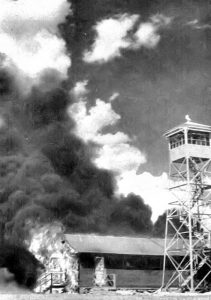
During the exercise, a number of bats escaped before the controlled release phase of the test. The animals, carrying their active devices, did what bats naturally do: they roosted. They found their way into the structures on the base itself — reportedly including a hangar and a general’s car, according to accounts documented in military historical records and later reported by the National Park Service and military historians.
When the timers reached zero, the incendiaries functioned exactly as designed. Fires broke out in the structures where the bats had roosted. The Carlsbad auxiliary airfield sustained documented fire damage as a direct result of the escaped test animals. No personnel were reported killed in the incident, but the property damage was real and the irony was not lost on anyone involved: the weapon had successfully demonstrated its concept — against the facility conducting the test.
YOUTUBE EMBED — SECONDARY SEARCH QUERY: “NPS bat bombs Carlsbad history”
Why the Accident Proved the Concept
The Carlsbad fire was an embarrassment to the program, but it was also, in a technical sense, a proof of concept. The bats had carried functional devices, revived from cold storage, sought enclosed spaces, and the incendiaries had ignited on schedule. The delivery mechanism had worked. The problem was not the weapon’s effectiveness — it was the difficulty of controlling where that effectiveness was applied.
Military assessors recognized that the program showed genuine destructive potential. Estimates compiled during the project suggested that a single properly executed raid, involving multiple release canisters, could seed fires across a wide urban area. The wooden construction common in many Japanese cities made the concept particularly applicable to that theater of the war.
Testing continued under Marine Corps oversight after the Army relinquished control. Additional trials were conducted at Dugway Proving Ground in Utah, where replica Japanese and German structures had been constructed for weapons testing. Reports from those trials indicated that the bat-borne incendiaries were capable of igniting the target structures, and that bats were indeed entering the buildings before the devices triggered.
By some assessments recorded in program documents, Project X-Ray showed enough promise that planners discussed a projected operational timeline. The weapon, however, never left the testing phase.
Why Project X-Ray Never Reached Combat
The program was ultimately canceled in 1944. Several compounding factors contributed to the decision.
The logistical challenges were significant. Sourcing, chilling, packaging, and transporting millions of bats from hibernation colonies to active combat zones required infrastructure that strained the program’s resources. The animals were fragile under extended cold storage, and mortality rates during transport reduced effective payload numbers considerably.
The timeline was also a critical factor. By mid-1943, the Manhattan Project had already progressed to the point where senior military leadership understood that an entirely different class of weapon was under development. Resources, attention, and urgency were redirected accordingly. The bat program, whatever its merits, could not compete with a program that promised to end the war in a single strike.
There were also practical control problems that the Carlsbad accident had illustrated in uncomfortable detail. A weapon that relied on living animals for its dispersion mechanism introduced variables that conventional ordnance did not. Bats could roost early, die in transit, revive at the wrong altitude, or — as had already been demonstrated — find their way into structures belonging to the people testing them.
The Marine Corps formally discontinued Project X-Ray before it reached an operational deployment stage. The program’s files passed into the historical record, where they remained largely classified for years before eventually being documented by military historians and the National Park Service, which has noted the program’s connection to Carlsbad Caverns and the bat colonies that first made it imaginable.
A Weapon That Proved Itself on Its Own Base
Project X-Ray occupies an unusual place in the history of American military research. It was not a fringe idea sketched on a napkin — it received federal funding, scientific oversight, live testing at multiple facilities, and serious assessments from military planners across three branches of service. Its central concept was sound enough that controlled tests at Dugway produced documented results.
What the program left behind was a documented record of a weapon that worked well enough to accidentally damage its own test installation, was technically credible enough to survive two years of government investment, and was ultimately set aside not because it was proven impossible, but because a different project made it unnecessary.
The bats of Carlsbad were never drafted. But for a period during World War II, the United States government considered them seriously enough to find out what happened when the test escaped the testers — and the answer came back in smoke from a burning airfield in New Mexico.

