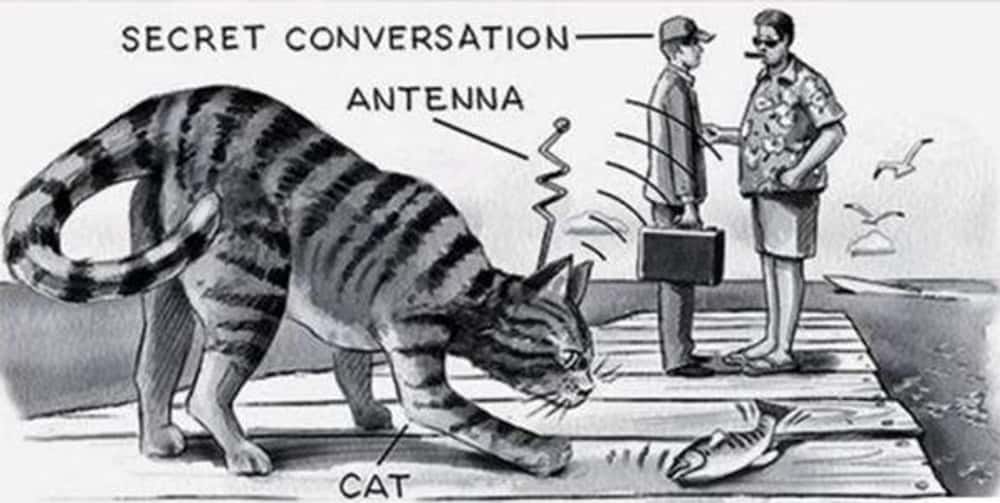
Imagine a park bench in a city where secrets change hands. Two men sit close together, speaking quietly, confident that no one nearby could follow the conversation. A cat crosses the path nearby—the kind of unremarkable, wandering animal that belongs to no one and draws no second glance. Now imagine that the cat is listening, or more precisely, that something inside the cat is listening.
That was the problem the CIA was trying to solve in the early 1960s. Not a dramatic, science-fiction problem. A practical intelligence problem: how do you place a microphone close enough to a conversation that is happening outdoors, in unpredictable conditions, without the people talking noticing that anything is wrong?
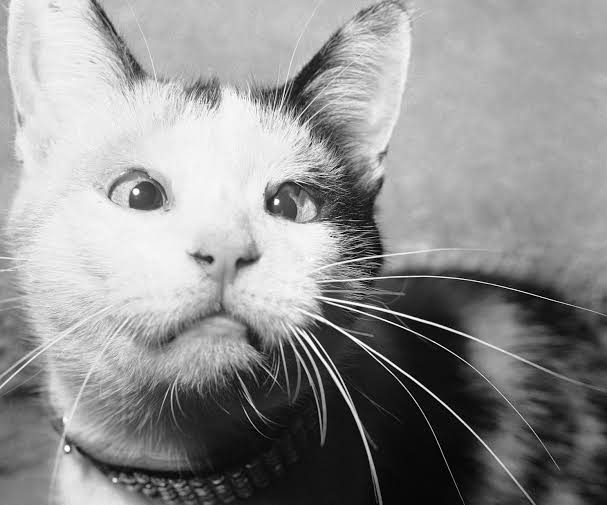
The answer, for a period inside the agency’s Directorate of Science and Technology, involved a cat. The project later became known as Acoustic Kitty—a name that sounds almost too strange to be real, but the record confirming its existence is genuine. A declassified CIA document, released under the Freedom of Information Act, establishes that the program took place and that it was formally judged to be operationally impractical.
What the Authentic Records Confirm
The central document in the Acoustic Kitty file is a CIA memorandum, declassified and released publicly, that dates to the late 1960s. The memo was authored within the agency’s technical operations division and addressed the question of whether the cat-based surveillance concept had any viable future as an intelligence collection tool. Its conclusion was direct: the technique was not considered practical for use in real foreign intelligence operations.
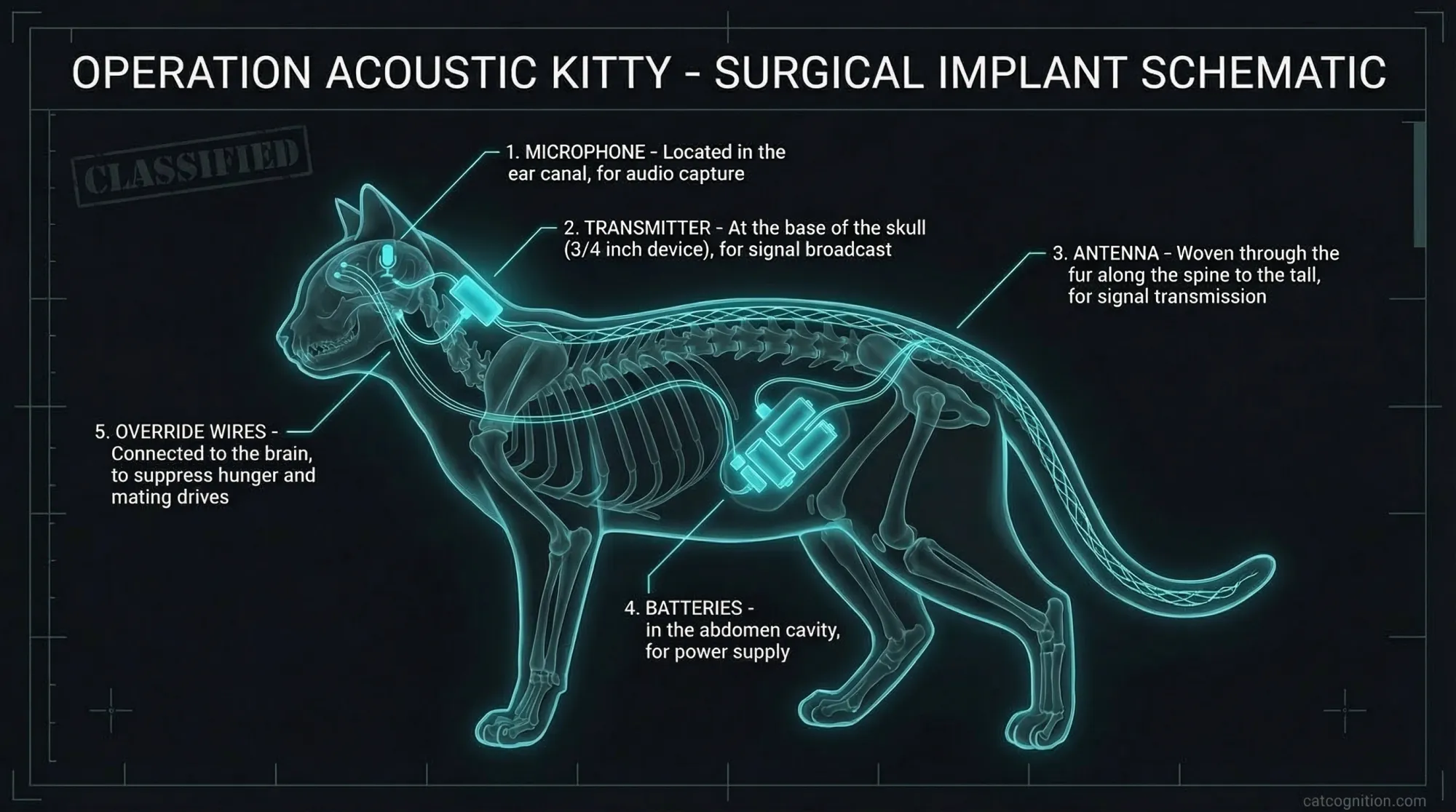
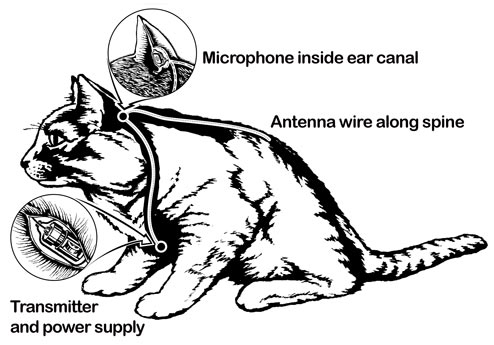
The document confirms several core facts. The CIA did pursue a program in which a cat was outfitted with listening equipment. The equipment involved a microphone implanted in the animal and a transmitter that could send audio to a nearby receiver. The goal was to deploy the cat in proximity to targets who would not suspect a stray or wandering animal of carrying surveillance technology. The program was housed within the Directorate of Science and Technology, the branch of the CIA responsible for developing technical collection methods during the Cold War.
The project name “Acoustic Kitty” appears in secondary and historical sources referencing this program, though the agency’s own documents may use different internal designations. The concept was not unique in Cold War imagination—animal-based surveillance and delivery systems were explored by multiple intelligence and military programs on both sides during the same era. What distinguished this effort was its specific engineering ambition: making the cat itself the listening instrument, rather than a carrier of a device placed separately.
The agency’s Science and Technology Directorate was active during a period of significant experimentation. Launched formally in 1962 under Director of Central Intelligence John McCone, the directorate pursued technical solutions that included satellite reconnaissance, remote sensing, and unconventional collection methods. The Acoustic Kitty effort fits within that broader pattern of experimental thinking—testing the edges of what technology and biology could accomplish together.
The closure memo did not describe the project as a failure of execution. It described it as a failure of operational concept. The problem was not that the engineering could not be done, but that the result could not be controlled well enough to be useful in the field. That is a meaningful distinction, and one the record makes clearly.
The surviving documentation, while limited in volume, is authentic. Researchers and journalists who filed FOIA requests received a small set of pages, enough to confirm the program’s existence, its general parameters and its official end. What those pages do not contain is a detailed operational log, a surgery report or an account of any specific field test. The file, as it has been released, is thin at its edges.
YOUTUBE EMBED 1 — PRIMARY SEARCH QUERY: “CIA Acoustic Kitty declassified document”
How the Program Began
The origins of Acoustic Kitty trace to a specific surveillance challenge that CIA technical officers faced in the early Cold War years. Foreign intelligence targets—Soviet officials, embassy personnel, visiting delegations—would sometimes hold sensitive conversations in outdoor settings, precisely because they knew that indoor locations could be bugged. A park, a garden, a square: open air felt safer. The problem for American intelligence was that placing a conventional listening device close enough to an outdoor conversation without detection was extremely difficult.
Surveillance equipment in the early 1960s required physical proximity and a stable placement. A microphone hidden in a park bench works only if your target chooses that bench. A microphone concealed in a lamppost works only if the conversation happens near enough to it. The CIA’s technical officers were looking for something mobile, unobtrusive and capable of getting close to a target without prompting suspicion.
The cat was proposed as a solution to the mobility problem. A cat moving through a park or courtyard draws no particular attention. Unlike a human operative, it does not need cover documentation, and its approach to a target does not require explanation. The core idea was to use the animal’s natural behavior—wandering, resting near humans, crossing open spaces—as a delivery mechanism for audio capture.
The technical challenge of embedding equipment in a living animal was serious. The microphone had to be small enough not to visibly alter the animal’s appearance or behavior. The transmitter had to function reliably while the animal moved. The battery had to be manageable. And all of this had to be accomplished without rendering the cat visibly injured or unwell, since an obviously distressed animal would defeat the purpose entirely.
By the accounts of former agency personnel who have spoken publicly about this period—including Robert Baer and others cited in historical journalism—the engineering phase was pursued seriously and with real resources. The surgery required to implant the equipment was performed. The cat was trained. The investment in reaching a working prototype was genuine. The program was not a thought experiment that stayed on paper. At some point in the mid-1960s, the concept moved from proposal to implementation.
What is harder to establish precisely from surviving documents is the exact timeline: when the idea was first formally proposed, how long the training phase lasted, how many animals were involved, and what the specific technical specifications of the equipment were. Secondary sources, including published memoirs and journalist reconstructions, have filled some of these gaps—but they have also introduced details that cannot always be traced to a primary document.
What Was Actually Carried Out
The implementation phase of Acoustic Kitty involved both surgical preparation and behavioral training. These two elements had to work together, and the tension between them was significant.
On the technical side, the task was to fit a microphone inside the cat in a way that captured usable audio. The most commonly cited account, from former CIA officer Victor Marchetti, who discussed the program in interviews after leaving the agency, describes a microphone wired through the animal’s body with an antenna running along its tail and a transmitter embedded in its chest. Marchetti spoke publicly about Acoustic Kitty in the 1970s, and his account has become the primary source for many of the engineering details that appear in later retellings.
Because Marchetti’s account is a former officer’s recollection rather than a surviving primary document, the specific details must be treated as documented report rather than verified fact. The general picture—a microphone, a transmitter, a working prototype—is consistent with what the closure memo implies when it refers to an operational concept being tested and evaluated. The fine-grained specifications remain outside the confirmed record.
On the behavioral side, the problem was more fundamental. Cats are not trained to do directed tasks in the way that dogs or other animals can be. A cat equipped with a microphone would need to approach and remain near a specific target conversation. But a cat follows its own sensory priorities: food, warmth, curiosity. It cannot be reliably directed toward a specific bench, table or pair of individuals in the way an operative can be briefed and positioned.
The training effort attempted to address this through conditioning—teaching the cat to move toward certain stimuli associated with target scenarios. How successful this conditioning was, and over what period it was tested, is not established in the released documents. What is established in the closure memo is that the training problem contributed significantly to the overall negative assessment. The animal could not be counted on to go where it needed to go, stay where it needed to stay, or ignore distractions—other animals, food sources, environmental noise—that would compromise a mission.
This is not a surprising conclusion to anyone familiar with animal behavior research. The use of animals in military and intelligence contexts has a long history, but the most successful cases involve animals with strong pack loyalty, food-drive motivation and a natural capacity for repeated task training. Cats, behaviorally and temperamentally, are poorly suited to those requirements. The CIA’s technical team may have recognized this early, or may have believed that conditioning could overcome it. The record suggests that by the time of the closure memo, the answer was clear: it could not.
What the Official Review Found
The 1967 closure memo is the strongest primary document available in this file. Its conclusion, based on internal review, was that the Acoustic Kitty concept was not practical for operational use against real foreign intelligence targets. The memo did not frame this as a technical failure in the narrow sense—the implication was that equipment had been developed and tested. The failure was operational: the system could not perform reliably enough under field conditions to justify continued investment.
Several factors contributed to that judgment. The training problem, as noted, was central: the cat’s behavior in an actual environment with competing stimuli was not sufficiently controllable. Beyond training, environmental factors created additional complications. Outdoor acoustic conditions are variable. Distances between a target conversation and a mobile animal change constantly. Interference from ambient noise—traffic, wind, other voices—degrades audio quality. A microphone in a stationary device can be positioned for optimal capture; a microphone in a moving animal cannot.
There was also the problem of security. If the cat were ever captured, intercepted or simply wandered into the wrong hands, the discovery of surveillance equipment embedded in an animal could create a significant diplomatic and intelligence embarrassment. The operational risks of exposure were real, and they compounded the reliability problem.
The memo’s language, as reported by those who have reviewed the released pages, was reported to include an assessment that the agency had “spent” considerable effort on the project and that the work was interesting as a technical exercise but did not meet the threshold required for field deployment. The agency moved on. There is no indication in the available record that Acoustic Kitty was revived or succeeded by a similar program.
Seen in its proper context, the closure memo is an ordinary bureaucratic document performing an ordinary bureaucratic function: evaluating a program that did not work and recommending its termination. What makes it extraordinary is the subject. The combination of Cold War urgency, intelligence agency resources and the specific choice of a house cat as a surveillance platform produces a document that, once declassified, reads as almost impossible—yet is clearly genuine.
YOUTUBE EMBED 2 — SECONDARY SEARCH QUERY: “CIA animals in espionage Acoustic Kitty”
The Missing, Destroyed or Redacted Records
The Acoustic Kitty file, as released to the public, is incomplete. This is not unusual for CIA programs of this era. Destruction of records, classification of portions and selective release under FOIA are all standard features of the agency’s document management during the Cold War period.
What is missing from the public record is significant. There are no detailed operational logs describing specific test dates, locations or results. There are no surgical reports specifying equipment dimensions, implantation methods or animal outcomes. There is no budget documentation that would allow confirmation of the program’s total cost—a number that has been repeated widely in later accounts, but without a primary source to anchor it.
The cost figure most commonly cited for Acoustic Kitty—often stated as approximately twenty million dollars—appears in secondary accounts and journalism, but has not been confirmed in a released primary document. That figure may reflect the broader Directorate of Science and Technology budget during the relevant period, or it may be an estimate or approximation that was repeated until it became treated as established. Without a budget document, it cannot be verified.
More significant is the absence of any field test record in the released material. The famous story—in which the cat was deployed for a real surveillance mission, crossed a street and was struck by a taxi—does not appear in the closure memo or in any other primary CIA document that has been publicly released. The taxi story comes from Marchetti’s later accounts and from journalists who built on his telling. It is not impossible that it is accurate. But it is not established by the surviving primary record, and the distinction matters for how the story should be categorized.
Some additional documents related to this period may still be classified, either in full or with redactions that prevent confirmation of specific operational details. The CIA’s historical declassification process has been selective, and programs that touch on technical methods are among the categories most likely to retain protections. Researchers who have worked with the released material have noted the gaps and have generally been careful to distinguish between what the documents confirm and what secondary accounts add.
Claims the Evidence Does Not Support
The Acoustic Kitty story has accumulated several layers of claim that the available evidence does not support, and that a careful reading of the file requires separating out.
The taxi story is the most prominent example. In the version that has become standard in popular retellings, the cat was deployed in a Washington, D.C. park or similar setting for its first real field test, walked into the street and was immediately killed by a passing cab—a darkly comic ending to an expensive and eccentric program. This version has appeared in books, documentaries and countless news articles, usually presented as established fact.
The problem is that the closure memo, which is the primary document available, does not describe this event. Marchetti, who introduced the story into public awareness, was not in a position with direct operational knowledge of every test result. It is possible that the taxi incident occurred and was reported internally in documents that have not been released. It is also possible that the story is an embellishment that captured the imagination of journalists and readers because it perfectly illustrated the project’s absurdity. The honest answer is that the primary record does not confirm it.
The cost figure, as noted, is similarly unanchored. Twenty million dollars is a number with a life of its own in this story, and it functions rhetorically to underscore the government’s wastefulness and the project’s outlandishness. It may be accurate. It may be an overstatement. Without a budget document, it cannot be confirmed.
Claims that Acoustic Kitty represented an entirely unique or unprecedented program are also worth qualifying. The CIA and other intelligence agencies explored biological and animal-based surveillance methods during this era more broadly. The Directorate of Science and Technology was not treating cats as its only unconventional avenue. Acoustic Kitty was one experiment among many, not an isolated act of institutional strangeness.
Finally, the conclusion that the project was a complete and unambiguous failure requires some nuance. The closure memo judged the technique impractical for real field use, which is accurate. But the engineering work itself—developing miniaturized implantable equipment capable of transmitting audio—was not without technical value. Whether any of the research fed into subsequent non-animal surveillance miniaturization efforts is not established, but dismissing the entire program as pure waste oversimplifies a more complicated institutional reality.
Why the Secret Became Larger Than the File
Acoustic Kitty entered public consciousness through a specific pathway: a former CIA officer who felt the story deserved to be told, journalists who recognized its extraordinary narrative appeal, and a reading public that found in it a near-perfect emblem of Cold War institutional hubris.
Victor Marchetti left the CIA in 1969 and became one of the agency’s most prominent internal critics. His 1974 book, co-authored with John Marks, was one of the first major insider accounts of CIA operations and was published only after a legal battle over classified content. Marchetti’s credibility as a source was real—he had worked at senior levels—but his accounts also carried the limitations of recalled memory and the framing of a man who had become critical of the institution he described. That combination of genuine insider knowledge and adversarial perspective is a common feature of the sources that first brought Acoustic Kitty into public view.
The story spread quickly because it had everything a compelling intelligence narrative needs: a real institutional context, genuine government resources deployed toward a bizarre goal, an implied failure and a darkly comic conclusion. The taxi ending, whether confirmed or not, was simply too perfectly absurd to be omitted. Once it entered the standard telling, it stuck.
The broader cultural moment reinforced the story’s staying power. The 1970s were a period of significant congressional scrutiny of CIA activities. The Church Committee hearings, which investigated intelligence agency abuses from 1975 to 1976, generated enormous public interest in what the CIA had actually been doing during the Cold War years. In that environment, a story about a surgically modified cat being deployed as a listening device fit naturally into a growing narrative of institutional overreach and technical excess.
Acoustic Kitty was not cited in the Church Committee findings—the hearings focused on far more serious abuses, including assassination plots and domestic surveillance programs. But the cultural moment the hearings created made audiences receptive to stories that seemed to confirm that the CIA had operated with minimal constraints and extraordinary license. A twenty-million-dollar cat was, in that context, entirely believable.
Subsequent decades added further layers. Documentary filmmakers, history writers and online content creators have returned to the story repeatedly, each retelling reinforcing the dramatic version over the cautious archival one. The closure memo, which is a dry institutional document summarizing a practical judgment, is a less appealing object than the image of a cat crossing a street into oncoming traffic. The story that survived is the one with a better ending, not necessarily the one with better documentation.
What the Documents Actually Prove
The Acoustic Kitty file, examined honestly, proves several things with confidence and leaves others genuinely open.
What is confirmed: The CIA’s Directorate of Science and Technology pursued a program in which a cat was outfitted with surveillance equipment, including a microphone and transmitter, during the 1960s. The goal was to use the animal as a mobile audio collection platform in outdoor settings where conventional surveillance was impractical. The program reached a stage beyond the drawing board—equipment was developed and the animal was prepared for use. A formal internal review, documented in a 1967 memo, concluded that the concept was not operationally practical for real foreign intelligence collection. The program was terminated.
What was reported but not confirmed by primary documents: The specific engineering details described by Victor Marchetti. The exact timeline and number of test phases. The taxi story and its dramatic framing as the program’s final moment. The exact cost figure attached to the program. Whether any field test was conducted in an actual foreign target environment or whether testing remained in controlled conditions.
What remains genuinely unknown: The content of any unreleased or still-classified records relating to the program. Whether additional tests were conducted. Whether any findings from the engineering work influenced later surveillance technology development. The full scope of similar programs within the Directorate of Science and Technology during the same period.
The closure memo’s practical judgment is, ultimately, what the file most clearly supports: the idea was innovative, the execution was serious, and the result was unusable. A cat cannot be reliably directed toward an intelligence target, cannot be controlled in a dynamic outdoor environment and cannot be trusted to behave in ways that a surveillance mission requires. The agency reached this conclusion and moved on.
What the memo could not anticipate was that the story would not move on with it. The gap between a dry feasibility judgment and a legendary tale of a CIA-equipped cat dying under a Washington taxi is exactly the kind of gap where a secret becomes larger than its file. The confirmed reality—a genuine program, seriously pursued, rationally abandoned—is already strange enough to demand attention. The embellished version simply made it irresistible. Both versions have now been part of the public record for decades, but only one of them can be called documented.
That distinction is what the file leaves behind, and it is, in its own quiet way, more interesting than the taxi.

