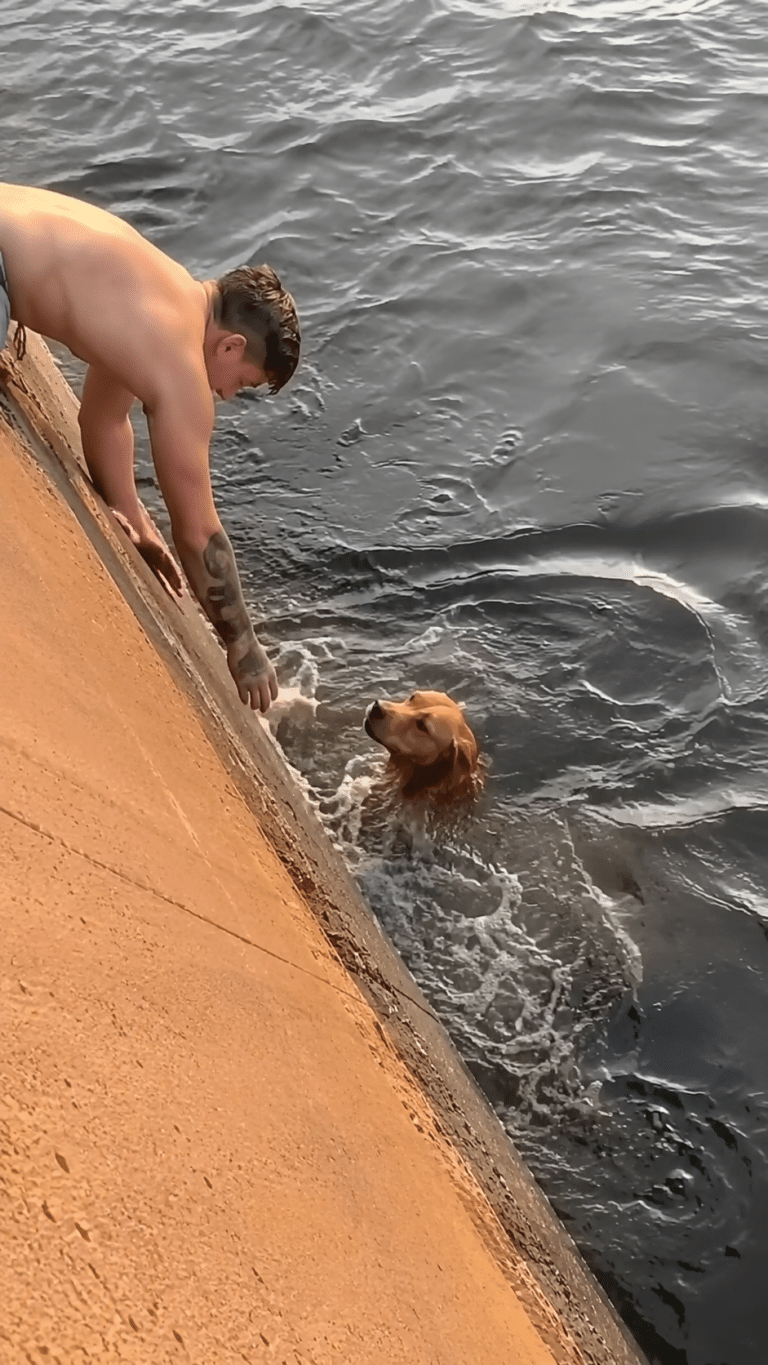
Each time the brown dog reached for the stone wall, the river pulled him back.
His paws scraped against the wet surface, searching for anything they could hold. For a moment, he would rise slightly above the water.
Then his footing would disappear.
His body would drop, the current would carry him away from the embankment, and he would have to begin struggling all over again.
From the top of the wall, a man saw what was happening.
He lowered himself onto the stone, reached toward the frightened animal, and decided he would not leave the riverbank without him.
The Dog Could See Safety but Could Not Reach It
The dog had become trapped beneath a tall stone embankment beside the river.
Dry ground was only a short distance above him, but the wall separating him from safety was steep, smooth, and wet. There were no steps he could climb and no ledges wide enough to support his weight.
Every attempt followed the same painful pattern.
The dog pushed his front paws against the stone.
He tried to lift his body.
The surface offered no grip.
Within seconds, he slipped back into the current.
The river continued moving around him, carrying his hindquarters away from the wall and forcing him to use more energy simply to keep his head above the surface.
At first, the dog was still actively fighting.
He paddled toward the embankment each time the water pulled him away. He stretched his paws toward the stone and tried again.
But the repeated effort was beginning to take a visible toll.
His movements became slower.
His body remained lower in the water.
And the distance between each attempt seemed to grow.
That was when the man rushed to the edge.
Video: Man Reaches From a Stone Embankment to Save a Dog Being Pulled Away by the River
The First Reach Was Not Enough
The man lay flat across the top of the embankment and extended his arms toward the dog.
Even from that position, the distance was difficult to close.
The stone wall was high, and leaning too far forward could place the rescuer in danger as well. He needed to keep enough of his body supported on the pavement while somehow reaching an animal being moved unpredictably by the water below.
The dog came close.
The man stretched farther.
For a moment, his fingers nearly reached the animal.
Then the current pulled the dog away again.
People nearby began gathering around the scene. Some called out suggestions while others watched from a short distance, aware that one wrong movement could send the man over the edge.
There was no rescue rope visible.
No harness.
No specialized equipment that could be lowered quickly.
The man had only his arms and the help of those standing behind him.
He adjusted his position and tried again.
Someone appeared to help secure his legs while he leaned farther across the wall. Below, the dog continued paddling toward the same point, as though beginning to understand that the outstretched hands represented his only clear path to safety.
Still, the river kept separating them.
The Current Gave Them Only Brief Chances
The rescue depended on timing.
When the current moved the dog close to the wall, the man had only a few seconds to reach him. If he hesitated, the water carried the animal beyond his grasp.
If he reached too quickly, he risked frightening the dog or failing to secure a safe hold.
The man waited for the current to bring the dog closer.
Then he leaned forward.
Once again, the distance was just slightly too great.
The dog’s paws touched the stone but could not remain there. He slipped and drifted backward, forcing everyone to wait for another opportunity.
The people along the embankment could do little except guide the man, hold him securely, and watch the exhausted animal continue struggling.
The dog was no longer climbing with the same strength he had shown earlier.
His paws still moved, but more slowly.
His body appeared to tremble whenever he reached the wall.
Keeping himself in position had become a battle of its own.
The man could see that time mattered.
He did not stand up or move away to search for an easier solution.
Instead, he lowered himself farther.
He reached again.
Then again.
Each failed attempt was followed by another.
One Final Reach Brought Him Close Enough
Eventually, the current moved the dog back toward the embankment.
This time, the man was ready.
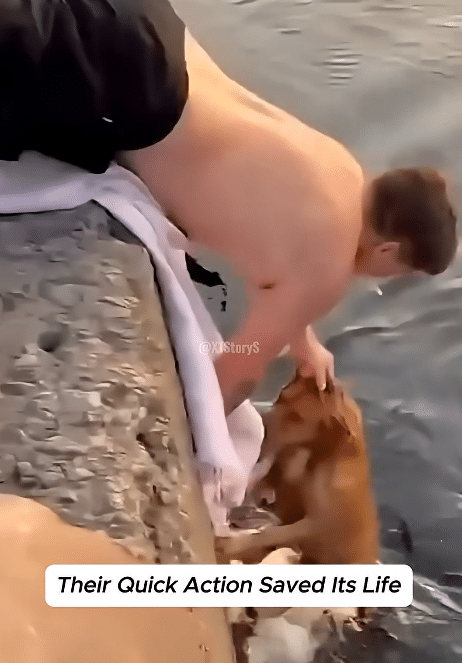
He extended his arm as far as he could and managed to place a hand firmly around the dog.
The animal was still partly supported by the water, and the rescuer’s position remained unstable. Simply touching the dog was not enough.
He needed to lift him up the vertical wall.
The man tightened his hold while the people behind him helped keep his body from sliding forward. Slowly, he began raising the dog.
For several seconds, the animal hung between the water and the top of the embankment.
His wet body was heavy.
The wall gave the man little room to reposition his grip.
Below them, the river continued flowing as though nothing had changed.
But the man did not release him.
He pulled upward, using his arms and the support of those around him to bring the dog closer to the edge.
First, the dog’s head rose above the wall.
Then his shoulders.
With one final effort, his entire body cleared the stone barrier.
The dog landed on dry ground.
Everyone Waited to See Him Breathe
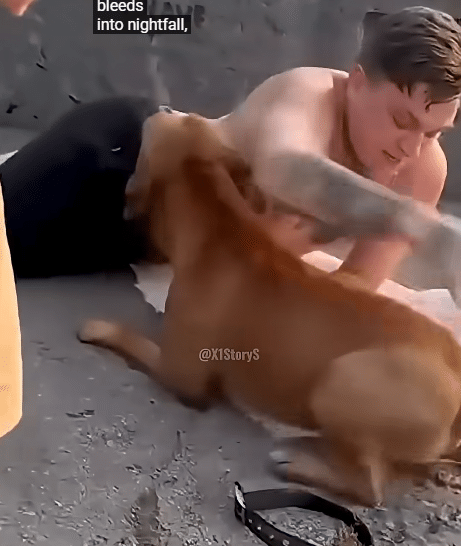
Once he was safely above the river, the dog immediately lowered himself to the pavement.
He did not run.
He did not jump toward the people gathered nearby.
He simply remained on the ground, soaked and exhausted after using nearly all of his strength against the current.
His body trembled.
Water dripped from his coat.
For a few quiet moments, the people around him seemed focused on one thing alone.
He was breathing.
The man who had pulled him from the river stayed close while others gathered around. Their movements became slower now that the immediate danger had passed.
Gentle hands reached toward the dog.
Voices that had been urgent moments earlier softened.
The animal remained tired and overwhelmed, but he no longer had to paddle, search for footing, or fight to keep his head above the water.
The river was now below him.
Solid ground was beneath his body.
And the person who had refused to leave him was still sitting nearby.
He Did Not Need to Know the Dog to Save Him
The man had no visible connection to the animal before the rescue began.
He did not know how the dog had entered the river.
He did not know whether someone was searching for him.
He could not know how the animal would respond when touched by a stranger.
None of those uncertainties changed his decision.
A life was in danger below the wall.
That was enough.
The rescue did not unfold perfectly. The man could not reach the dog on his first attempt, and the current repeatedly pulled the animal away.
Yet every time that happened, he prepared for another chance.
That persistence became the difference between a dog remaining trapped in the river and resting safely on the pavement.
Many meaningful acts of compassion look ordinary from the outside.
They are not always carried out by trained rescue workers.
They do not always involve elaborate equipment or carefully planned operations.
Sometimes they begin when one person notices what others have not yet seen.
They continue when that person refuses to step back after the first attempt fails.
And they succeed because several strangers come together—one reaching, others holding him securely, and everyone focused on getting one frightened animal safely over the wall.
The River Nearly Carried Him Away
The dog had tried everything his body could manage.
He paddled against the current.
He pressed his paws against the stone.
He climbed until the slippery wall sent him back into the water.
But eventually, his survival depended on something beyond his own strength.
It depended on someone above noticing that he could not keep fighting forever.
The man could not calm the river.
He could not make the embankment easier to climb.
He could only lie down at the edge, reach as far as possible, and keep trying until his hand finally found the dog.
That simple choice changed the ending.
Moments earlier, the animal had been slipping lower into the water with each attempt.
Now, he was surrounded by people on dry ground.
The scene resonated with so many viewers not because it was polished or carefully staged, but because it showed compassion in its most direct form.
A frightened dog was losing strength.
A stranger saw him.
And instead of assuming someone else would help, he stayed.
The river pulled the dog away more than once.
The man reached for him more than once.
In the end, persistence proved stronger than the current.
The dog could finally stop fighting—not because he had surrendered, but because someone else had taken hold and refused to let him go.


