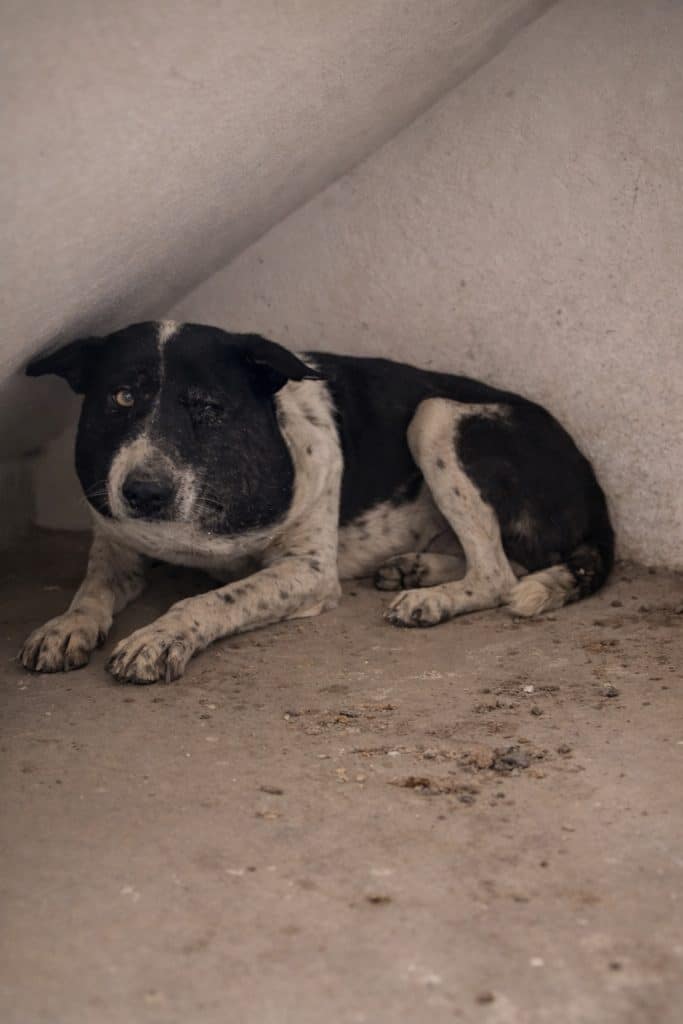
At first, he was easy to miss.
The stray dog had tucked himself beneath a dim stairwell, away from the movement of the street and the people passing nearby.
He was curled tightly against the ground.
Barely moving.
But once rescuers looked closer, there was no overlooking what he had been carrying.
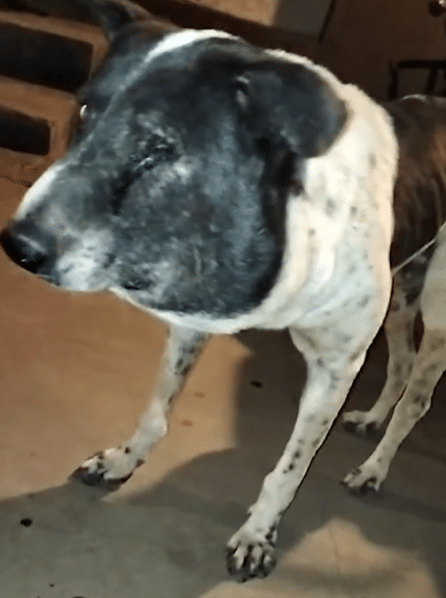
A large swelling had developed along his neck, changing the shape of his face and making his already exhausted condition even more concerning.
His breathing appeared labored.
His body looked weak.
And instead of searching for food or approaching people, he had chosen the shadows.
Whatever had brought him there, he could no longer manage it alone.
He Was Hiding Where Almost No One Would Look
When rescuers received the call, they began searching the area.
Eventually, they found him beneath the stairwell.
The dog did not rush toward them.
He remained curled in place, conserving what little energy he seemed to have left.
The swelling on his neck was impossible to ignore at close range.
It was large enough to affect his appearance and appeared to be interfering with his comfort.
His breathing was uneven.
His movements were limited.
The rescuers could not determine everything simply by looking at him, but they knew one thing immediately:
He needed veterinary attention.
And he needed it soon.
Video: A Stray Dog Was Found Hiding Beneath the Stairs With a Massive Swelling on His Neck
Getting Him Out Required More Patience Than Force
A dog in pain does not always understand that approaching hands are there to help.
So the rescuers did not rush toward him.
They lowered their voices.
Moved carefully.
And allowed him time to process their presence.
There was no reason to create another frightening experience for an animal who was already physically compromised.
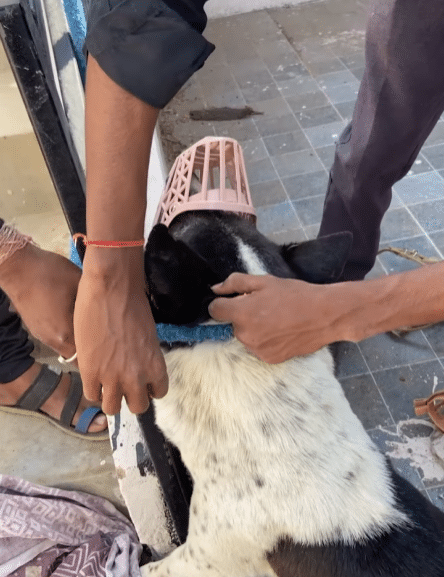
Little by little, they were able to get close enough to secure him.
The dog did not have much strength to resist.
Once he was safely under their control, they transported him to a veterinary hospital.
Only there could doctors determine what the swelling actually was and what treatment might be possible.
The rescue from beneath the stairs had ended.
The more difficult part was about to begin.
The Examination Revealed a Malignant Tumor
At the clinic, veterinarians began a more detailed evaluation.
The swelling was not simply temporary inflammation.
According to the rescue account, testing identified it as a malignant tumor.
That diagnosis helped explain why his condition had become so serious.
The growth had become large.
His strength had declined.
And his breathing had become more difficult.
There was no suggestion that this would be solved with one simple treatment.
The veterinary team now had to consider both the tumor itself and the condition of the dog carrying it.
He needed medical care.
But he also needed enough nutrition and stability for his body to tolerate whatever came next.
Treatment Began With the Dog, Not Just the Tumor
It would have been easy to focus only on the enormous growth.
But the rescuers were caring for an entire animal whose body had been weakened over time.
So treatment also included the basics he had been missing.
Regular food.
A protected place to rest.
Medical monitoring.
Time away from the conditions of the street.
For a dog who had been found hiding beneath concrete steps, even those ordinary things represented a major change.
There was now someone watching his breathing.
Someone making sure he ate.
Someone noticing whether he appeared comfortable.
His diagnosis remained serious.
But he was no longer facing it alone.
The First Changes Were Small
There was no overnight transformation.
His recovery did not suddenly become certain after reaching the clinic.
Instead, caregivers watched for small signs that he was responding.
He ate.
He rested.
His body began receiving consistent nourishment.
And as the days continued, he became more familiar with the people around him.
The change could also be seen in his behavior.
At first, he had remained withdrawn.
Gradually, he became more willing to stay near caregivers.
He watched them rather than immediately retreating.
He tolerated gentle contact.
Those moments did not mean the medical problem had disappeared.
They meant something simpler.
The dog who had hidden beneath the stairs was beginning to understand that the people around him were there to care for him.
His Future Was Still Uncertain — But His Present Had Changed
A malignant tumor is not something that disappears because an animal has been rescued.
There were still difficult questions ahead.
The medical team would need to continue evaluating his condition and determine what treatment his body could tolerate.
The outcome could not be guaranteed.
But the most immediate part of his life had already changed.
He was no longer lying unseen beneath a stairwell.
He had food.
Shelter.
Veterinary attention.
And people who were paying attention to changes that once might have gone unnoticed.
For an animal whose condition had progressed while he remained on the street, being observed every day mattered.
If something worsened, someone would know.
If he needed help, someone was already there.
Being Found Did Not Erase His Illness — It Ended His Isolation
The most striking part of his story is not simply the size of the tumor.
It is where rescuers found him.
Hidden beneath the stairs.
Quiet.
Weak.
Removed from the places where someone might easily notice an animal in distress.
He could not explain what was wrong.
He could not ask for a veterinary appointment.
And as his condition became more difficult, withdrawing may have been one of the few choices available to him.
Then someone looked into that dark space.
From there, everything changed.
He was carried out.
Examined.
Diagnosed.
Fed.
Treated.
And given somewhere safe to remain while his care continued.
His journey was far from finished.
There was no easy promise about what came next.
But for the first time, he would not have to face the next part hidden from view.
Sometimes rescue cannot immediately remove every illness.
Sometimes it cannot guarantee an ending.
But it can still give an animal something profoundly important:
The chance to stop suffering alone.


