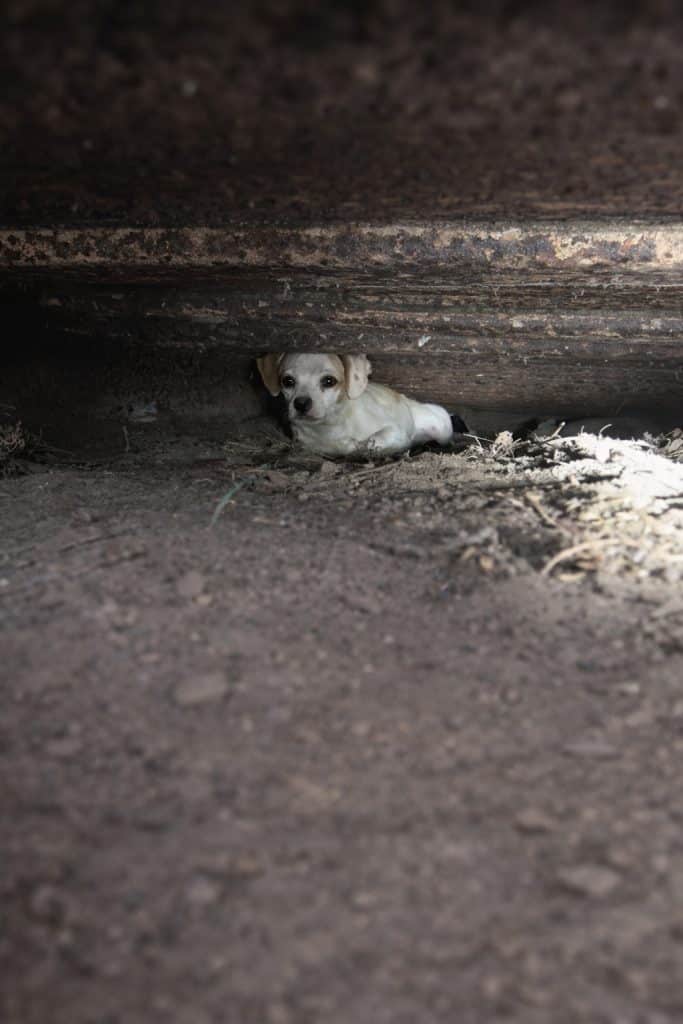
From the outside, the old shipping container looked empty.
It sat in a quiet corner of a public park, rusted by time and easy to ignore.
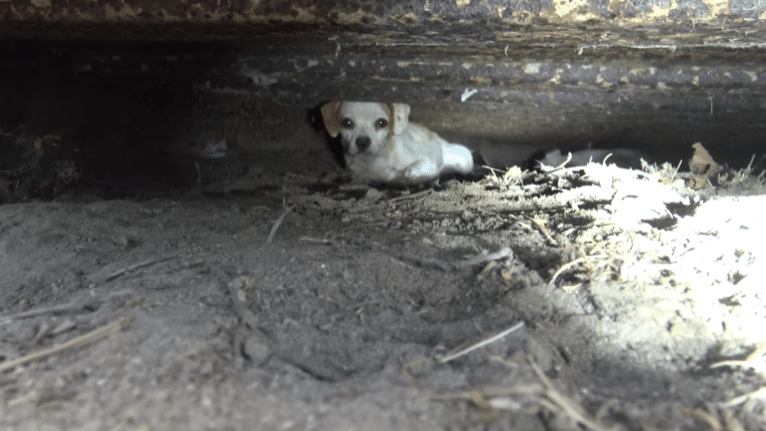
People could walk past without ever realizing that beneath its heavy metal frame, a small family was hiding in the narrow space between the container and the ground.
A mother dog.
And her puppies.
They had pushed themselves deep into the shadows, using the cramped opening as shelter from everything beyond it.
There was barely enough room to move.
Little light reached them.
But the space offered one thing the mother seemed to value above everything else.
Distance.
From people.
From noise.
From whatever had taught her that staying hidden was safer than being seen.
When rescuers finally learned the family was there, they came to help.
Then they discovered a problem.
They could see the dogs.
But reaching them safely was another matter entirely.
The Family Had Chosen the Hardest Place to Reach
The gap beneath the container was extremely narrow.
The puppies had crawled far underneath it, where ordinary hands could not simply reach in and lift them out.
Their mother remained nearby.
She watched.
She stayed close to her babies.
And she was understandably cautious about the strangers now standing around the only shelter her family knew.
The rescuers examined the space carefully.
Trying to pull the puppies out without the proper equipment could frighten them deeper beneath the container.
Moving too quickly could also place the mother under unnecessary stress.
So the team made a decision that might have looked strange to anyone watching.
They stopped.
Then they left.
Not because they were giving up.
Because they needed the right tools.
Their base was approximately three hours away.
That meant several hours of driving with no guarantee that Candy and her puppies would still be beneath the container when they returned.
But improvising a risky rescue was not worth it.
If they were going to bring this family out, they wanted to do it carefully.
So they made the long trip.
Gathered what they needed.
And turned around.
When they finally returned to the park, the first question was obvious.
Were the dogs still there?
They looked beneath the container.
The shadows moved.
The family had stayed.
Video: Candy and Her Puppies Were Hidden Deep Beneath a Shipping Container — Rescuers Drove Three Hours to Return With the Right Equipment
The First Puppy Came Out Without a Fight
With better equipment available, the rescuers could finally begin.
They moved slowly around the container.
The puppies were still packed into the dark space, uncertain about the unfamiliar people outside.
The first one they were able to reach would later be named Skittles.
Getting him out required patience.
There was no reason to pull suddenly or turn the rescue into a struggle.
The rescuers gently guided him toward the opening.
Little by little, the puppy emerged.
Then he was out.
For the first time, Skittles was no longer lying beneath the metal container.
He was being held safely in the open air.
The rescuers checked him and moved him somewhere secure.
Then something important happened.
The mother had been watching.
She would later be called Candy.
With one puppy now outside, Candy began moving closer.
No one could know exactly what she understood about the situation.
But her behavior changed.
Rather than retreating farther beneath the container, she came toward the opening.
Slowly, Candy stepped out.
The mother who had kept her family hidden in the shadows was now standing near the people trying to help them.
It was an encouraging moment.
But the rescue was far from finished.
Several puppies remained underneath.
And unlike Skittles, they were not ready to follow.
The Remaining Puppies Wanted Nothing to Do With the Open World
Deep beneath the container, the other puppies stayed still.
They had spent much of their young lives surrounded by metal above them and dirt beneath them.
The opening outside was unfamiliar.
So were the voices.
The movement.
The equipment.
Everything beyond their hiding place was larger than the little world they understood.
When rescuers tried to encourage them forward, the puppies remained farther inside.
There was no need to interpret that as stubbornness.
They were frightened.
So the team adjusted.
Soft nets and appropriate tools allowed them to reach farther without forcing hands blindly into the confined area.
Every movement remained controlled.
A puppy was guided closer.
Pause.
Another adjustment.
Then the little body reached the edge.
One by one, the remaining puppies came out.
Some were easier than others.
Some froze when they reached the opening.
But eventually, every member of the family was accounted for.
Candy.
Skittles.
And the rest of the litter.
For the first time since the rescue began, there were no animals left hidden beneath the container.
The entire family stood together outside.
The difficult part of reaching them was over.
Now rescuers could finally see what life beneath that metal shelter had done to their bodies.
Once They Were in the Light, the Fleas Became Impossible to Miss
The puppies were small and tired.
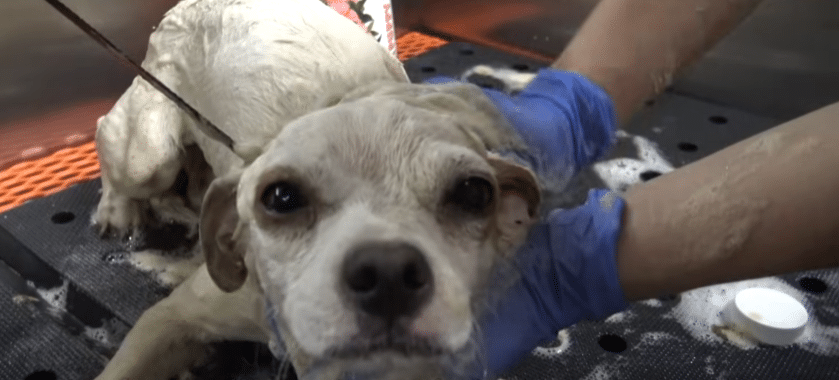
Their bodies were covered with fleas.
For animals living outdoors without regular care, parasites can become far more than an annoyance.
The puppies needed relief.
They also needed food.
Warmth.
And a chance to sleep somewhere that did not require them to press themselves beneath several tons of metal just to feel protected.
The rescue team began with simple things.
The puppies were cleaned carefully.
Baths helped remove the fleas and dirt from their coats.
Their tiny bodies were dried and kept warm afterward.
Food was offered.
The response was immediate enough to show how welcome it was.
Candy was cared for as well.
Through all of this, the family remained together.
That was important.
Almost everything in their environment had changed in a single day.
The container was gone.
The park was gone.
New people were touching them.
New smells surrounded them.
But the mother and puppies could still hear and smell one another.
That familiarity gave them something stable while everything else changed.
Eventually, the family was given soft bedding.
And once the activity around them settled, the puppies began to sleep.
Not the light, cautious rest of animals hiding beneath a public structure.
Deep sleep.
The kind that comes when there is finally nothing immediate to respond to.
Candy relaxed nearby.
For the first time since the rescuers had arrived, no one needed to crawl into darkness to find her family.
They were all safe in the same place.
Their First Safe Night Was Remarkably Quiet
There was no dramatic celebration that evening.
No need for one.
The puppies ate.
They slept.
Candy rested.
The rescuers checked on them and allowed the family to recover from an exhausting day.
Sometimes those quiet hours are among the most important parts of a rescue.
An animal does not need to be photographed constantly to be making progress.
A puppy sleeping without interruption is recovering.
A mother no longer scanning every sound for danger is recovering.
A full stomach is progress.
A clean coat is progress.
A warm blanket is progress.
For Candy and her puppies, these were all new experiences arriving at once.
The metal container had provided shelter of a kind.
But it had also forced the family into a cramped, hidden existence.
Their new surroundings offered something different.
Protection without confinement.
Food without searching.
Rest without disappearing.
By morning, the puppies had already experienced one complete night in which nothing chased them from where they were sleeping.
The next step would introduce them to an even bigger world.
A foster home.
Grass Replaced the Metal Roof Above Their Heads
The family was moved into foster care.
For the puppies, the change was enormous.
Instead of a narrow strip of dirt beneath a container, there was open ground.
Grass.
Space.
Fresh air.
At first, the puppies did not immediately race across it.
That would have been a lot to expect.
They hesitated.
Sniffed.
Stayed close.
Everything needed investigation.
Then curiosity began winning.
One puppy moved farther.
Another followed.
Soon the careful exploration became play.
The puppies began tumbling across the grass.
Chasing one another.
Changing direction for no reason other than the excitement of moving.
The difference was striking.
Only a short time earlier, rescuers had been trying to coax these same animals from a dark opening because they were too frightened to leave it.
Now there was nothing above them.
No metal ceiling.
No narrow edge defining how far they could travel.
They could simply move.
Candy remained nearby.
She watched the puppies explore the foster space.
Her job had changed too.
Beneath the container, staying alert and keeping the family hidden had been part of daily survival.
Here, food arrived.
People monitored the puppies.
There was shelter.
Candy no longer had to solve every problem by herself.
Gradually, her posture reflected that difference.
She could rest while the puppies played.
The Rescue Worked Because Nobody Forced the First Attempt
One of the most important moments in Candy’s rescue happened when the team decided not to rescue her immediately.
That sounds contradictory.
It was not.
They arrived.
Evaluated the space.
Recognized that they lacked the equipment necessary to reach the puppies safely.
Then made the harder choice.
Drive back.
Collect the correct tools.
Return.
That meant additional hours on the road.
It meant uncertainty.
The dogs could have moved while the rescuers were gone.
Someone else might have disturbed them.
The weather or circumstances could have changed.
But rushing would have introduced different risks.
Patience was not inactivity.
It was part of the rescue plan.
When the team came back, they could approach the problem more carefully.
That decision allowed the first puppy to be removed without unnecessary struggle.
Then Candy came forward.
Then the more frightened puppies could be reached one by one.
The entire sequence depended on resisting the temptation to force a quick solution.
Rescue sometimes requires urgency.
An injured animal in traffic cannot wait for hours.
But urgency and speed are not always the same thing.
For Candy’s family, doing the job properly required slowing down first.
The Puppies Finally Had Time to Be Puppies
Once their immediate needs were addressed, the personalities of the puppies began appearing.
Life beneath the container had not provided many opportunities for ordinary puppy behavior.
There, space was limited.
The family needed to remain hidden.
Resources were uncertain.
In foster care, the priorities changed.
The puppies could investigate.
Play.
Rest.
Eat again.
Wake up and do all of it another time.
They learned that human footsteps could mean meals rather than something to hide from.
They experienced handling that did not hurt.
They discovered soft places to sleep.
And they learned how much room existed beyond the edge of a shipping container.
Every playful tumble across the grass represented something simple but important.
They had enough security to spend energy on play.
Candy benefited from that change as well.
A mother caring for puppies outdoors carries an enormous burden.
She must find food for herself while nursing or protecting young animals.
She must choose shelter.
Monitor danger.
Keep the litter together.
In foster care, people could take over many of those responsibilities.
Candy could remain their mother without also being their only defense against the world.
The Container Became Part of Their Past
The place where Candy and her puppies were discovered is easy to picture.
A rusted shipping container.
A thin dark gap beneath it.
Several tiny bodies pressed into the shadows.
A mother staying close enough to watch them.
It could easily have remained their entire world for much longer.
Instead, someone learned they were there.
Then a rescue team came.
And when the first attempt revealed that the job would be difficult, they did not decide the family was unreachable.
They drove three hours away.
Got the proper tools.
Then drove three hours back.
That part of the story matters because compassion is not always demonstrated by a dramatic moment.
Sometimes it is demonstrated by inconvenience.
By deciding that six hours of driving is worth it.
By returning to a place when it would be easier not to.
By being patient with puppies that do not understand why coming out of hiding is good for them.
By refusing to make an animal’s fear a reason to rush.
Candy and her puppies did not emerge because someone demanded that they trust.
They were given time.
The first puppy came out.
Candy followed.
The others were brought out carefully.
Then the family received the things they had been missing.
Food.
Parasite treatment.
Warmth.
Rest.
Space.
And eventually, grass beneath their paws.
The puppies who once resisted leaving the darkness began running in the open.
That is the distance this family traveled.
Not simply from beneath one container to a foster home.
From needing to disappear in order to feel safe—
to finally living somewhere they no longer had to hide.
And it happened because when rescuers realized they were not prepared the first time, they made one important promise through their actions:
We will come back.
Then they did.


