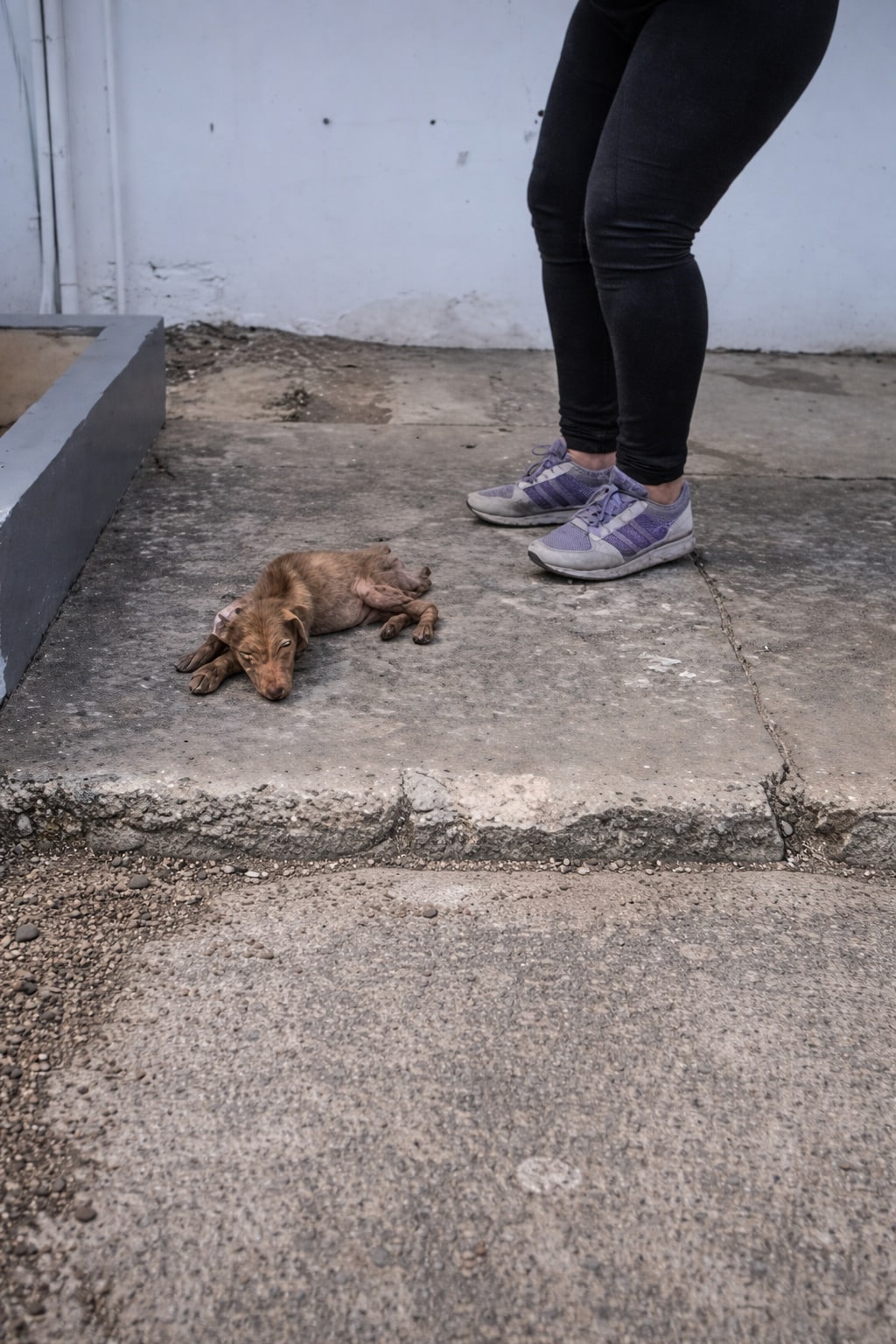
When rescuers first saw the puppy, he looked almost too fragile to touch.
His small body was painfully thin. Large areas of fur were missing, leaving irritated skin exposed beneath the light. His eyes appeared tired, and even lifting his head required more effort than a puppy his age should ever have needed.
He tried to stand.
His legs trembled beneath him.
After only a few seconds, his body lowered toward the ground again.
No one knew exactly how long he had been struggling before help arrived. But his condition made one thing clear: he needed veterinary care immediately.
At the clinic, the team gave him a name connected to survival and renewal.
They called him Fenix.
Not because recovery was guaranteed.
But because they hoped his story was not ending.
The Puppy Who Arrived With Almost No Strength
Fenix was only a few months old, yet his body showed signs of prolonged hardship.
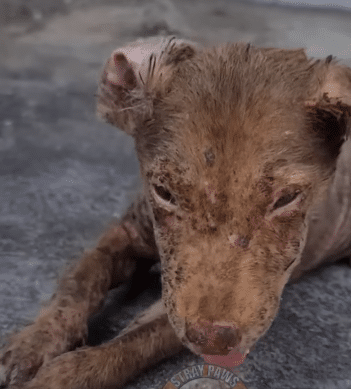
His ribs and hip bones were clearly visible beneath his damaged skin. Patchy hair loss covered much of his body, while inflamed areas suggested that infection, parasites, or another untreated skin condition had been affecting him for some time.
He appeared dehydrated and severely underweight.
His movements were limited.
Instead of showing the restless curiosity expected from a young puppy, Fenix remained mostly still, conserving whatever energy he had left.
The veterinary team handled him carefully.
A dog in such poor condition cannot always tolerate a full examination immediately. Even ordinary procedures may become stressful when the body is weak, cold, or painful.
The staff first focused on stabilization.
They checked his temperature.
They examined his skin.
They monitored his breathing and circulation.
Bloodwork and other testing reportedly showed that his immune system was struggling and that infection had placed additional strain on his already weakened body.
The situation was serious.
The team could provide treatment, warmth, nutrition, and constant observation.
But they could not promise how his body would respond.
The next 48 hours would be especially important.
Video: Severely Weakened Puppy Fenix Arrives at the Clinic as His Critical First 48 Hours Begin
Why the First Two Days Mattered So Much
When an animal arrives severely malnourished, recovery cannot be rushed.
The instinct may be to offer a large meal immediately, but a depleted body often needs food reintroduced in carefully controlled portions. Too much too quickly may create additional complications.
Fenix received small amounts of nutrition according to the medical team’s plan.
Warm fluids helped address dehydration and support his circulation.
Medication was introduced to control infection and treat the condition affecting his skin.
His body temperature was monitored closely.
He was kept on soft, clean bedding where he could rest without pressure from rough ground.
During those first hours, there were no dramatic changes.
Fenix did not suddenly stand and begin playing.
He did not immediately show interest in everyone around him.
Much of the time, he slept.
The clinic staff watched for smaller signs.
Was his breathing steady?
Could he maintain his temperature?
Was he responding to fluids?
Could his digestive system tolerate nourishment?
Would he become more alert when someone spoke nearby?
Those details mattered more than a dramatic transformation.
Every hour that Fenix remained stable gave his body another opportunity to respond to treatment.
The staff continued working quietly around him.
Medication arrived on schedule.
His bedding remained warm.
Food was offered in tiny amounts.
No one demanded that he appear brave.
Surviving the day was enough.
One Small Bite Gave Everyone a Reason to Hope
Then Fenix showed interest in food.
At first, he only noticed the bowl.
His nose moved slightly toward it.
He appeared to smell the meal, then rested again.
The staff did not force him.
Later, they offered food once more.
This time, Fenix leaned forward and took a small bite.
It was not enough to restore his strength.
It did not mean the danger had passed.
But it was the first clear sign that he was willing and able to participate in his own recovery.
For the people caring for him, that tiny bite felt enormous.
Eating independently meant his body still had an appetite.
It meant he could begin receiving more of the nutrition needed to repair damaged skin, rebuild muscle, and support his immune system.
The following meals remained small and carefully supervised.
Some were easier than others.
Fenix still tired quickly.
But the pattern had begun to change.
Instead of remaining completely withdrawn, he started responding to what was happening around him.
He raised his head when food arrived.
His eyes followed a caregiver crossing the room.
Then, during one quiet interaction, his tail moved.
Only slightly.
The motion lasted no more than a moment.
It could easily have been missed.
But the staff noticed.
A tail movement did not mean Fenix was fully recovered or that every fear had disappeared. It showed that the exhausted puppy was becoming more engaged with his surroundings.
He was beginning to respond not only as a patient, but as a puppy.
Healing Appeared in Changes Small Enough to Overlook
Fenix’s recovery unfolded gradually.
His condition stabilized before his appearance changed dramatically.
The redness and irritation across his skin began to calm as treatment continued. Damaged areas were cleaned and monitored, while medication addressed the underlying medical problems.
Regular nutrition slowly gave his body more energy.
He became able to hold his head upright for longer periods.
Then he began repositioning himself without assistance.
Standing remained difficult at first.
His legs lacked the muscle needed to support him confidently, and the staff stayed close whenever he attempted to rise.
There were moments when he trembled.
Moments when he needed to lie down again after only a few steps.
No one treated those pauses as failure.
Fenix had lost strength over time. Rebuilding it would also take time.
The team celebrated practical milestones instead.
He finished a meal.
He remained standing a little longer.
He walked several steps toward a familiar person.
He slept peacefully through the night.
His eyes became brighter.
Each improvement was connected to the care surrounding him.
Nutritious food.
Medication.
Clean bedding.
Gentle handling.
And people who continued returning even when progress was slow.
Recovery rarely happens through one extraordinary moment.
For Fenix, it was built through ordinary care repeated every day.
The Frightened Patient Began Acting Like a Puppy
By the second week, Fenix’s personality was becoming easier to see.
He was still delicate.
His body remained thin, and his skin needed continued treatment.
But he was no longer lying quietly through every interaction.
When staff members entered, he watched them.
When someone spoke to him, his ears shifted toward the sound.
He began showing interest in attention and staying alert for longer periods.
Then came short moments of play.
At first, the movements were cautious.
Fenix might reach toward an object or respond briefly to a caregiver before becoming tired.
But those bursts of curiosity carried special meaning.
Play is not essential to emergency stabilization.
It is something a puppy begins exploring when his immediate needs are being met and he has enough energy to focus on more than survival.
The medical team started seeing the young dog hidden beneath the illness.
Fenix was curious.
He enjoyed company.
He wanted to know what people were doing around him.
Sometimes he followed them with his eyes as they moved across the clinic, waiting for someone to return to his resting area.
The puppy who had once seemed almost absent was becoming present again.
Not all at once.
But more clearly each day.
Trust Grew Alongside His Physical Strength
Medical treatment helped Fenix’s body recover.
Consistency helped him feel secure.
He learned that food would arrive regularly.
His bedding would remain clean.
The hands touching his skin were trying to treat discomfort rather than cause it.
No one could know exactly what experiences Fenix had with people before his rescue. His history was not fully explained by the condition in which he was found.
The caregivers could only respond to the puppy in front of them.
When he seemed tired, they allowed him to rest.
When he became interested in contact, they offered gentle affection.
When a procedure was uncomfortable, they moved carefully and gave him time to settle afterward.
This predictable routine gradually changed the way Fenix responded to people.
He no longer appeared as uncertain when familiar staff members approached.
He accepted touch more comfortably.
Eventually, he began seeking attention instead of simply tolerating it.
That change mattered because trust cannot be restored through one kind gesture.
It grows through repetition.
A person approaches calmly today.
The same person returns with food tomorrow.
A hand cleans an irritated area without becoming rough.
A voice remains gentle even when the puppy is frightened.
Through those experiences, Fenix began learning that the people around him were not temporary visitors.
They were staying to help.
His Name Began to Feel Like a Promise Fulfilled
When the clinic first named him Fenix, the word represented hope more than reality.
He was still dangerously weak.
The outcome remained uncertain.
No one knew whether his body would respond well enough for him to experience a normal puppyhood.
As the weeks passed, the meaning of his name became easier to understand.
His skin improved.
Early patches of new fur began appearing in areas that had once been completely bare.
His body filled out gradually as regular meals restored healthy weight.
The trembling in his legs became less noticeable.
He walked with greater balance.
Soon, he could move through the room without needing someone ready to support him after every step.
The clinic staff could see the transformation, but they did not treat appearance as the only measure of success.
Fenix was also becoming confident.
He greeted people.
He explored.
He showed preferences.
He became excited about food and interested in play.
The puppy who had arrived barely able to lift his head now had enough energy to make his opinions known.
His recovery still required patience.
Skin conditions can take time to resolve fully, and hair often grows back unevenly before the coat becomes healthy again.
But the direction of his life had changed.
The first 48 hours had been about survival.
Now the team could begin thinking about his future.

Someone Saw a Family Member Instead of a Rescue Case
As Fenix became stronger, people began learning about his story.
They saw the photographs of the fragile puppy who had arrived at the clinic.
They saw the gradual changes.
The first meal.
The cautious steps.
The returning fur.
The moments when his personality appeared brighter than his medical history.
Then someone looked at Fenix and saw more than a patient.
They saw a dog they wanted to bring home.
Adoption after a difficult recovery is not simply the final scene of a rescue video. It is another transition that must be handled thoughtfully.
Fenix would be leaving the people and routines that had become familiar.
A home would introduce new rooms, sounds, expectations, and relationships.
His new owner needed to understand that adjustment might take time.
Fenix needed consistency.
He needed continued attention to his health.
Most importantly, he needed someone willing to care for him after the dramatic part of his rescue was over.
That person was ready.
Fenix entered a home where meals arrived regularly, resting places were soft, and affection was offered without uncertainty.
For the first time, his safety did not depend on the temporary structure of a clinic.
He belonged to a family.
The Puppy Who Could Barely Stand Began Running
Months after his rescue, Fenix looked remarkably different.
His coat had returned, covering the skin that was once inflamed and exposed.
His body was no longer defined by sharply visible bones.
Healthy weight and growing muscles gave him the strength to move with confidence.
But his energy may have been the most striking change.
Fenix ran.
He played.
He explored parks and investigated new scents with the curiosity that had been missing during his earliest days at the clinic.
He interacted with other animals.
He accepted affection without the same hesitation.
The puppy who once became exhausted from lifting his head now used his entire body to chase experiences he had almost never received the chance to know.
For his family, these were ordinary moments.
Walks.
Games.
Resting together at home.
Watching him become excited about going outside.
But each ordinary moment carried the weight of what might have happened if no one had stopped to help him.
Fenix had once been close to losing those experiences before he even knew they existed.
Now they formed his daily life.
His Transformation Was Created One Decision at a Time
It is tempting to describe Fenix’s survival as a miracle.
But his recovery was not created by hope alone.
It happened because people made a series of practical decisions.
Someone noticed a critically weak puppy.
Someone transported him to veterinary care.
A medical team began treatment immediately.
Caregivers stayed through the uncertain first 48 hours.
Food was offered patiently when he could manage only small amounts.
Medication continued long after the first emotional rescue moment had passed.
Then a family chose to give him a permanent home.
Each decision carried Fenix farther from the condition in which he had been found.
His own resilience mattered too.
His body responded.
He ate.
He stood.
He became curious.
But he could not have completed that journey alone.
The care surrounding him created the conditions in which his strength could return.
Fenix’s story is powerful not because it suggests every severely ill animal will recover in the same way.
Outcomes depend on many factors, including the condition involved, how long treatment has been delayed, and how the body responds.
His story matters because it shows what becomes possible when an animal receives a chance before it is too late.
Fenix Finally Got the Puppyhood He Nearly Missed
Today, Fenix is no longer the hollow-eyed puppy lying almost motionless at a clinic.
He has a healthy coat.
A stronger body.
A home where his presence is expected every day.
He runs through open spaces because his legs can finally carry him.
He plays because his energy is no longer being consumed by untreated illness.
He rests safely because there is no need to remain alert for the next danger.
The name chosen during his most uncertain hours now fits the life he built afterward.
Fenix rose from a condition that had left him almost unrecognizable.
But his transformation did not happen overnight.
It began with fluids and medication.
Then one small bite.
One slight movement of his tail.
One careful attempt to stand.
One person after another deciding that his life was worth the effort.
There was a time when no one could confidently promise that Fenix would survive the following two days.
Now he wakes each morning with places to explore, people to greet, and an entire life ahead of him.
He was not saved by one dramatic miracle.
He was saved through treatment, patience, and the refusal to walk away when recovery still looked uncertain.
And for the puppy named after a new beginning, that single chance became everything.


