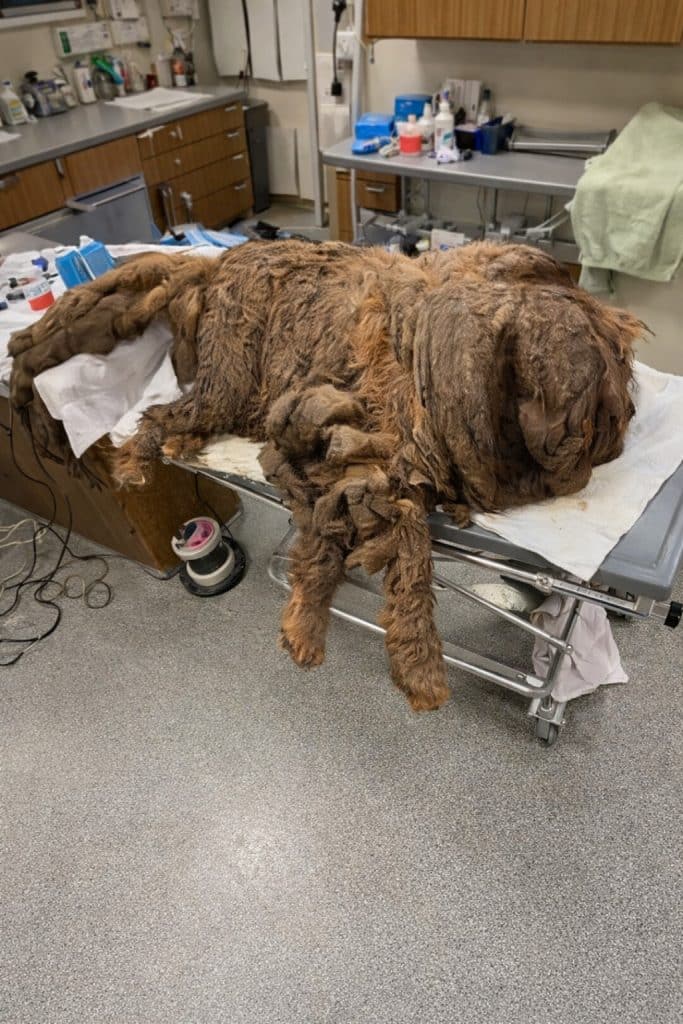
From a distance, the dog barely resembled a Tibetan Mastiff.
She moved slowly along a quiet street, carrying an enormous mass of hardened fur around her body. Dirt and debris had become trapped inside the coat, pulling against her skin and making every step more difficult.
Rescuers estimated that she weighed close to 130 pounds when they found her.
Yet much of that weight did not belong to the dog herself.
It was the burden she had been forced to carry.
When a rescuer placed a hand gently against her back, the large dog did not growl or pull away. She simply stood still and allowed someone to come close.
They named her Sprout.
And beneath the tangled coat, they were about to discover a remarkably gentle dog who had been hidden for far too long.
A Giant Dog Moving Beneath a Heavy Shell
Sprout’s coat had once been designed to protect her.
Tibetan Mastiffs naturally have thick, dense fur suited to cold conditions. But without regular grooming, that protective coat can become tightly tangled.
Sprout’s fur had gone far beyond ordinary knots.
Large sections had fused into heavy, solid mats that surrounded her legs, chest, back, and underside. Dirt, moisture, and waste had become trapped inside the coat, adding more weight and placing constant pressure against her skin.
Walking required effort.
Her legs had to move beneath layers that pulled whenever she stepped. The mats restricted her natural range of motion and made it difficult for rescuers to understand the condition of the body underneath.
Despite her discomfort, Sprout remained quiet when the team approached.
She did not appear energetic enough to resist, but she also showed no obvious aggression. When a leash was placed on her, she followed slowly toward safety.
The rescuers could not yet see her true shape.
They could only see that the dog inside the coat needed immediate help.
Video: Rescuers Remove More Than 32 Pounds of Matted Fur From a Gentle Tibetan Mastiff
The Veterinary Team Could Barely Examine Her
At the clinic, Sprout’s size created an immediate challenge.
It took more than one person to help position her safely for an examination. Even then, the veterinary team could inspect only limited areas of her body because the compacted coat covered almost everything.
They checked what they could see.
Sprout appeared tired and physically weakened. Her skin showed signs of prolonged irritation, and the dense matting created an environment where moisture and infection could remain hidden.
Before treatment could properly begin, the coat had to be removed.
The team prepared clippers, grooming tools, towels, and medical supplies. Because the mats were so close to the skin, every cut had to be made carefully.
One rushed movement could injure her.
Sprout remained surprisingly cooperative.
She stood when she could and rested when her body needed a break. The people working around her spoke calmly and supported her weight during the longest parts of the process.
There was no single dramatic moment when the coat simply fell away.
The transformation happened slowly.
One section at a time.
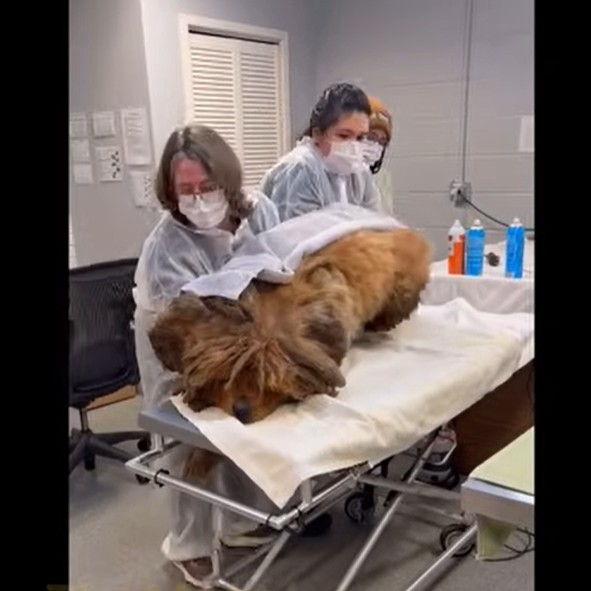
More Than 32 Pounds Were Cut Away
The grooming process took hours.
Clippers moved carefully beneath thick sections of hardened fur. Some pieces were so dense that they came away in large, heavy sheets.
With every section removed, more of Sprout’s body became visible.
Her legs appeared narrower than expected.
The outline of her back changed.
Her face, once surrounded by an oversized mass of dirty fur, began to look softer and more alert.
By the end of the grooming, more than 32 pounds of matted coat and trapped debris had been removed.
The number was difficult to comprehend.
It was the weight of a medium-sized dog carried around the body of one exhausted animal.
Sprout’s true weight appeared to be somewhere in the range of approximately 95 to 100 pounds. She was still a very large dog, but her body no longer looked buried inside an unnatural shell.
For the first time, the team could properly examine her skin.
They discovered irritated areas that required cleaning and medical treatment. Her body also needed time to adjust after being released from the constant pulling and pressure of the mats.
When Sprout stood again, her movement was cautious.
She did not suddenly begin running through the clinic.
But her legs could now move without dragging more than 32 pounds of neglected coat behind them.
That alone changed the way she carried herself.
A Foster Home Gave Her Time to Recover
Sprout was placed with a foster caregiver named Elisa.
The clinic had removed the physical barrier covering her body, but her recovery was only beginning.
Her skin required continued treatment.
She needed nutritious meals, veterinary follow-up, and a quiet environment where she could regain strength without pressure.
Elisa allowed Sprout to settle at her own pace.
The large dog was given a comfortable place to sleep and enough space to move without feeling surrounded. Baths and skin treatments were handled carefully, especially around areas that remained sensitive after the matting was removed.
At first, Sprout’s days were simple.
Eat.
Rest.
Go outside briefly.
Return to her bed.
She did not need to perform or immediately become playful. Her body had spent a long time compensating for discomfort, and recovery required patience.
Gradually, changes appeared.
Sprout began walking more confidently through the home.
She showed interest in nearby sounds.
She lifted her head when Elisa entered the room.
Instead of standing silently during every interaction, she began moving closer to investigate.
These moments were small, but they showed that Sprout was becoming more engaged with her surroundings.
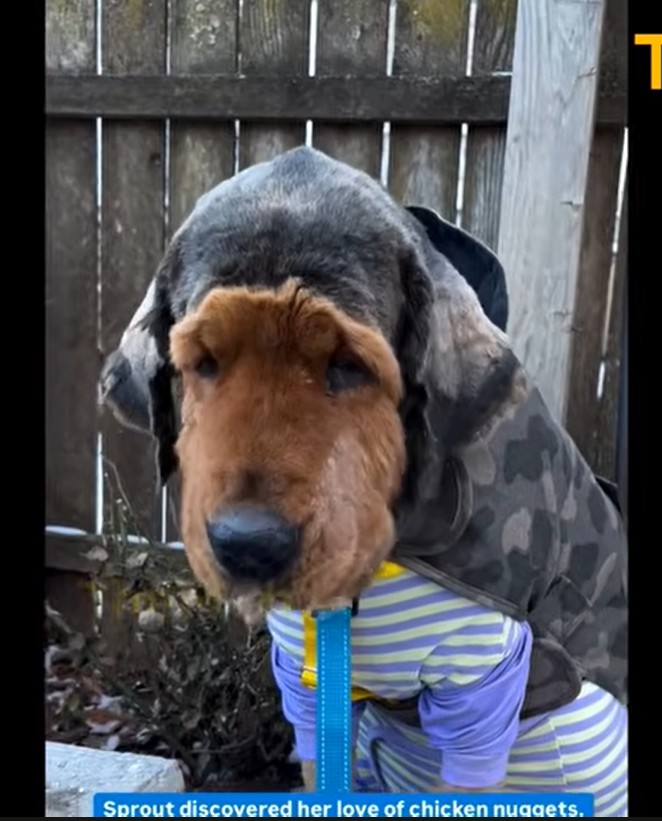
The Dog Beneath the Fur Was Calm and Affectionate
Sprout’s size could easily have made strangers cautious.
But as she became more comfortable, her personality became easier to see.
She enjoyed quiet attention.
She accepted gentle touch.
She preferred remaining close to the people she trusted and often watched Elisa move around the home.
The rescue team had first met a dog almost entirely hidden beneath neglected fur. They could not know whether she would be frightened, defensive, or uncomfortable around people once treatment began.
Instead, Sprout repeatedly showed a calm temperament.
Her trust was not expressed through dramatic gestures.
It appeared in the way she rested while someone sat nearby.
In the way she allowed her healing skin to be examined.
In the way she approached familiar people rather than avoiding them.
New fur began growing across her body in soft, uneven patches. The coat would take time to return fully, but the change made her look increasingly different from the dog who had arrived at the clinic.
She was no longer defined by the heavy shell surrounding her.
People could finally see Sprout herself.
A Family Saw More Than Her Past
After weeks of veterinary care and recovery, Sprout became ready for the next stage of her life.
The rescue began searching for a permanent home capable of caring for a dog of her size.
A Tibetan Mastiff requires space, appropriate grooming, regular veterinary attention, and people who understand the responsibilities that come with a large breed.
Sprout also needed a family willing to continue monitoring her skin and help her adjust without expecting immediate perfection.
Eventually, a family learned about her story.
They saw the photographs from the day she was found.
They saw the enormous pile of coat removed at the clinic.
But they also saw the dog Sprout had become in foster care.
Calm.
Observant.
Gentle with the people around her.
They chose to welcome her into their home.
The transition was handled gradually. Sprout was allowed to become familiar with new rooms, new routines, and the people who would now care for her every day.
There was no need to rush the relationship.
Sprout already understood the value of patience.
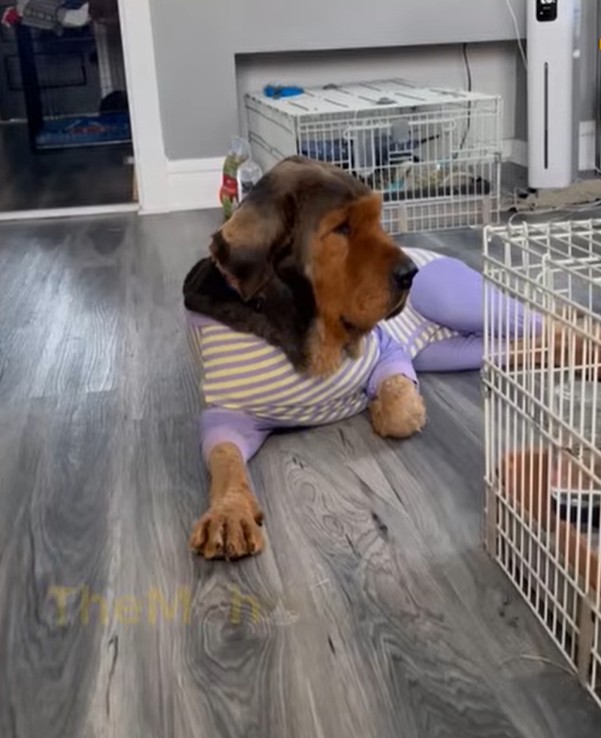
The Weight She Was Never Meant to Carry
Sprout’s transformation is striking because the physical difference is impossible to ignore.
More than 32 pounds were removed from her body.
Her skin received treatment.
Her natural shape emerged.
Her coat began growing again.
But the most meaningful result was not a before-and-after photograph.
It was the ordinary life that followed.
A clean place to sleep.
Meals arriving consistently.
Regular grooming before tangles could become painful.
Hands that approached gently.
People who noticed when something was wrong.
Sprout had not been transformed into a different dog.
The grooming process simply allowed the dog who had always been there to become visible.
Her calm behavior had been hidden beneath the coat.
Her face had been buried inside the mats.
Even basic movement had been overshadowed by the weight surrounding her.
Once that burden was removed, Sprout did not need to prove anything extraordinary.
She only needed time to heal and people willing to care for her properly.
Today, she no longer moves beneath a shell of hardened fur.
She walks as the large, gentle dog rescuers first sensed was waiting underneath.
Sprout’s story reminds us that severe neglect can hide an animal almost completely.
But it also shows what careful intervention can reveal.
Not a hopeless case.
Not a frightening giant.
Just a dog who had been carrying far more than she ever should have—and who was finally given permission to put it down.


