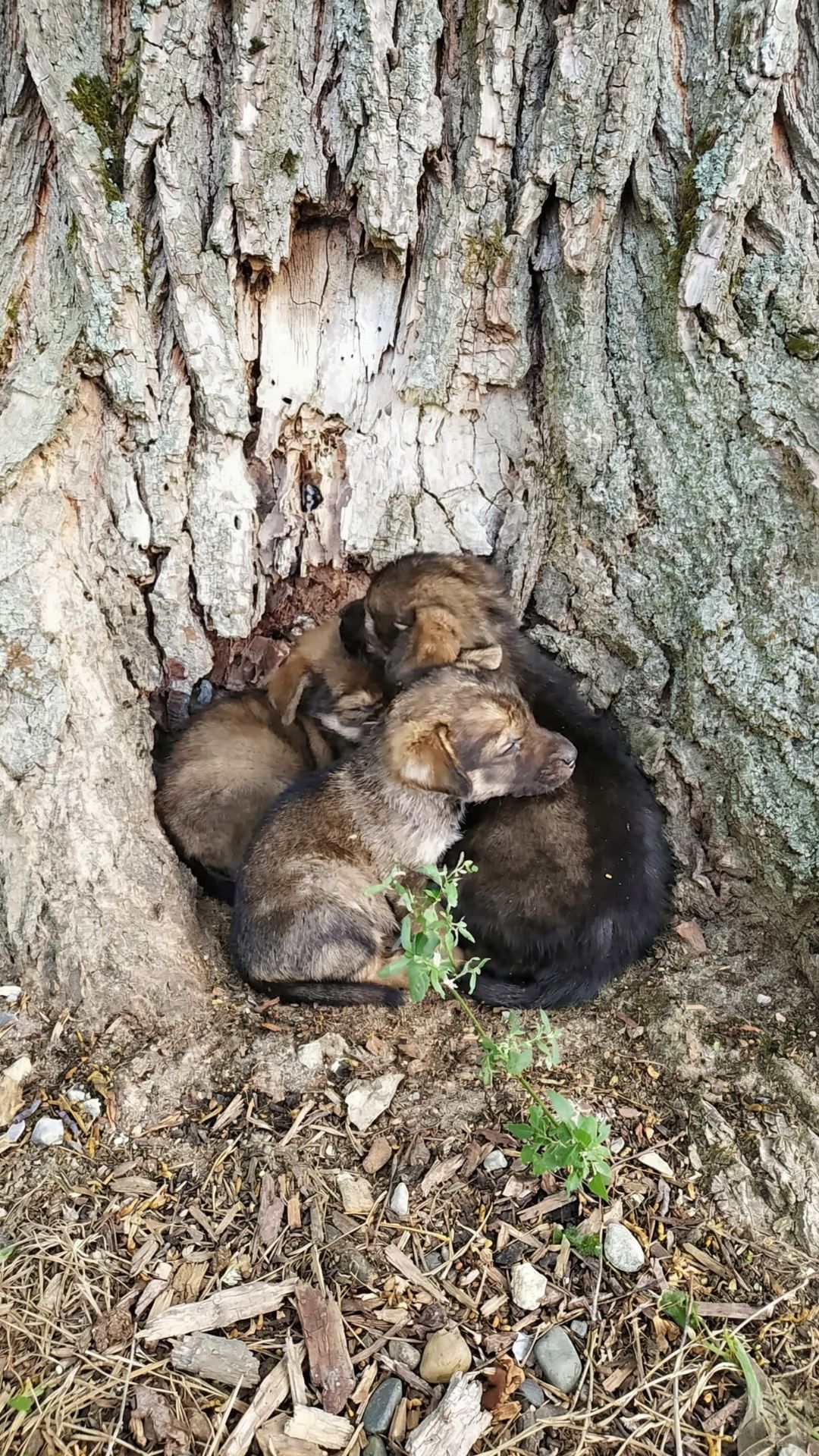
Beneath the shade of a quiet tree, three tiny puppies pressed their bodies tightly together.
There was no mother nearby.
No food.
No shelter beyond a patch of ground beneath the branches.
They had only each other.
Their cries were soft, but persistent—small sounds coming from animals far too young to understand why the person who brought them there had disappeared.
For a while, the world continued around them.
Then someone finally noticed.
Someone Had Seen Exactly How They Got There
The puppies had not wandered to the tree on their own.
According to a witness, a man arrived with them, placed the three puppies beneath the branches, and then drove away.
There was no indication that he planned to return.
The puppies were left in an unfamiliar place with nothing to eat and no adult dog nearby to care for them.
They waited.
Hours became longer.
Their hunger grew.
And still, no one came back.
By the time rescuers reached the tree, the puppies were desperate for food.
A meal was placed in front of them, and hesitation disappeared almost immediately.
They ate quickly, crowding around the food as though they had learned that a full bowl could not be taken for granted.
But once the immediate hunger eased, something else became noticeable.
The puppies did not move away.
They stayed close to the rescuers.
They watched every step.
And when someone began walking, the tiny dogs tried to follow.
They had lost the person—or the mother—they once depended on.
Now they seemed unwilling to let another source of safety disappear.
Video: Three Abandoned Puppies Clung Together Beneath a Tree — Then Their Rescue Took an Unexpected Turn
Their Small Bodies Were Hiding Bigger Problems
From a distance, the puppies might have looked like three hungry strays in need of food and a safe place to sleep.
A closer examination told a different story.
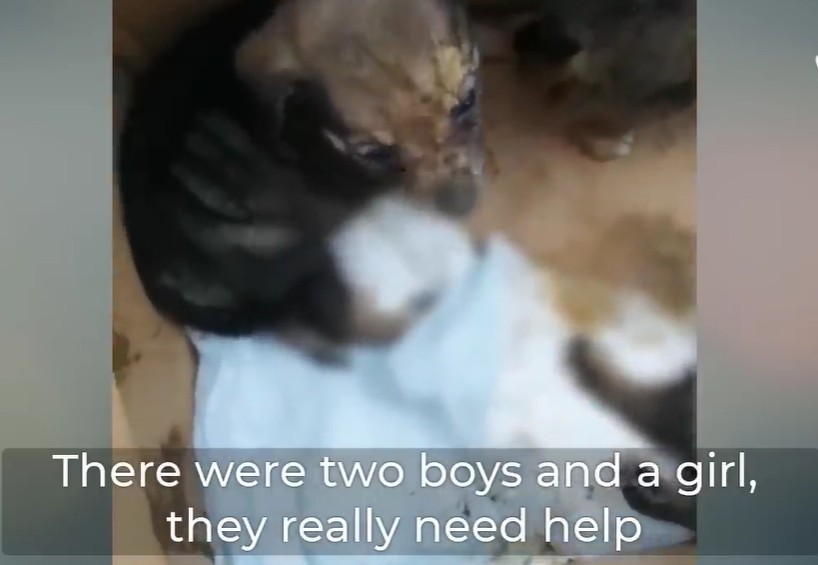
Ticks were spread across their bodies, including around sensitive areas near their eyes.
Their bellies were noticeably swollen.
Yet beneath that swelling, the puppies remained thin.
The combination suggested that parasites had already taken a considerable toll on their young bodies.
Treatment began carefully.
The rescuers worked to remove the ticks and address the parasite burden while keeping the frightened puppies as calm as possible.
At first, unfamiliar sounds and movements startled them.
They pulled away when treatment equipment came close.
They did not yet understand why strangers were touching them.
So everything was done slowly.
The rescuers gave them time between each step and avoided forcing more interaction than necessary.
Gradually, the puppies settled.
As the irritation affecting their skin was addressed, they became less restless.
They allowed the caregivers to continue.
Another small barrier between fear and trust had begun to disappear.
Then Their Recovery Suddenly Became Much More Serious
For a short time, it seemed that food, parasite treatment, and rest might be enough to put the puppies on the right path.
Then their condition changed.
Their energy dropped.
They became noticeably weaker.
Veterinary evaluation revealed enteritis, a serious intestinal illness that can be particularly dangerous in very young puppies.
Suddenly, the rescue was no longer only about treating the effects of abandonment and parasites.
The puppies were facing an illness their small bodies might not be strong enough to overcome.
They were taken for intensive veterinary care.
Supportive treatment began immediately.
Their condition was monitored closely, and blood transfusions were used as part of the effort to stabilize them.
The caregivers stayed involved throughout the process, hoping that all three puppies would respond.
But their bodies had already been through a great deal before help arrived.
And despite the treatment, one puppy continued to decline.
One of the Three Could Not Make the Journey With Them
Not every rescue story ends exactly the way people hope.
One of the puppies did not survive.
The veterinary team had done what they could, but his young body was unable to recover from the illness and weakness he was facing.
For the people caring for the litter, the loss was difficult.
Only a short time earlier, there had been three puppies huddled beneath a tree.
Now there were two.
There is no way to know how different the outcome might have been if the puppies had received care earlier.
What mattered now was protecting the two who remained.
Their treatment continued.
They still needed time.
They still needed close observation.
And after losing one member of the litter, every small improvement in the surviving pair felt especially important.
They were given names.
The male became Knopa.
The female became Klepa.
And together, they continued recovering side by side.

Two Weeks Later, Their Energy Started Coming Back
Recovery was not immediate.
For nearly two weeks, Klepa and Knopa needed consistent care while their bodies regained strength.
At first, much of their time was spent resting.
Then the changes began.
Knopa became more active.
He showed interest in playing and exploring instead of remaining quiet for long periods.
Klepa began seeking attention from the people around her and became noticeably affectionate.
Their appetites improved.
Their movements became stronger.
And the weakness that had defined the early days of treatment slowly gave way to the restless curiosity of young puppies.
It was the kind of progress their rescuers had been hoping to see from the moment they were found.
They were no longer simply being kept stable.
They were growing.
Playing.
Interacting.
The two puppies who had once depended on each other beneath a tree were beginning to discover a much larger world.
They Had Survived Together — So Their New Life Would Stay Together
When Klepa and Knopa were finally well enough to leave intensive care, their excitement was impossible to miss.
They explored their new surroundings with the energy that had been absent only weeks earlier.
Grass became something to run across.
Beds became places to curl up safely.
Meals arrived regularly instead of appearing only when someone happened to find them.
And through all of it, the two puppies remained together.
That mattered to the people caring for them.
Their earliest days had been defined by uncertainty, and during those days the litter had relied heavily on one another for warmth and familiarity.
Klepa and Knopa had already lost their third sibling.
The rescuers decided the surviving pair would not have to lose each other too.
They would remain together.
For two puppies who had once been left beneath a tree with nothing predictable around them, that promise created something entirely new.
Consistency.

The Puppies Beneath the Tree Are No Longer Waiting
Today, Klepa and Knopa are no longer the frightened little animals found crowding around a bowl of food.
They are active.
Affectionate.
Safe.
Their days are no longer shaped by waiting for someone to return.
They have food they can rely on, places to rest, and people who pay attention when something is wrong.
They also still have each other.
Their beginning cannot be changed.
They were left beneath a tree without the protection or care puppies that young needed. Illness followed, and one member of their litter could not be saved.
But that is not where the story stopped.
Two puppies recovered because someone noticed them.
Because veterinary care arrived.
Because people continued showing up even when the situation became more difficult than expected.
Once, Klepa and Knopa pressed against each other because they had almost nothing else.
Now they stay together for a very different reason.
They are not trying to survive another night beneath a tree.
They are growing up side by side in a place where no one intends to leave them behind.


