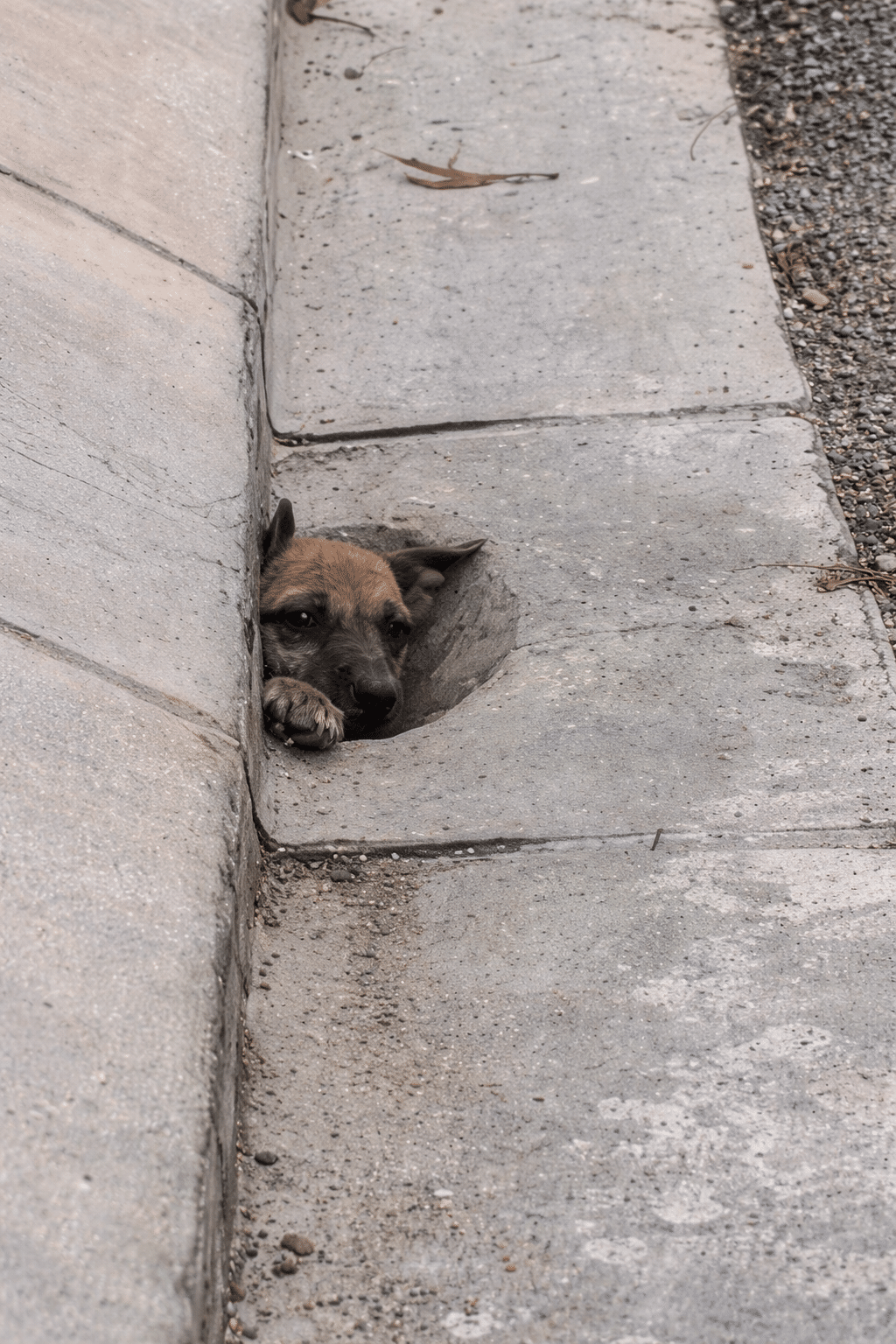
At first, the opening looked too small to matter.
Just a narrow break in a slab of roadside concrete.
Cars passed nearby.
People moved along the street.
Nothing about the little gap suggested that anything was living inside.
Then rescuers looked closer.
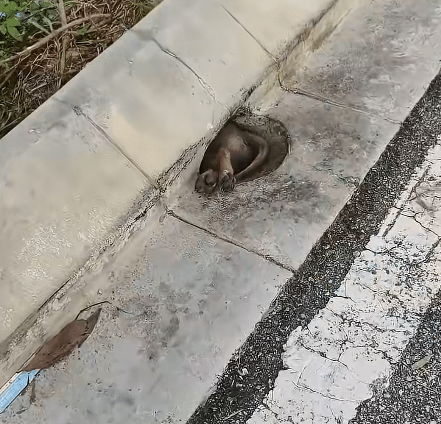
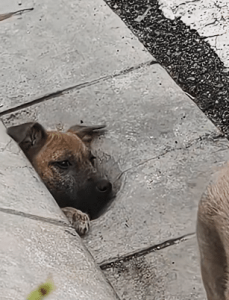
Deep in the dark space beneath the concrete were three tiny puppies, pressed together where the road met the curb.
They were small enough to squeeze through the opening.
For now.
That was exactly what worried the rescue team.
Because puppies do not stay this size for long.
The shelter that protected them today could become a place they could no longer escape tomorrow.
And when the puppies were not hiding inside the concrete, they were often beneath parked vehicles.
One danger above them.
Another around them.
The rescuers did not wait for something terrible to happen.
They reached into the darkness.
And one by one, they began lifting the puppies out.
Three Small Faces Appeared From Inside the Concrete
Getting the puppies out required patience.
The opening was narrow enough that rescuers could not simply step inside or clearly see every part of the cavity.
They had to reach their arms through the gap and feel carefully into the darkness.
Somewhere beyond their fingertips were three frightened puppies who had learned that the hollow space was where they could hide.
There was no room for sudden movements.
A frightened puppy could retreat deeper.
So the rescuers moved slowly.
One hand reached farther inside.
Then another.
Eventually, fingers found a small body.
The first puppy was carefully guided toward the opening and lifted into daylight.
Then came the second.
Then the third.
Each emerged blinking and uncertain, their small bodies trembling as they were brought away from the only hiding place they knew.
The concrete cavity had given them somewhere to disappear from the noise outside.
But it was never designed to keep an animal safe.
There was no proper bed.
No dependable food.
No protection from every danger surrounding the roadside.
And there was another problem the puppies could not understand.
The space was already tight.
As they grew, it would only become tighter.
Video: From a Concrete Crevice to Safety — The Urgent Rescue of Three Roadside Puppies
What Felt Like Shelter Could Soon Become a Prison
For a tiny puppy, the narrow opening was still passable.
A small body could flatten itself.
Crawl inside.
Turn around with difficulty.
Then emerge again when hunger or curiosity pulled it back toward the street.
But puppies grow quickly.
Their shoulders become wider.
Their bodies become longer.
Within weeks, the same entrance could become much harder to navigate.
That possibility changed the way rescuers viewed the cavity.
It was not enough to say the puppies had survived there so far.
The question was what would happen next.
If one puppy became too large to squeeze through the opening, getting trapped inside could become a serious problem.
The concrete would not bend around a growing body.
The space would not expand.
And because the hollow sat along a roadside structure, reaching a trapped animal later could be much more difficult.
The team understood that rescue did not always need to happen after injury.
Sometimes the best moment to intervene is before the emergency occurs.
These puppies had already given enough warning.
They were living somewhere that could not remain safe as their bodies changed.
Waiting until one became stuck would mean waiting too long.
Outside the Hole, Parked Cars Created Another Risk
The concrete cavity was not the only place the puppies used for cover.
When they ventured out, they were sometimes found hiding underneath parked cars.
For small animals, the space beneath a vehicle can feel appealing.
It is shaded.
It can be cooler than exposed pavement.
The vehicle creates a roof overhead.
Street activity feels slightly farther away.
But a puppy cannot understand the danger built into that shelter.
A driver may return without ever seeing the animal underneath.
An engine can start suddenly.
A tire can begin moving before a puppy has enough time to crawl away.
A vehicle that has been completely still for hours can become dangerous in seconds.
That made the puppies’ routine especially precarious.
When inside the concrete, they faced the possibility of eventually becoming trapped.
When outside it, they were exposed to the hazards of the road and parked vehicles.
Neither option offered real security.
The puppies were simply using whatever spaces they could find.
That instinct had helped them stay hidden.
But hiding is not the same as being safe.
The Rescue Team Decided Not to Wait for an Accident
Once the situation was clear, the rescuers did not need a dramatic debate.
The puppies were leaving.
The decision was preventive as much as it was compassionate.
No one needed to wait for a puppy to become stuck inside the cavity.
No one needed to wait for a car to move unexpectedly.
No one needed to wait for hunger, illness, or exposure to create another emergency.
The team could already see enough risk.
So they acted while all three puppies were still reachable.
That mattered.
Many rescue stories begin after something has already gone terribly wrong.
An injury.
An illness.
A collision.
An animal trapped beyond reach.
This story was different.
The danger was visible before the worst outcome arrived.
And that gave rescuers an opportunity to change the puppies’ future early.
One by one, the three little dogs were moved away from the roadside environment.
For the first time, safety would not depend on finding the smallest possible gap and disappearing inside it.
Their New Routine Began With the Basics
Once the puppies were removed, the plan was simple.
Stable shelter.
Nutritious food.
Veterinary attention if needed.
And patient human care.
None of those things look dramatic on camera.
But they are exactly what young animals need.
The puppies no longer had to rely on whatever food might appear near the roadside.
They no longer needed to choose between a concrete cavity and the underside of a vehicle.
There was now a dependable place for them to rest.
Meals could arrive regularly.
Their condition could be observed.
If one puppy became sick or showed signs of a problem, someone would notice.
That predictability changed the environment around them completely.
Still, the puppies did not instantly understand that change.
They had spent their early lives surviving by hiding.
A hand reaching toward them might still feel unfamiliar.
An open room could feel less secure than a tiny enclosed hole.
New sounds could cause hesitation.
So the rescuers did not expect confidence to appear immediately.
They gave the puppies something more useful.
Time.
Fear Did Not Disappear the Moment They Reached Safety
Being physically rescued and feeling secure are not always the same thing.
The three puppies were now away from the roadside, but their behavior still reflected caution.
They remained timid.
They watched people carefully.
They were still learning that being approached did not always mean they needed to retreat into darkness.
That process could not be rushed.
The rescuers offered food.
They stayed nearby.
They handled the puppies gently.
Repeated safe interactions slowly introduced a new pattern.
Someone approaches.
Nothing bad happens.
A meal appears.
Hands lift carefully rather than roughly.
A quiet place remains available when they want to rest.
Then the same things happen again the next day.
For young animals, consistency can change behavior little by little.
The puppies did not need one dramatic moment of trust.
They needed many ordinary moments where the world behaved predictably.
That was something the roadside could never provide.
Their World Was Finally Bigger Than One Small Hole
One of the most striking things about the puppies’ rescue is how small their original world had been.
A crack in concrete.
The darkness behind it.
The underside of a parked car.
A narrow stretch of roadside.
Those spaces may have felt enormous to puppies who knew nothing else.
But once they reached care, their environment expanded.
There was room to move without squeezing through a gap.
Room to lie down without pressing against concrete.
Room to grow.
That last detail mattered most.
The puppies no longer had to fit themselves into a shelter that would become less suitable with every passing week.
They could get bigger without their home becoming more dangerous.
Their bodies could change normally.
Their needs could increase.
And the space around them could still accommodate those changes.
What seemed like a small rescue decision had removed a very real future problem.
They had been taken out while they still could be reached easily.
Before the opening became too narrow.
Before the roadside claimed another victim.
Nothing Terrible Had Happened Yet — And That Was the Point
There is a tendency to think of animal rescue only in the most dramatic moments.
A dog pulled from deep water.
A puppy carried from traffic after an accident.
An animal freed after becoming trapped.
But rescue can also mean recognizing the pattern before the crisis.
These puppies had not yet become permanently stuck inside the concrete.
The source does not describe one being hit by a car.
There was no final emergency that forced everyone to act.
Instead, the rescuers looked at the conditions surrounding them and understood what could happen if nothing changed.
The puppies were growing.
The opening was not.
Cars moved.
The puppies were too small for drivers to reliably notice.
Those facts were enough.
By intervening early, the team replaced a dangerous routine before it produced a tragedy.
That is not less meaningful than a last-second rescue.
In many ways, it is exactly what rescue should aim for.
Three Puppies Were Given a Future With Room to Grow
By the end of the documented rescue, the puppies were no longer living alone beside the road.
They remained cautious.
They were still adjusting.
Their story had not suddenly become perfect.
The source does not provide a final adoption outcome for each puppy, so their later lives are not something that can responsibly be invented.
What is known is already important.
They were found.
They were removed from the concrete cavity.
They were moved away from the danger of parked vehicles.
They were given stable housing, food, and human care.
And they were no longer dependent on a hole that would eventually become too small for them.
That change gave them something the roadside could not.
Time to grow safely.
The first image of their story is easy to remember:
A narrow opening in concrete.
A rescuer’s arm reaching into darkness.
Then a tiny face appearing in daylight.
One puppy.
Then another.
Then the third.
No dramatic accident had happened yet.
No puppy had become permanently trapped.
And because someone noticed the danger early enough, perhaps none of them ever had to.
Sometimes rescue begins after the worst has already happened.
This time, it began before.
Three puppies had been calling a concrete hole home.
Rescuers understood that it was only temporary.
So before that hiding place could become a prison, they reached inside and gave all three of them somewhere safer to grow.


