On October 9, 2024, Florida was preparing for Hurricane Milton.
Roads filled with families trying to get inland. Rain intensified. Emergency warnings spread across the state as people rushed to leave areas expected to be hit hardest.
Along Interstate 75 near Tampa, however, one dog had no way to evacuate.
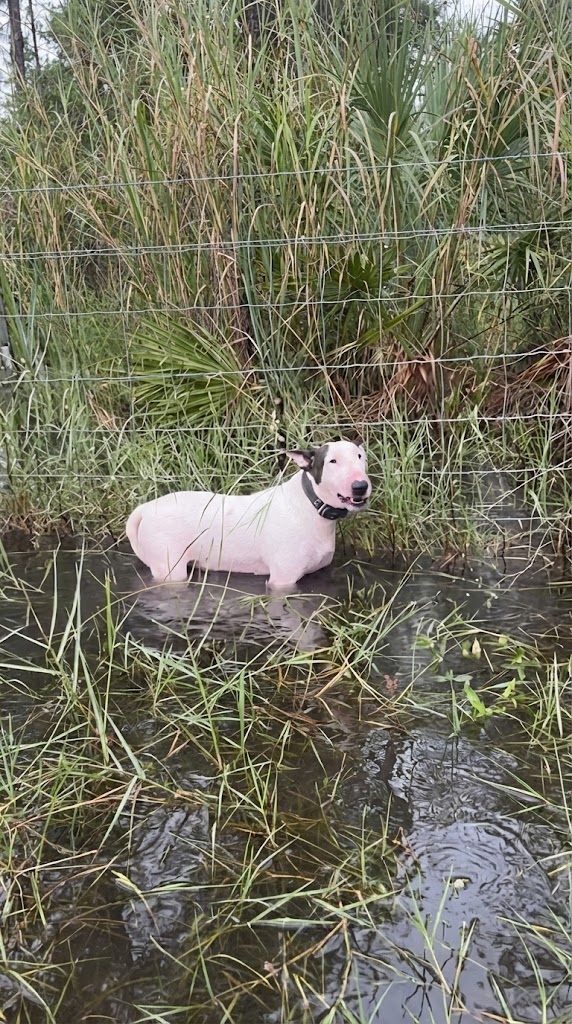
A white Bull Terrier stood beside the highway with a leash securing him to a metal fence.
He could move only a few feet.
As the weather worsened and water gathered around the roadside, he remained exactly where he had been left.
Cars passed.
Rain continued falling.
The water rose.
And the dog could do nothing except wait.
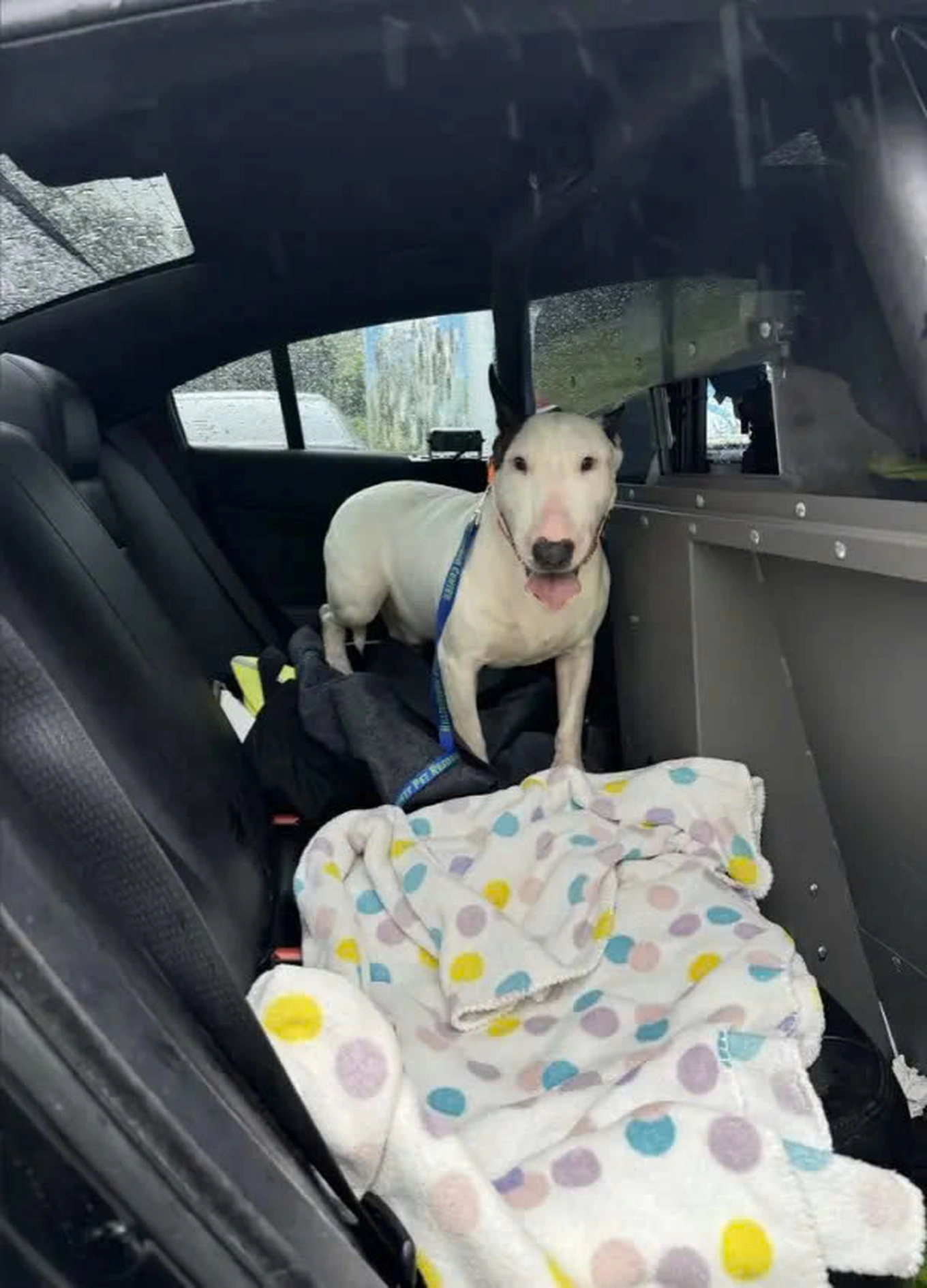
Then a Florida Highway Patrol officer saw him.
That moment would save his life.
It would also give him a name that Florida would remember.
Trooper.
The Dog Beside I-75
The scene was difficult to understand at first.
A dog alone near an interstate during a major hurricane evacuation was concerning enough.
Then the officer realized he was restrained.
Trooper was not simply wandering along the roadway looking for shelter.
A leash kept him attached to the fence.
As water rose around the area, his options were almost nonexistent.
He could not move farther inland.
He could not search for higher ground.
He could not follow traffic away from the approaching storm.
All he could do was remain within the small radius allowed by the restraint.
When the patrol officer approached, Trooper barked repeatedly.
The dog was frightened and surrounded by unfamiliar conditions—heavy rain, moving water, traffic, and a stranger approaching him.
The officer continued carefully.
What happened next was captured in footage that would spread far beyond Florida.
A dog who had been left beside an evacuation route was finally being removed from danger.
Video: Tied Beside I-75 as Hurricane Milton Approached, Trooper Is Found by a Highway Patrol Officer
A Rescue in the Middle of an Evacuation
Rescuing an unfamiliar dog during severe weather carries its own risks.
Trooper did not know why the officer was approaching.
He could not understand that the stranger in front of him represented his best chance of getting out.
His repeated barking made his uncertainty clear.
But the officer stayed with him.
Eventually, Trooper was freed from the roadside and taken away from the rising water.
For most animals, being brought somewhere safe would be the end of the emergency.
For Trooper, it was only the beginning of what people would learn about him.
He had survived the immediate danger of the storm.
Questions now remained about how he had ended up tied beside the highway in the first place.
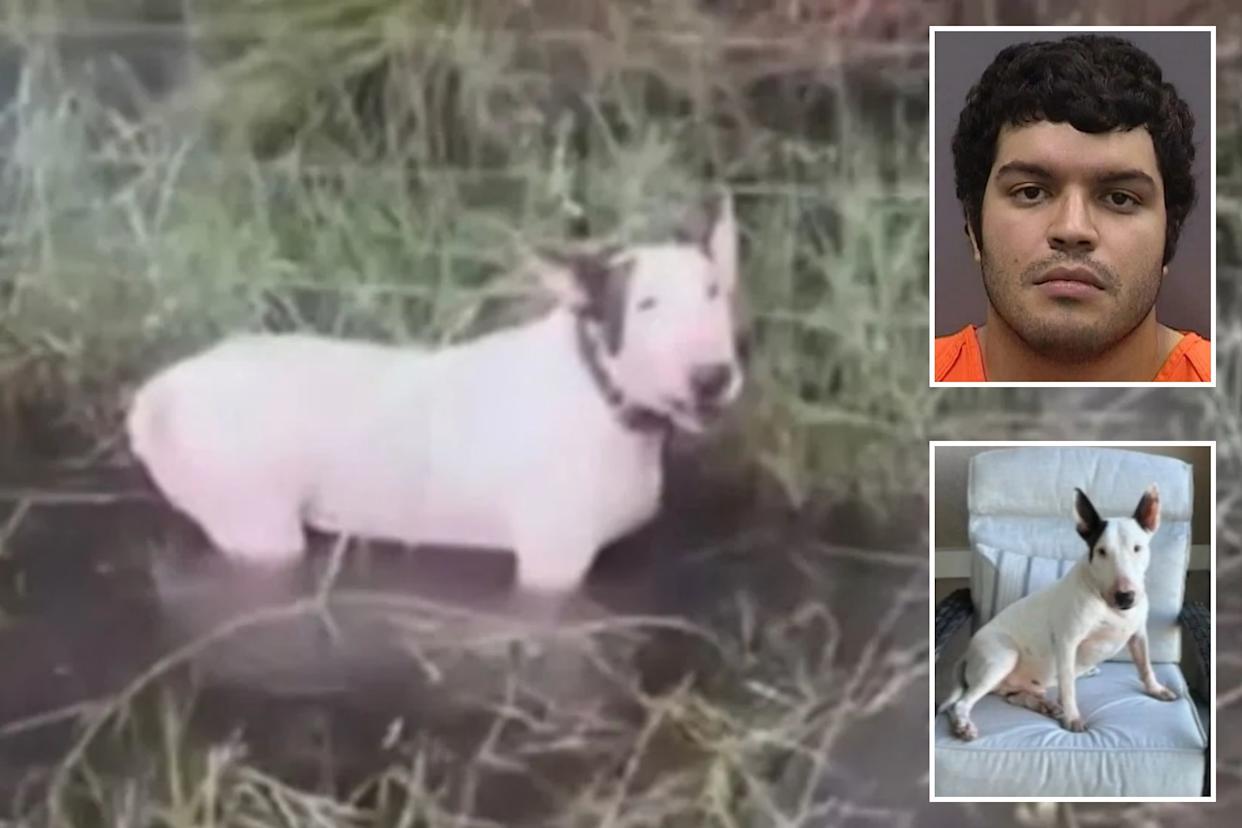
According to the account surrounding the case, Giovanny Aldama Garcia later told authorities that he had been attempting to leave the state and had been unable to find someone to take the dog.
The circumstances quickly drew enormous public attention.
Images of Trooper beside the flooded interstate spread widely.
People wanted to know who had left him there.
And many wanted consequences.
The Case Became More Complicated Than the Viral Video
Public reaction was immediate.
To many people watching the rescue footage, the situation seemed straightforward: a dog had been restrained near an interstate while a hurricane approached.
But the legal process became more complicated.
According to the original account, felony animal cruelty charges were eventually dropped because prosecutors said they could not establish sufficient proof that Garcia himself had been the person who physically tied Trooper to the fence.
For animal advocates following the case, that distinction was frustrating.
The footage showed Trooper restrained.
The danger was obvious.
Yet the legal question depended on proving specific actions by a specific person.
Frank Spina, who would later become Trooper’s adopter, publicly expressed his disappointment with the outcome.
The frustration surrounding the case became one part of Trooper’s story.
But something else was happening at the same time.
Away from the legal arguments, veterinarians were beginning to discover just how much care this dog actually needed.
The Hurricane Was Not His Only Medical Problem
After Trooper was brought to safety, he eventually came under the care of the Leon County Humane Society.
There, veterinary examinations revealed problems that had nothing to do with Hurricane Milton.
Trooper had cancer.
Multiple tumors required medical attention and surgery.
That discovery alone would have been serious.
Then veterinarians reportedly found something even more alarming.
Inside Trooper’s stomach was a large freezer bag containing more than 120 pieces of debris.
Metal.
Plastic.
Other discarded material.
The combined mass was described as weighing close to one kilogram.
The finding raised disturbing questions about what Trooper’s life had been like before he was ever seen beside the highway.
Dogs sometimes swallow inappropriate objects for many reasons, and no one could know every circumstance that led Trooper to ingest so much debris.
But the amount found inside him made clear that his medical problems extended well beyond one stormy afternoon.
The hurricane had made Trooper visible.
His veterinary examination revealed that he had already been carrying serious problems long before the patrol officer found him.
Surgery Became the Next Fight
Trooper now needed treatment on several fronts.
The tumors had to be addressed.
The dangerous material in his stomach had to be removed.
His body needed time to recover from procedures that would be significant for any dog.
The dramatic roadside rescue had lasted only a short time.
Recovery would take much longer.
This is the part of animal rescue that rarely fits into a viral clip.
After an animal is lifted out of danger, someone must handle everything that follows.
Veterinary examinations.
Diagnostics.
Surgery.
Medication.
Monitoring.
Special food.
Follow-up visits.
Quiet days when improvement is difficult to measure.
Trooper had people willing to do that work for him.
For perhaps the first time in the story the public knew about, his needs were no longer something he had to manage alone.
A Name That Began to Mean More Than One Dog
As Trooper recovered, public attention surrounding his case did not disappear.
His name had become linked to a larger question.
What protections should animals have during natural disasters?
Hurricanes create extraordinary circumstances.
Families may have only a limited amount of time to evacuate.
Roads become crowded.
Shelters may be overwhelmed.
Plans fall apart.
But for animals who depend entirely on humans for transportation and safety, being restrained or abandoned during those conditions can leave them with almost no chance of protecting themselves.
Trooper became a powerful example of that vulnerability.
He could not interpret evacuation warnings.
He could not understand weather reports.
He could not release himself from a fence.
His survival depended on another person noticing him before conditions became worse.
The images from I-75 made that reality difficult to ignore.
Trooper’s Law Followed
According to the original account, Florida lawmakers later introduced legislation that became known as Trooper’s Law.
The measure was signed by Governor Ron DeSantis and established severe criminal penalties for abandoning or restraining an animal during a natural disaster.
Trooper could never understand what legislation was created in his name.
He could not know that the video of his rescue had become part of a statewide conversation.
But his experience had moved beyond a single case.
The dog who once stood tied beside a highway during a hurricane became associated with legal protections intended to prevent similar situations.
For rescuers and animal advocates, that development meant Trooper’s story had created an impact they could measure beyond his own recovery.
He had survived.
And what happened to him had helped focus attention on animals facing the same type of danger.
Then Trooper Needed Something Laws Could Not Give Him
Legal protection could change the future for other animals.
It could not give Trooper a home.
That part would depend on people.
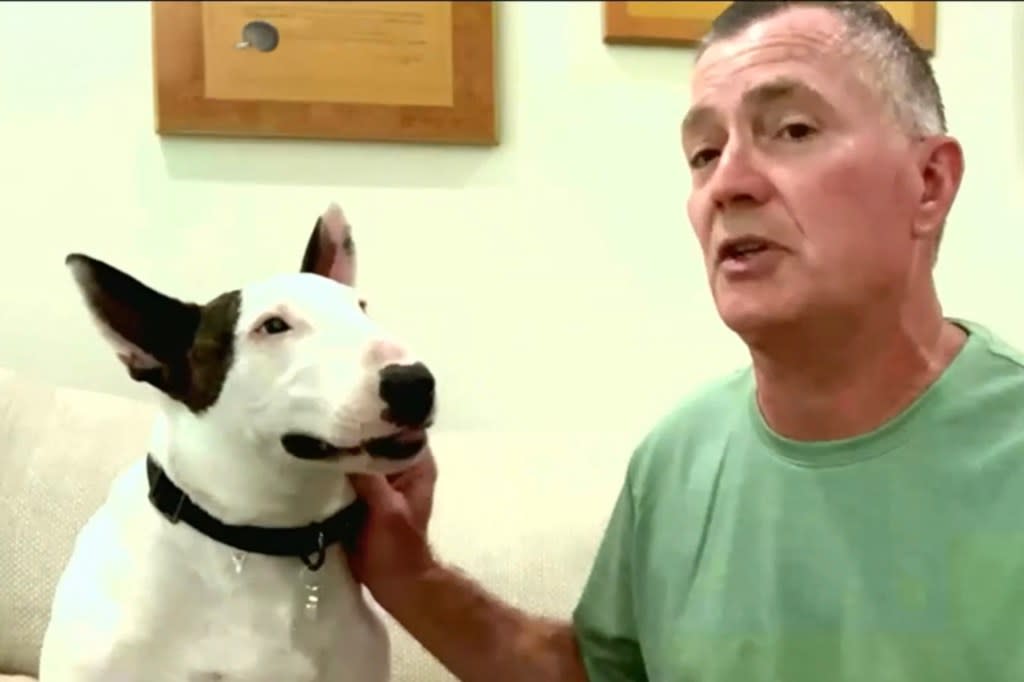
After his medical treatment and recovery, Trooper eventually met Frank and Karla Spina.
Their relationship with him would become the final transformation in his story.
Not another emergency.
Not another surgery.
Not another courtroom discussion.
A home.
Trooper went from a dog whose movement had once been limited by a leash beside an interstate to a dog with soft places to sleep and people who expected him to be there the next morning.
The contrast was enormous.
No fence holding him in place.
No floodwater rising around his legs.
No traffic rushing past while he waited.
His world became smaller in a completely different way.
A family.
Meals.
Rest.
Affection.
The ordinary routines that many dogs spend their entire lives taking for granted.
For Trooper, ordinary was something worth celebrating.
Becoming a Dog Instead of a Headline
For a period of time, Trooper had been known almost entirely through one image.
The hurricane dog.
The Bull Terrier tied beside I-75.
The dog whose rescue went viral.
The dog at the center of a criminal case.
The dog whose name appeared on legislation.
But none of those labels described what Trooper needed most.
He needed to be allowed to become simply a dog.
A dog who could wait for dinner instead of waiting for someone to return.
A dog who could stretch out comfortably rather than remain tethered within a few feet of metal fencing.
A dog whose daily concerns could become ordinary ones.
Where is the food?
Who is sitting on the couch?
Is someone available for attention?
That change may be the most important part of his entire story.
Trooper no longer had to represent anything while at home.
He did not have to be a symbol of abandonment.
He did not have to be evidence in a case.
He did not have to carry the meaning that people placed on his experience.
He could simply belong.
The Photograph From the Highway Still Matters
It is impossible to tell Trooper’s story without returning to the image of him beside the interstate.
Rain.
Floodwater.
A white dog.
A metal fence.
A leash that prevented him from going anywhere.
The photograph remains difficult because of how many things could have gone wrong.
What if the officer had not seen him?
What if the water had continued rising?
What if traffic, debris, or worsening conditions had made the rescue impossible?
Trooper survived partly because someone arrived while there was still time.
That is why disaster planning matters for animals as much as it does for people.
Pets rely on human decisions long before a storm makes landfall.
Transportation.
Identification.
Medication.
Food.
A safe destination.
A plan for what happens if the first plan fails.
Trooper had none of those choices for himself.
Every option depended on the people around him.
Rescue Did Not Erase What Happened
A happy home does not rewrite the highway.
Medical treatment does not erase the tumors or the foreign material veterinarians removed.
A new law does not change the fact that Trooper was found restrained during a major hurricane.
Rescue cannot make those moments disappear.
What it can do is prevent them from being the final moments.
That distinction defines Trooper’s journey.
His story did not stop at the fence.
It moved to veterinary care.
Then recovery.
Then a family.
And finally, into a broader conversation about how animals should be protected when disasters force people to evacuate.
Each stage added something the previous one could not provide.
The officer gave him immediate safety.
Veterinarians addressed his health.
Rescuers provided recovery.
A family gave him permanence.
And lawmakers, according to the account surrounding his case, used his experience as the name behind stronger disaster-related animal protections.
From a Fence Beside the Highway to a Home
Today, the most powerful image of Trooper may not be the one from Hurricane Milton.
It may be the quieter photographs that came later.
Trooper sitting safely beside his new family.
Trooper resting without a restraint around him.
Trooper living a routine so ordinary that, for another dog, it would barely deserve mentioning.
That ordinary life is the victory.
Not because Trooper understands how close the storm came.
Not because he knows people across the country learned his name.
And certainly not because he understands that legislation now carries it.
But because he no longer needs to survive each day as an emergency.
There is food.
There is shelter.
There are people expecting him home.
What Trooper’s Story Leaves Behind
Trooper’s story contains several chapters that could each have defined him.
The dog tied beside I-75.
The hurricane rescue.
The cancer diagnosis.
The stomach filled with dangerous debris.
The legal case.
The new law.
The adoption.
But perhaps the most meaningful lesson comes from something simpler.
Animals cannot prepare themselves for disasters the way people can.
They cannot choose evacuation routes.
They cannot book a hotel.
They cannot untie a leash from a fence.
Their safety depends on the choices humans make for them.
On October 9, 2024, Trooper had no control over where he was.
Then a highway patrol officer stopped.
From that moment forward, people began making very different choices on his behalf.
They removed him from danger.
They treated his body.
They gave him time to recover.
They opened a home.
And his name became attached to an effort intended to protect other animals when the next storm comes.
Once, Trooper stood in rising water with nowhere to go.
Now he has somewhere to return to.
A home.
A family.
A life beyond the fence.
And that may be the clearest measure of how far he has traveled.


