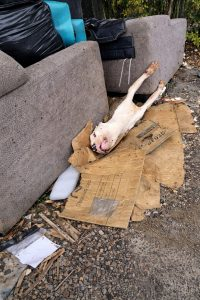
At first, there was nothing unusual about the old couch.
It sat among scattered debris in an overlooked part of Houston, weathered and broken like something no one wanted anymore.
A local community feeder had seen scenes like this many times before. She regularly visited the area to leave food for animals living on the streets, checking quietly on the dogs and cats that had learned to survive around abandoned lots and discarded belongings.
That afternoon, she might have walked past the couch without giving it another thought.
Then something moved underneath it.
She stopped.
Looked closer.
And realized there was a dog beneath the furniture.
An elderly dog.
Painfully thin.
Too weak to get himself out.
His name would become Jericho.
And that moment—when someone chose to investigate a small movement beneath what looked like trash—would change the course of whatever time he had left.
The Old Dog Beneath the Couch
Jericho was wedged beneath the discarded furniture, his fragile body partially trapped in the narrow space below.
He did not bark when the woman approached.
He did not scramble frantically to escape.
He barely seemed capable of moving at all.
His body was extremely thin, and his legs offered little strength. His age was visible in nearly every part of him—from his limited mobility to the cloudy appearance of his eyes.
No one could say exactly how long he had been there.
It was also impossible to know every detail of how Jericho ended up beneath the couch.
What was clear was much simpler.
He could not free himself.
And in his condition, leaving him there was not an option.
The feeder called for help.
For Jericho, the long period of being overlooked was finally coming to an end.
Video: Too Weak to Escape From Beneath a Discarded Couch, Jericho Is Finally Carried to Safety
Getting Him Out Had to Be Done Slowly
Moving an elderly dog in such poor condition required care.
Jericho was not simply thin.
He was frail enough that rescuers had to consider how much stress his body could tolerate.
They worked around the couch carefully, creating enough room to reach him without pulling roughly against his weakened body.
Jericho offered little resistance.
Whether that stillness came from exhaustion, weakness, or both, no one wanted to push him beyond what he could manage.
Eventually, the rescuers were able to lift him free.
And once Jericho was no longer hidden beneath the furniture, the extent of his condition became easier to see.
His frame was severely underweight.
His legs were weak.
Standing appeared extremely difficult.
His vision also seemed impaired.
This was not an animal who needed only a meal and a bath.
Jericho needed medical care.
Immediately.
The Hospital Could Not Promise a Miracle
Jericho was taken directly to an emergency veterinary hospital.
During the drive, there was no certainty about what the doctors would find—or how much his elderly body could recover from.
But the rescuers had already made one decision.
Whatever happened next, Jericho would receive care.
At the hospital, veterinarians began evaluating him carefully.
The problems were significant.
Jericho had severe weight loss.
His mobility was limited.
His vision was impaired.
And his overall condition suggested that his decline had developed over a long period rather than from one recent incident.
His body did not tell the story of a single bad day.
It showed the accumulation of time without the support an aging dog needs.
For the veterinary team, this changed the goal of treatment.
Jericho did not need to be pushed toward an unrealistic recovery.
He needed to be comfortable.
He needed stability.
And he needed his remaining quality of life to matter.
Sometimes Rescue Means Choosing Comfort
With a younger, stronger dog, aggressive treatment may sometimes be appropriate.
Jericho was different.
His body was already fragile, and putting him through stressful interventions simply for the sake of doing more could have caused additional hardship.
So his medical team focused on supportive care.
Pain management.
Monitoring.
Nutrition.
Circulation and physical comfort.
Rest.
The goal was not to turn Jericho into a young dog again.
No one could do that.
The goal was to make sure the elderly dog who had been found beneath discarded furniture finally experienced what it meant to be cared for.
That distinction mattered.
Rescue is often associated with dramatic transformations.
A starving dog gains weight.
A frightened dog learns to play.
An injured dog runs again.
But there is another kind of rescue that rarely receives the same attention.
Sometimes success means allowing an old dog to sleep without discomfort.
Sometimes it means helping him eat.
Sometimes it means giving him a clean blanket and knowing someone will notice if he needs help.
For Jericho, those ordinary things were becoming extraordinary.
Then He Began Eating on His Own
The first improvements were quiet.
Jericho began eating.
His appetite was not enormous.
But it was consistent enough to encourage the people caring for him.
A little food became another little meal.
And then another.
For a dog with so little body weight remaining, every meal mattered.
As his routine became more predictable, Jericho also began responding more to the people around him.
He noticed familiar voices.
He accepted gentle touch.
At times, he leaned subtly toward a hand offering affection.
There was nothing dramatic about these moments.
Jericho did not suddenly leap into someone’s arms.
He did not become energetic overnight.
But he was participating.
He was noticing.
He was allowing care into his world.
That was progress.

A Foster Home Offered Something Medicine Could Not
Once Jericho was stable enough to leave the hospital, he was placed in a medical foster home.
This next step mattered enormously.
Hospitals can treat illness and monitor physical problems.
A foster home can provide something different.
Routine.
Quiet.
Familiarity.
A person who begins recognizing the small differences between a good day and a difficult one.
For an elderly dog with impaired mobility and vision, those details matter.
Jericho’s foster caregiver understood that his recovery would not follow a predictable timeline.
There could be setbacks.
There could be mornings when he needed more help than the day before.
There could be days when rest was more important than exercise.
None of that made him less deserving of a home.
His foster space was arranged around what he could manage.
Soft bedding replaced the hard surfaces of the streets.
Warm meals arrived regularly.
He no longer had to search for shelter.
And when he needed assistance, someone was there.
For the first time in an unknown amount of time, Jericho did not have to solve every problem alone.
The Day His Legs Lifted Him Up
One of Jericho’s most memorable milestones came when he attempted to stand.
His legs were extremely weak.
They trembled beneath him as he shifted his weight.
His caregiver remained nearby, prepared to support him.
Jericho pushed upward.
For a moment, his body rose.
He stood.
Unsteadily.
Briefly.
But he stood.
No one mistook that moment for complete recovery.
Jericho’s mobility challenges had not suddenly disappeared.
He was still an elderly dog carrying the effects of prolonged decline.
But the attempt mattered.
It showed that he still had some strength to work with.
His caregivers encouraged him without forcing him.
That balance became central to his care.
Support him.
Allow him to try.
But never demand more than his body could comfortably give.
Progress would happen on Jericho’s terms.
Meeting the Dog Hidden Beneath the Frailty
As the weeks passed, caregivers began learning more about Jericho himself.
Not Jericho the rescue case.
Not Jericho the emaciated dog from beneath the couch.
Jericho.
He was gentle.
He enjoyed warm food.
He appreciated soft bedding.
He seemed comfortable with familiar people nearby.
His reactions to affection were often understated.
A small lean.
A relaxed posture.
A look toward someone speaking softly to him.
These gestures could easily have been overlooked.
But the people caring for him learned to recognize them.
For an old dog whose world had become so uncertain, trust did not need to look dramatic.
Sometimes it looked like remaining beside someone instead of withdrawing.
Sometimes it looked like allowing a hand to rest gently against his head.
Sometimes it was simply sleeping peacefully because the room around him finally felt predictable.
There Were Still Difficult Days
Jericho’s improvement was never perfectly steady.
Some days he seemed stronger.
On others, age and weakness were more obvious.
That was expected.
Healing does not move in a straight line, especially for senior animals with long-standing problems.
His eyesight remained limited.
His legs remained weak.
His body continued requiring more support than that of a younger dog.
The people caring for him adjusted their expectations accordingly.
Success was not measured by whether Jericho could run.
It was measured differently.
Did he eat today?
Was he comfortable?
Could he rest?
Was he interested in the people around him?
Did he have moments he appeared to enjoy?
Those questions became more important than chasing an impressive before-and-after transformation.
Because Jericho did not need to become extraordinary.
He needed to be allowed to live with dignity.

The Couch Was Only One Moment in His Life
It would be easy for Jericho to become known only as “the dog beneath the couch.”
The image is powerful.
An elderly, emaciated animal lying under abandoned furniture in an overlooked area of Houston.
But Jericho’s story continued beyond that moment.
There was the trip to the emergency hospital.
The first meals he ate willingly.
The gentle examinations he tolerated.
The move into foster care.
The trembling attempt to stand.
The warm bed.
The familiar voices.
Those moments deserve to be remembered too.
Because rescue did not suddenly make Jericho valuable.
It simply brought people into his life who treated him as though he had always been valuable.
Old Dogs Deserve More Than Being Written Off
Senior rescue animals often arrive with needs that can seem intimidating.
Mobility problems.
Poor eyesight.
Chronic conditions.
Special diets.
Medication.
More frequent veterinary visits.
Sometimes there is no promise of many years ahead.
That can make people focus on what an elderly animal cannot offer.
Jericho’s caregivers chose to focus on something else.
What could still be given to him.
A comfortable afternoon.
A good meal.
Gentle touch.
A safe night.
A familiar person nearby.
These things may sound small when measured against an entire lifetime.
But to an animal experiencing them in the present, they are not small at all.
Jericho could not get back whatever years had already passed.
Neither could his rescuers.
What they could change was the way his remaining time felt.
Everything Began Because Someone Looked Again
Jericho’s rescue did not begin with a specialized piece of equipment or a dramatic operation.
It began with attention.
A community feeder saw movement beneath an abandoned couch.
Instead of assuming it was nothing, she went closer.
That led to a rescue.
The rescue led to emergency veterinary care.
Veterinary care led to medical fostering.
And foster care gave Jericho the chance to experience comfort and routine.
One action connected to another.
This is often how overlooked animals are saved.
Someone notices.
Someone calls.
Someone responds.
Someone opens a home.
None of those actions alone can fix every problem surrounding abandonment and neglect.
But for one animal, they can mean everything.
Jericho No Longer Has to Fight for Every Day
Today, Jericho has challenges.
His age has not disappeared.
His mobility is still limited.
His eyesight remains impaired.
There are days when he needs more help than others.
But there is one difference that changes everything else.
He is not facing those challenges alone.
When he is hungry, food arrives.
When he needs rest, there is somewhere soft to lie down.
When he struggles to move, someone notices.
When the day becomes difficult, there is a person nearby.
No one can know exactly how much time Jericho has.
That was never something his rescuers could control.
What they could control was whether that time would be spent overlooked.
And it will not.
The old couch where he was found is now part of his past.
So is the moment when he was too weak to crawl out by himself.
Jericho’s life today is quieter.
Warmer.
Safer.
He does not need a miracle to make his rescue meaningful.
He does not need to run again.
He does not need to become young.
Jericho only needed someone to recognize that an elderly dog who could barely stand was still worthy of tenderness.
Someone finally did.
And now, instead of lying unnoticed beneath something the world had thrown away, Jericho rests in a place where every small need is seen.
For an old dog who had once become almost invisible, being seen may be one of the greatest gifts of all.


