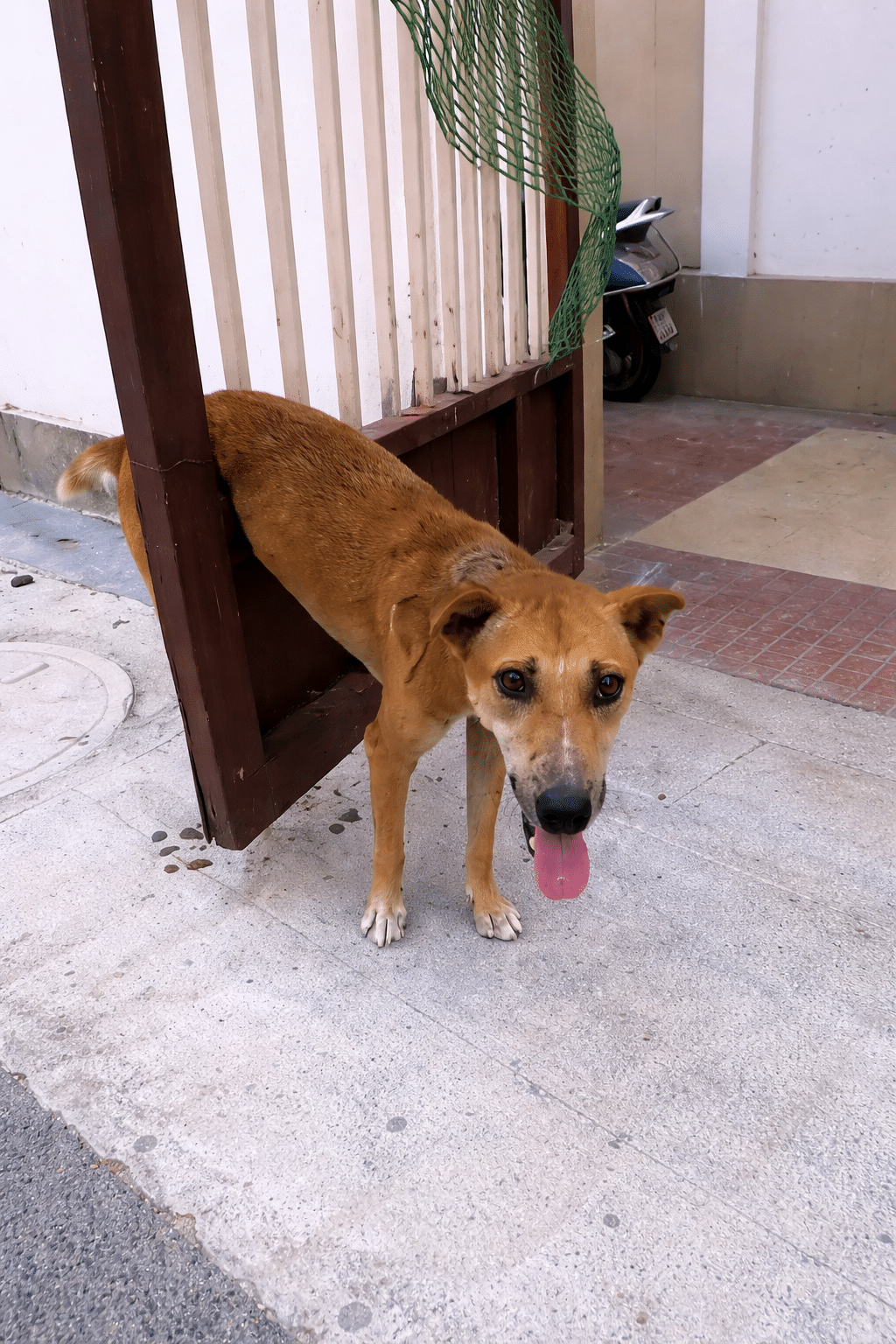
At first, the opening in the metal gate must have looked wide enough.
A brown stray dog had tried to squeeze through the narrow space between two iron bars.
Part of his body made it through.
The rest did not.
Within moments, the dog was stuck.
He could not continue forward.
He could not pull himself backward.
Every attempt to twist free only left him more exhausted.
The metal bars pressed closely around his body while he remained trapped beside the property gate.
Then someone nearby noticed what had happened.
That simple moment of attention brought help to a dog who had no way to free himself alone.
The More He Struggled, the Harder It Became
The dog had already spent time trying to escape before rescuers arrived.
He twisted his body.
He pushed.
He pulled backward.
But the spacing between the bars was simply too narrow.
The problem was not only that he was stuck.
It was that struggling harder could make the situation worse.
An awkward movement could place more pressure on his body or cause him to injure himself against the metal.
Eventually, exhaustion began to replace frantic movement.
The dog remained wedged in place, breathing quickly and watching everything around him.
A nearby person realized that pulling him out without experience could be risky.
Instead, they called for professional help.
Video: A Stray Dog Became Wedged Between Iron Bars — Watch How Rescuers Carefully Freed Him
Blue Cross of India Responded to the Call
A rescuer from Blue Cross of India arrived at the property.
By then, the dog was visibly stressed.
He was surrounded by unfamiliar people while unable to move away from them.
That made the rescue more delicate.
A frightened animal can react defensively when touched, even when the person approaching is trying to help.
The rescuer did not immediately begin pulling at the dog.
First, he needed to make the situation safer for everyone involved.
Using a simple length of rope, he created a temporary muzzle.
The purpose was not punishment.
It was a safety precaution while working at close range around an animal whose fear level was difficult to predict.
Once the dog was secured, the rescuer could focus on the real problem.
The gate.
Pulling Harder Was Not the Answer
The dog could not simply be dragged backward.
His body was positioned awkwardly between the bars.
Using force could have caused additional pain or injury.
So the rescuer chose a slower approach.
He examined how the dog had become lodged.
Then he began adjusting the animal’s position.
The goal was to recreate the angle that had allowed part of the body through in the first place.
Instead of pulling directly backward, the rescuer lifted the dog’s hind legs.
That changed the position of his hips.
Then he carefully rotated the body slightly.
A little higher.
A little to one side.
Then another adjustment.
The movement had to be controlled.
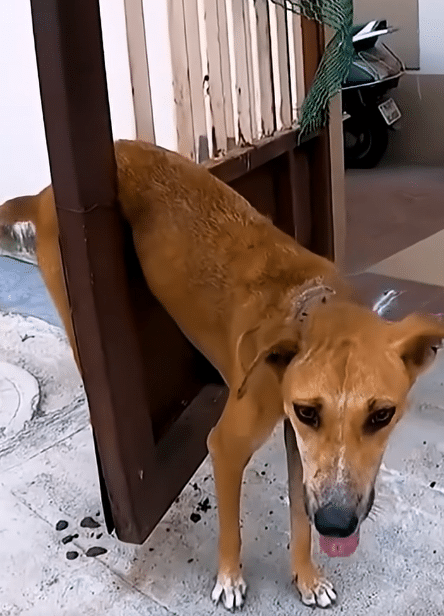
Every Small Change Created a Little More Space
The rescue became a matter of inches.
The dog was still surrounded by the narrow iron bars.
But each careful change in position reduced the pressure holding him there.
The rescuer continued supporting the rear of the dog’s body.
He did not rush.
He did not yank.
He simply kept adjusting until the dog’s body began lining up with the gap.
Gradually, the trapped section started moving.
The dog was still tense.
The rescuer kept one hand controlling his position while continuing to guide the rest of his body through.
Then the gap finally became wide enough.
The dog began to slide free.
One Final Adjustment Was Enough
After several careful attempts, the dog’s body cleared the bars.
He was no longer trapped.
For the first time since entering the gap, there was nothing restricting his movement.
The rescuer kept control briefly while making sure the dog was completely clear of the gate.
Then he removed the temporary rope muzzle.
There was no need for complicated equipment.
No section of the gate had to be cut away.
The solution had simply required understanding how the dog was positioned and changing that angle slowly enough to avoid causing harm.
Within moments, the entire rescue was over.
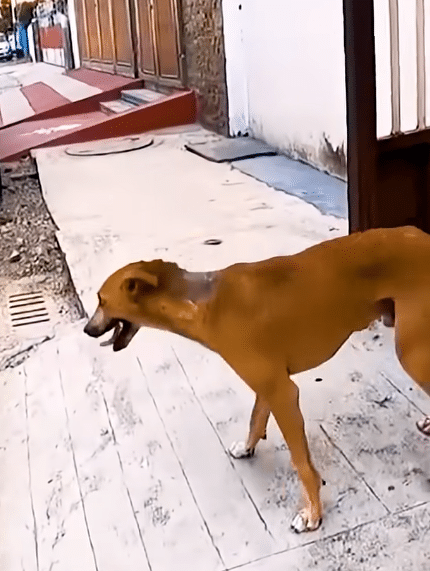
Once Released, the Dog Did Not Stay Long
As soon as he was free and the muzzle had been removed, the brown dog stood on his own.
Then he moved away.
Within seconds, he was running down the road.
There was no long recovery scene documented in the original account.
No shelter intake.
No adoption ending.
The dog simply left the property under his own power.
That was enough to show that the immediate danger had passed.
Only minutes earlier, he had been unable to move more than a few inches.
Now he could choose where to go again.
A Small Rescue Still Required the Right Approach
Compared with rescues involving major injuries or emergency surgery, this situation may appear simple.
But freeing a frightened dog from rigid metal bars still carried real risks.
Pulling too hard could have hurt him.
Approaching too quickly could have caused panic.
Working without a safety precaution could have put both the dog and rescuer at risk.
The outcome depended on patience more than strength.
One person noticed the problem.
Blue Cross of India responded.
The rescuer secured the dog safely.
Then he changed the animal’s position little by little until the bars finally let him go.
The Gate Stayed Behind — The Dog Did Not
Afterward, the iron fence looked exactly the same.
The narrow opening remained.
The road remained.
But the dog was no longer trapped there.
His story ended simply.
He ran.
That may be the clearest sign that the rescue had worked.
There was no dramatic final scene.
Just a stray dog moving freely again after being stuck in a place he could not escape on his own.
Sometimes rescue means weeks of treatment.
Sometimes it means surgery.
And sometimes it means one careful person recognizing that the answer is not to pull harder—but to slow down, change the angle, and give an animal just enough room to get free.


