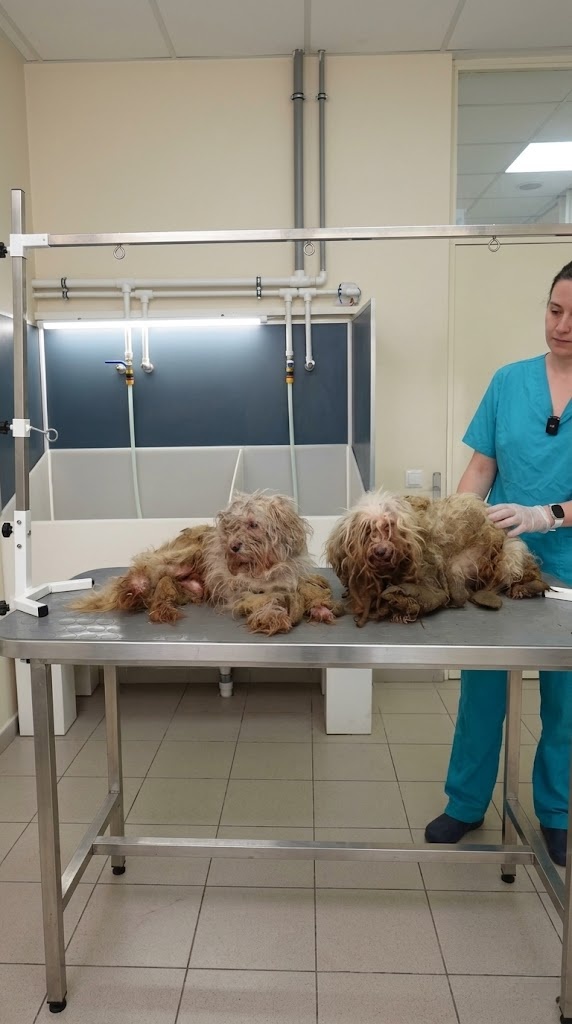
At first, Lana could barely tell where one dog ended and the other began.
Two small animals sat close together beside a quiet road, their bodies almost completely hidden beneath thick, hardened coats. Years of tangled fur had formed heavy shells around their legs, faces, and undersides.
One of the dogs appeared unable to stand for more than a few moments.
The other remained beside her.
Neither tried to run when Lana approached.
They simply stayed pressed together, waiting to see what the stranger would do next.
Two Small Dogs Hidden Beneath Their Own Coats
The pair had been left in a condition that made even ordinary movement difficult.
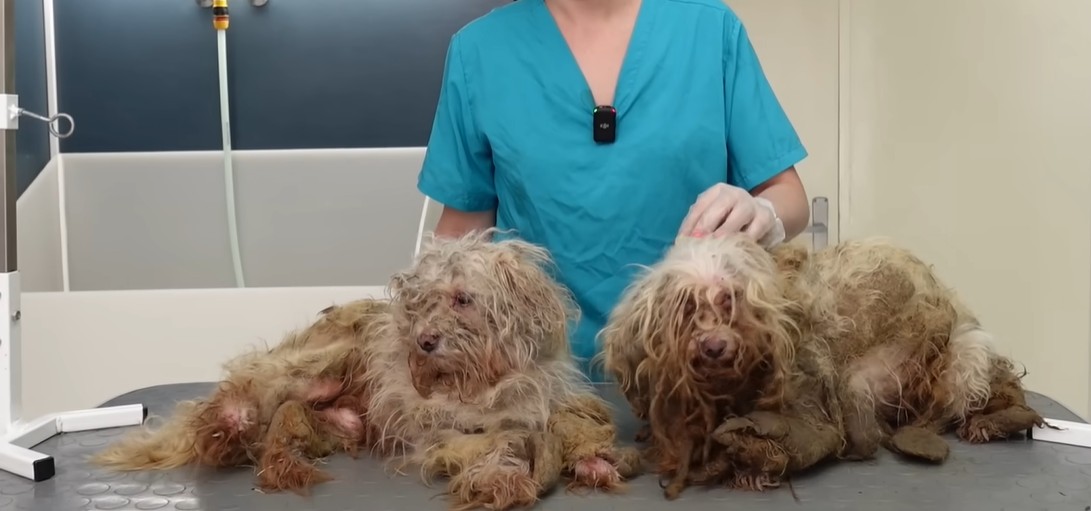
Their coats were not simply dirty or overdue for grooming. Large sections of fur had fused into dense mats that pulled against the skin whenever the dogs shifted position.
Their paws were barely visible.
The outlines of their legs had disappeared beneath the tangled coat.
Dirt, moisture, and waste had become trapped inside the fur, creating an environment where irritation and infection could develop unnoticed.
Lana understood that she could not safely remove the mats herself.
Cutting too close could injure the fragile skin underneath. Bathing the dogs before separating the hardened fur might make the mats tighten further and place even more pressure on their bodies.
She contacted a local groomer experienced with severely neglected rescue dogs.
The dogs were later named Mickey and Minnie.
Before anyone could begin treating their skin or assessing their true condition, the heavy coats had to come off.
Video: Mickey and Minnie Arrive With Their Faces and Legs Hidden Beneath Severe Matting
Grooming Became a Careful Rescue Procedure
Inside the grooming space, the extent of the neglect became clearer.
An unpleasant odor came from the compacted coats, suggesting that moisture and waste had remained trapped against the dogs for a long time.
The groomer prepared clippers, scissors, towels, and medical supplies.
This would not be a normal grooming appointment.
Every section had to be examined before it was cut. The mats sat close to the skin, making it difficult to know where the fur ended and the body began.
Mickey and Minnie were handled slowly.
The groomer supported them whenever they needed to change position and paused when either dog appeared uncomfortable or tired.
Large sections of coat came away in heavy pieces.
With each pass of the clippers, more of their bodies became visible.
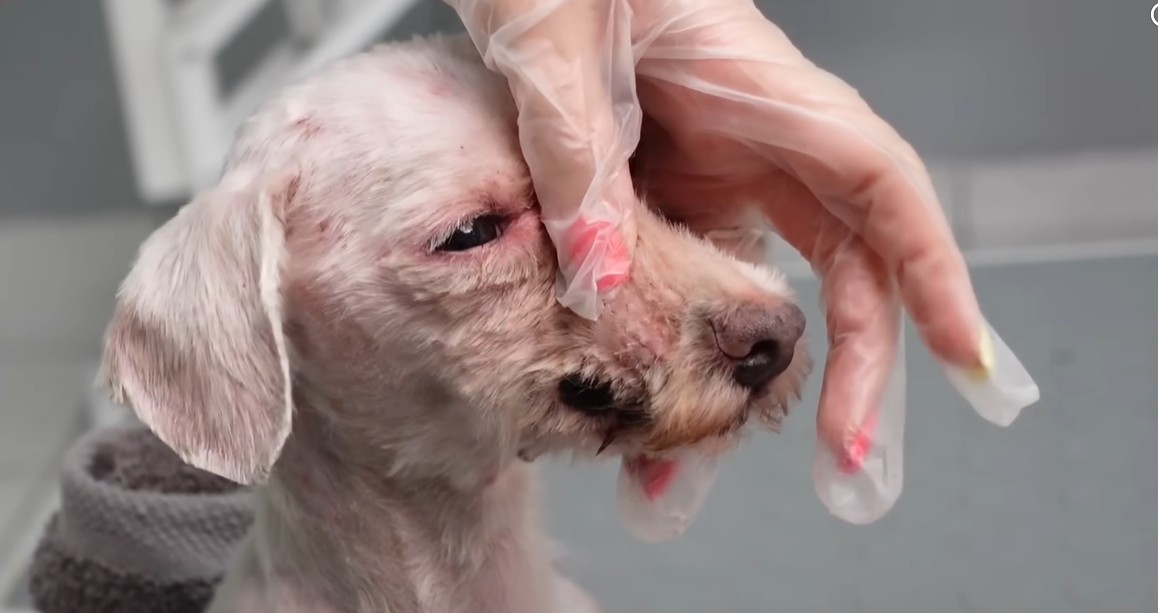
Their legs were much thinner than the surrounding fur had suggested. Their skin was irritated in several areas, and their movement remained cautious after being released from the constant pulling of the mats.
Minnie was especially weak.
Once the coat around her legs had been removed, it became clear that she could not properly support herself. She tried to rise, but her body lowered again almost immediately.
Mickey remained nearby.
When Minnie rested, he settled close to her. When people moved her for examination, his attention followed.
The rescuers could not know exactly how long the dogs had lived together or what they had experienced before being found.
But their behavior showed that separation made them uneasy.
Whenever possible, the team allowed them to remain within sight of one another.
The First Days Required More Than Clean Fur
Removing the mats brought immediate physical relief, but it did not complete the rescue.
Both dogs needed veterinary evaluation.
Dr. Nenad began assessing their skin, weight, mobility, and overall condition. Areas that had remained hidden beneath the coat required cleaning and treatment.
Medication and continued skin care became part of their routine.
They also needed carefully selected food to help restore strength and support healthy coat growth.
The groomer and her husband agreed to foster Mickey and Minnie while they recovered.
Their home offered something the dogs had not possessed beside the road: a controlled, quiet environment where every meal, movement, and physical change could be monitored.
During the first days, the pair rested frequently.
Minnie still struggled to stand.
Her foster caregivers placed bedding where she could lie comfortably without pressure against the sensitive areas of her skin. Food and water were kept close so she would not need to cross the room before she had regained enough strength.
Mickey moved more easily, but he rarely traveled far from her.
He rested beside Minnie’s bed.
He approached when caregivers examined her.
When she attempted to move, he often stood nearby or followed at her pace.
It would be easy to describe his behavior as though he understood every part of her medical condition.
No one could know that.
What they could see was that Mickey consistently chose to remain close.
For Minnie, that familiar presence may have made the unfamiliar home easier to tolerate.
Minnie Learned to Support Herself Again
Recovery developed gradually.
Regular meals began restoring weight and energy to both dogs. Their irritated skin received continued treatment, and the areas exposed during grooming slowly became less inflamed.
Minnie’s progress required particular patience.
At first, standing lasted only seconds.
Her legs trembled beneath her, and caregivers remained close enough to support her if she lost balance.
They did not force her to walk long distances.
Instead, she was encouraged to make small, controlled movements.
Stand.
Pause.
Take one step.
Rest.
Then try again later.
Mickey often became part of those exercises without being asked.
When he moved across the room, Minnie watched him.
As her strength increased, she began attempting to follow.
The distance might be only a few feet, but it gave her a clear reason to move forward.
Over time, her stance became steadier.
A few steps became a short walk.
She no longer lowered herself immediately after standing.
Her caregivers continued matching activity to what her body could safely manage, understanding that progress after prolonged neglect rarely happens in a straight line.
Some days brought visible improvement.
Other days required more rest.
Mickey remained part of each stage.
He did not heal her legs or replace veterinary care. But his familiar presence accompanied her through the uncertain early weeks.
Their Fear Slowly Gave Way to Curiosity
Physical recovery was only one part of the change.
When Mickey and Minnie first arrived, they appeared cautious around unfamiliar hands and surroundings.
They did not yet know what would happen when someone approached.
The routines in foster care began answering that uncertainty.
Hands brought food.
Baths were followed by warm towels.
Skin treatment stopped when either dog became uncomfortable.
People entered the room and left without causing harm.
Beds remained available every night.
As those experiences repeated, both dogs began interacting more openly with their caregivers.
Mickey approached first more often.
He investigated hands and followed people through the room.
Minnie took longer, but she gradually stopped shrinking away from gentle touch. She lifted her head when familiar voices entered and began moving toward the people providing her care.
Their eyes appeared brighter as their health improved.
Their bodies filled out.
New coats began growing where the mats had been removed.
Eventually, moments of play appeared.
Mickey moved toward Minnie with more energy, and she responded instead of remaining still. Their interactions remained gentle while Minnie continued regaining strength.
The dogs had not suddenly forgotten their earlier fear.
They had simply experienced enough safety to become curious again.
Video: Mickey and Minnie Two Months Later—Walking, Playing and Growing New Coats
Lana Never Stopped Following Their Recovery
The woman who first noticed the dogs did not disappear after bringing them to safety.
Lana remained involved while Mickey and Minnie recovered.
She visited them, followed their veterinary progress, and watched their personalities emerge as the neglected coats and physical weakness began to recede.
At first, the dogs had been almost entirely defined by their condition.
They were the pair beside the road.
The dogs hidden beneath mats.
The little female who could barely stand.
Weeks of care revealed far more.
Mickey was attentive and eager to remain near familiar people.
Minnie was quieter but increasingly affectionate as her confidence grew.
Together, they had established routines that reflected how closely their lives were connected.
They rested near each other.
They moved through the home together.
When one dog became interested in something, the other usually followed.
As their health improved and adoption became possible, Lana faced an important decision.
Separating them might have created additional stress after everything they had experienced together.
She had also developed a relationship with both dogs throughout their rehabilitation.
Rather than searching for two different homes, Lana chose to adopt Mickey and Minnie herself.
The person who had stopped beside the road became the person waiting for them at home.
The Life They Reached Together
Mickey and Minnie’s new life was not defined by one dramatic adoption day.
It developed through ordinary routines.
Regular meals.
Scheduled veterinary care.
Grooming before tangles could become painful.
Soft places to sleep.
Time outside.
Quiet moments near the people they had learned to trust.
Their coats continued growing, now maintained through consistent care. Minnie became stronger and increasingly capable of moving without the instability seen during her first days.
Mickey continued staying close, though the reason was no longer that Minnie lay too weak to stand.
Now they could explore together.
Rest together.
Play together.
The roadside remained part of their history, but it no longer controlled their daily lives.
Their transformation was not created through grooming alone.
The clippers revealed their bodies.
Veterinary care treated the physical damage.
Nutrition helped rebuild their strength.
Foster care gave them stability.
And Lana provided a permanent home where the pair would not have to lose each other after surviving so much side by side.
When they were first found, Mickey and Minnie appeared to possess almost nothing.
No safe shelter.
No reliable care.
No one nearby who knew their names.
But they had remained together.
Then Lana looked closely enough to notice them.
That single pause led to a groomer, a veterinarian, a foster home, and eventually an adoption that kept their bond intact.
Once, they sat beside the road hidden beneath years of neglect.
Today, there is no longer any difficulty telling the two dogs apart.
Their faces are visible.
Their legs move freely.
Their personalities have room to appear.
And when they settle down at the end of the day, they still choose a place beside each other.


