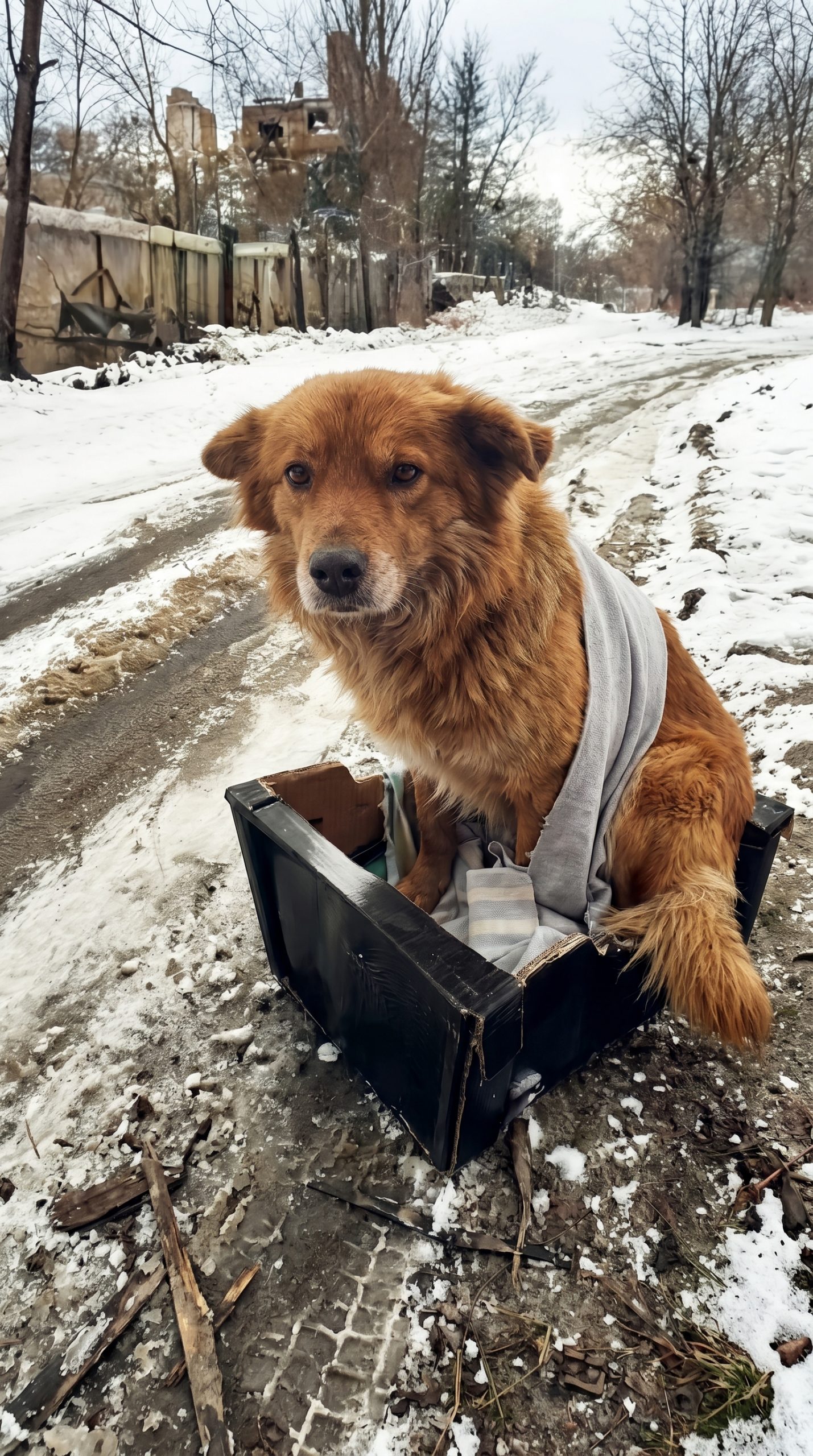
Veta was lying alone on a deserted road when someone finally noticed her.
Dust clung to her body. Her hind legs remained completely still, and when rescuers approached, she made no attempt to drag herself away.
She simply watched them.
Her condition suggested that whatever had happened was not recent. Something serious had already taken away the use of her back legs, and she had been surviving without the medical care she needed.
But there was another detail no one understood yet.
Even after being brought to safety, Veta barely moved from the place where caregivers set her down.
At first, they believed pain or fear was responsible.
Then an ultrasound revealed something none of them had expected.
Veta was pregnant.
X-Rays Revealed an Injury That Could No Longer Be Reversed
Veta was taken directly to a veterinary clinic.
There, X-rays provided the first clear explanation for her paralysis.
Her spine had been badly fractured weeks earlier.
Because the injury had gone untreated for so long, it had already healed incorrectly. The damage was permanent, and veterinarians could not restore normal use of her hind legs.
That alone would have made Veta’s case difficult.
Then another concern appeared.
During her examination, doctors discovered a mass in one of her mammary glands.
Cancer could not immediately be ruled out.
A biopsy was performed, but the results would take time.
For now, rescuers brought Veta back to the shelter and focused on keeping her comfortable.
They placed her on soft bedding.
They helped reposition her.
They stayed nearby.
And that was when they began noticing something unusual.
VIDEO: Veta Couldn’t Move Her Back Legs — Then Doctors Discovered She Was Carrying a Puppy
She Would Lie in One Place for Hours Without Moving
Most dogs with limited mobility still attempt to adjust their position.
Veta rarely did.
If caregivers placed her on a blanket, she sometimes remained almost exactly where they had left her for hours.
Occasionally, nearly an entire day would pass with very little movement.
At first, the team suspected discomfort.
Perhaps dragging herself hurt.
Perhaps unfamiliar surroundings frightened her.
But they also noticed how frequently Veta watched the doorway and followed movement around the room with her eyes.
There was no way to know exactly what she was thinking.
Still, something about her behavior made caregivers wonder whether another medical issue had been missed.
They decided to bring her back for additional testing.
This time, veterinarians performed an ultrasound.
The screen provided the answer.
Inside Veta was a developing puppy.
She was pregnant.
Twenty Days Later, One Tiny Puppy Arrived
Pregnancy complicated almost every part of Veta’s care.
Her body was already weakened.
She could not use her hind legs.
She required assistance with basic functions, including urination.
And some medications had to be reconsidered while veterinarians protected the developing puppy and later her milk supply.
For the next several weeks, caregivers watched her closely.
Then, roughly twenty days after her pregnancy was discovered, Veta gave birth.
There was only one puppy.
Tiny.
Fragile.
Alive.
They named him Timosha.
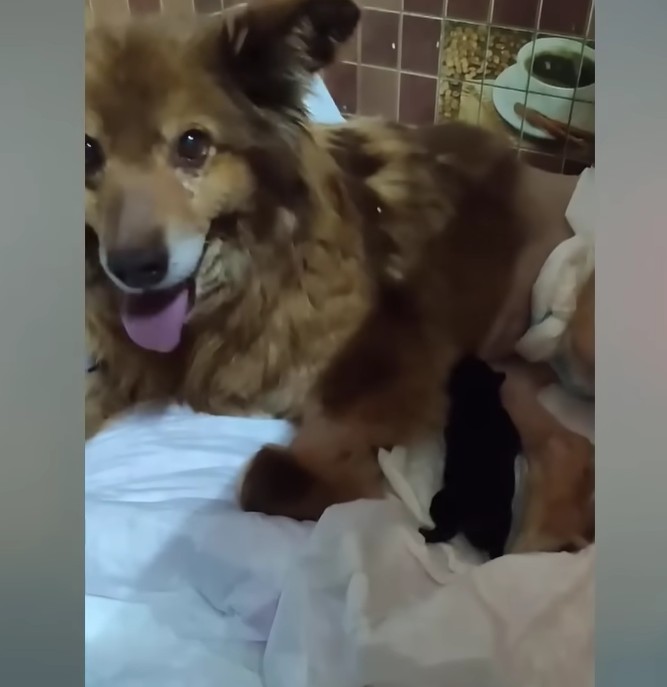
When he was placed beside his mother, Veta immediately became attentive to him.
She listened to his movements.
Kept him close.
Allowed him to nurse.
The same dog who had spent long stretches lying quietly now appeared increasingly engaged whenever her puppy was nearby.
No one could know whether Veta had deliberately remained still before the birth to protect him.
But once Timosha arrived, one thing was unmistakable.
Her attention was fixed on her baby.
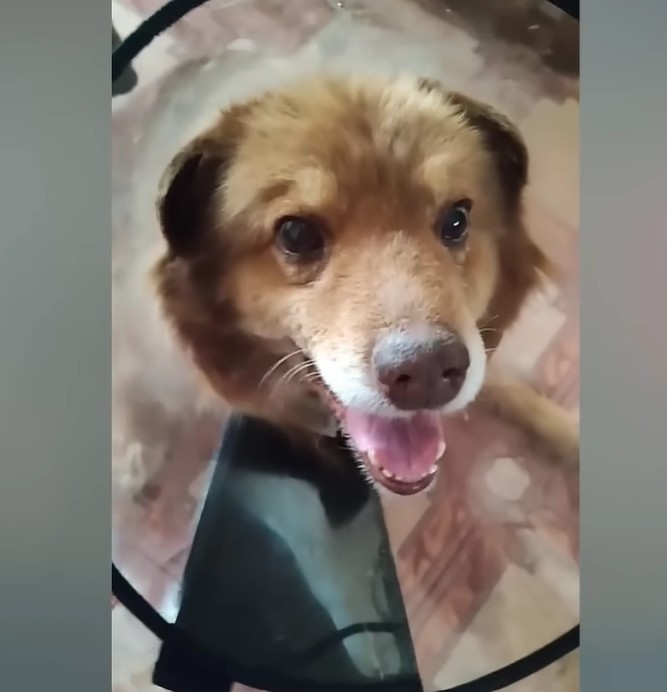
Caring for Timosha Made Veta’s Recovery More Complicated
Motherhood did not make Veta’s medical problems disappear.
In some ways, it made her care more demanding.
Because of her paralysis, caregivers still needed to help her empty her bladder.
That meant assistance throughout the day and night.
Her medication also required careful management while she was nursing.
Her own rehabilitation progressed slowly.
Yet Veta continued caring for Timosha.
As he grew, the puppy became stronger and increasingly active.
He crawled beside her.
Then walked.
Then began exploring the space around them.
Veta could not follow him in the way an able-bodied mother might.
But she remained attentive to his sounds and movements.
And whenever Timosha returned to her side, she settled with him.
Then the Biopsy Results Finally Came Back
Throughout Veta’s pregnancy and the first weeks of Timosha’s life, another uncertainty remained.
The mammary mass.
Everyone was still waiting for the biopsy.
If the growth was malignant, Veta would face another serious medical challenge on top of her spinal injury and paralysis.
Eventually, the results arrived.
The mass was benign.
There was no cancer diagnosis.
For the people caring for her, the news removed one enormous concern.
Veta still had significant long-term needs.
Her spinal damage remained permanent.
She would continue requiring assistance and specialized care.
But the feared cancer diagnosis was no longer hanging over her future.
For now, she could simply remain beside Timosha and continue recovering.
Timosha Grew — And People Began Asking to Adopt Him
As the weeks passed, Timosha changed quickly.
The tiny newborn became an energetic young puppy.
He played.
Explored.
Moved farther from his mother before returning to her side.
Eventually, people began expressing interest in adopting him.
Under ordinary circumstances, finding a good home for a healthy puppy would have been a positive next step.
But Veta and Timosha’s caregivers made a different decision.
They chose to keep them together.
Veta had already lost the ability to walk.
She had arrived without a known home or family.
And throughout her recovery, Timosha had become a constant presence beside her.
Separating them was not something the rescuers wanted to do.
So adoption inquiries were declined.
Mother and son would remain together.
Her Injury Remained — But Her Life Was No Longer Empty
Veta did not experience the kind of recovery where every injury disappeared.
Her spinal damage could not be undone.
She would continue living with paralysis and needing help with parts of her daily care.
That reality did not change.
What changed was everything surrounding it.
She was no longer lying beside an empty road.
She had medical supervision.
Soft bedding.
People helping her with the things her body could no longer do independently.
And beside her was Timosha.
The puppy she had carried while injured.
The puppy born after rescuers discovered the unexpected heartbeat on an ultrasound.
The puppy who continued growing beside her while she adjusted to an entirely different life.
Veta’s story does not need the claim that motherhood magically healed her.
It did not.
Her spine remained damaged.
Her medical needs remained real.
But caregivers saw a clear difference in her engagement after Timosha was born.
She watched him.
Responded to him.
Stayed attentive to his movements.
And through the difficult weeks that followed, mother and puppy continued forward together.
One Ultrasound Changed the Way Everyone Understood Her
When rescuers first found Veta, they saw a paralyzed dog lying motionless beside the road.
At the clinic, they discovered a fractured spine.
Then a suspicious mass.
It already seemed like more than one small dog should have to endure.
But the ultrasound added another life to the story.
A heartbeat.
One puppy.
Timosha.
Twenty days later, he was lying beside his mother.
Then growing beside her.
And eventually becoming the companion rescuers decided she should not have to lose.
Veta never regained the use of her hind legs.
Her ending was not a perfect physical recovery.
It was something quieter.
A dog who had been found unable to move was given medical care instead of being left behind.
A feared tumor turned out to be benign.
A tiny puppy survived.
And the two were allowed to remain together.
Once, Veta lay alone on a deserted road with no one knowing she was carrying another life inside her.
Now, when she looks beside her, Timosha is there.
And this time, neither of them has to face what comes next alone.


