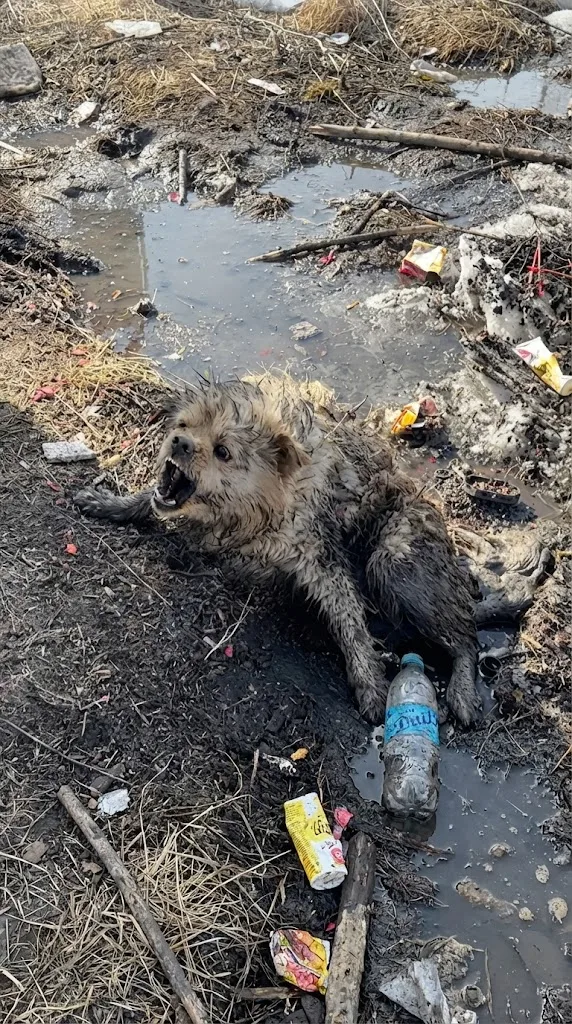
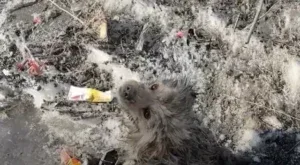
On the icy edge of a quiet northern town, one stray dog’s entire world had shrunk to a single, filthy puddle.
She lay there day after day. Her back legs no longer worked, so any movement meant dragging herself across frozen ground, and each attempt seemed to cost her more than she had to give. Sudden sounds made her flinch.
When everything around her became too much, she simply stopped where she was, in the mud. It did not look like a choice. It looked like a dog with nowhere else to go.
A Puddle She Could Not Leave
Nothing about her situation suggested comfort. The cold ground, the mud and the dirty water were all she had, and with her hind legs unable to carry her, even a short distance was exhausting work.
She did not seem to be staying out of preference. She stayed because moving was hard, and because the world beyond the puddle was unfamiliar and frightening.
Rescuers Who Expected an Easy Save
The first people to reach her believed they could help right away. They were mistaken.
As soon as they stepped closer, she snapped and growled, then tried to haul herself away with whatever strength she had left. To her, every outstretched hand appeared to be a threat.
The rescuers did not read this as meanness. They saw it as fear, a form of self-defense. Little is known about her earlier life, but her reaction suggested she had learned to expect pain from people.
Hours in the Cold, Without Reaching
It soon became clear that this would not be a quick rescue, so the team changed its approach. Instead of pressing forward, they sat nearby and kept their distance. They spoke softly. Then they waited.
Minutes stretched into hours while the cold settled around everyone. Nobody left.
Eventually something shifted. It was only a small change, but it was enough for the rescuers to bring her to safety. The account does not describe that moment in detail, only that patience made it possible.
Her fear, however, came along with her.
Two Stories at the Shelter
At the shelter, her body and her behavior told different stories. Her body showed old injuries and untreated damage, the reason she could no longer walk.
Her behavior showed something less visible. She avoided every gaze, startled at the smallest movement and tried to make herself as unnoticeable as possible. Neglect, loneliness and fear seemed to have settled in deeply.
The first changes were tiny. By the second week, she allowed someone to touch her while she ate. By the third week, her tail moved. Just once, and so slightly that it was easy to miss.
For the people caring for her, it meant a great deal.
Learning That Hands Can Be Gentle
From that point, progress was slow, but it kept coming. She stopped shrinking away. She began leaning into gentle hands, and she started choosing closeness over isolation.
Her body was still fragile. Yet the dog who had once guarded a muddy puddle was now resting in warmth, surrounded by people who looked after her.
Little by little, she was learning that not every person brings pain and not every hand has to be feared.
What Her Recovery Shows
The account does not say whether her legs have improved or where she will live in the long run. What it records is a change in how she meets the world.
Fear, in her case, looked like something learned rather than something chosen. Trust could not be forced. It came after hours of quiet presence, then a touch at mealtime, then a single wag of the tail.
She was once stuck in one place, unable to move forward. Today she trusts a little more, rests more easily and lives with far less dread. Her story suggests that even the most guarded dog may soften when someone is willing to wait.