The rescue boat moved through the neighborhood at a crawl, because there was no longer a street to follow.
Brown floodwater had swallowed the roads and filled the front yards. Fences, rooftops, and the upper edges of doorways rose from a surface that looked more like a river than a residential block. In a landscape this unfamiliar, the crew did what rescue teams do: they kept looking for anyone who might still be waiting for help.
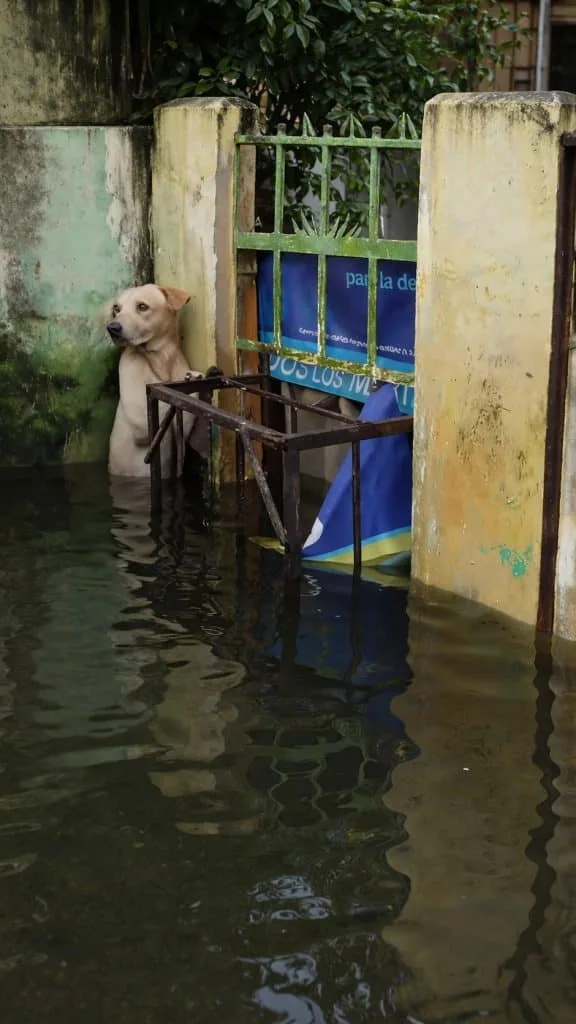
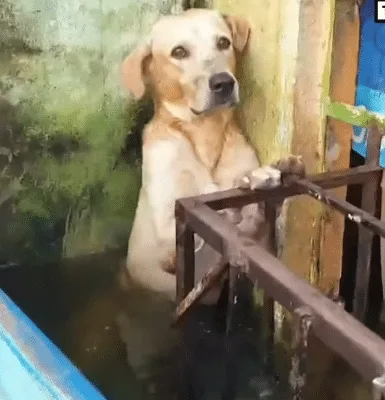
What they found was a small golden dog, alone, holding on to a metal gate while the current pushed against her.
A Small Dog Where the Road Should Have Been
Searching a flooded neighborhood by boat is slow, careful work. With no clear path, the rescuers had to steer around floating debris and check every place that could offer a foothold: doorways, windows, fences, the tops of walls. Any of those spots might have held a stranded person or animal, and a boat passing too quickly could easily miss one.
Then one of them spotted her. A small, golden-colored dog stood partially submerged beside a gate. She was not swimming, and she was not trying to cross the water. She had positioned herself upright against the bars, front paws gripping the metal, and the gate was taking much of the strain the flood was putting on her.
Only her head remained above the surface. Her body trembled with fatigue, yet she kept her grip. Each ripple that reached her seemed to demand a little more effort to stay in place, and nothing in the scene suggested she had much strength left to spend.
No one aboard knew how long she had been there. The water may have risen faster than she could escape. She may have been separated from her family in the confusion. She may have reached the gate just in time and found nothing else to hold. The account establishes none of these explanations. It establishes only the picture in front of the rescuers: one small dog, one gate, and floodwater all around.
Video: A Small Dog Clings to a Flooded Gate as a Rescue Boat Draws Near
What a Flood Takes Away From an Animal
Floodwater does more than cover the ground. It hides the markers that people and animals use to find their way: curbs, hedges, doorsteps, the edge of a yard. Familiar smells can disappear beneath moving water, and places that once felt safe may suddenly be too deep to stand in.
Whether this was the little dog’s own neighborhood is not known. If it was, the transformation would have been complete. Streets she might have walked many times had become open water, and the landmarks she may have relied on were gone. If it was not, she was facing that confusion in a place she did not know at all.
This is part of why rescue crews search so thoroughly after a flood. Animals can be tucked behind structures, out of sight from the main channel of water, or clinging to whatever remains above the waterline. A stranded dog does not always draw attention to herself. Sometimes survival looks like stillness.
That was how this dog appeared when the boat found her. She was small against the wide expanse of water, and what stood out most was that she was not moving. She simply stayed where she was and kept holding on.
A Careful Approach to a Frightened Dog
As the boat drew closer, the dog watched the people approaching. She looked wary and worn out, and from her position there was no way to know whether these strangers meant help or another threat.
The rescuers seemed to understand that getting her out of the water depended as much on trust as on reach. They lowered their voices. They kept their movements slow. A sudden lunge could have startled her into losing her grip, and the whole effort would have been undone.
One rescuer extended a hand and gently touched her head. He did not grab her or try to pull her free. It was a quiet contact, a way of letting her know someone was beside her.
The dog stayed pressed against the gate, paws still locked on the bars. That is understandable. From her point of view, the metal was the one solid thing that had kept her above the water, and accepting help meant giving it up. Trust of that kind rarely arrives on command.
So the rescuers waited. They spoke softly and stayed calm, and gradually the look in her eyes began to shift. It did not change completely, and it did not change all at once, but it changed enough to matter.
One Paw, Then Another
For as long as she had been at the gate, it was her lifeline. Floodwater surrounded her from every side, and the bars were the only fixed point she had. Letting go must have looked like a risk on every level.
But the boat was now within reach, and the team was ready. Slowly, she lifted one paw from the gate. Then the other.
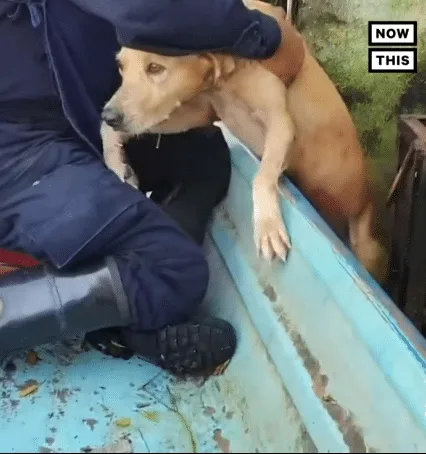
It was a small movement with a great deal riding on it. She reached toward the boat while the rescuers supported her, working quickly but gently so she would not slip back into the current. Moments later, they lifted her aboard.
The whole transfer took only seconds. Yet those seconds ended a stretch of struggle that no one aboard had witnessed from the start. She was no longer fighting the current, no longer gripping cold metal, and no longer alone in rising water.
Stunned, Then Wagging
For a brief moment on the boat, the dog seemed almost stunned, as if her body had not yet caught up with the change. Then her tail began to move. A small wag, and then another.
It was a modest signal, but an easy one to read. The tension that had held her to the gate appeared to be easing.
The rescuers stayed close and gave her time. Animals often remain tense after a frightening ordeal, even when the danger itself has passed, so the team offered patience, calm, and a steady presence rather than rushing her into anything. Her tail kept wagging, not wildly, just enough to suggest some relief.
The flood was still all around the boat. But the water no longer decided what happened to her. She was now surrounded by people who had stopped, looked closely, and chosen to help.
A Name and a Place to Stay
The story did not end when she stepped into the boat. After the rescue, the team made a decision that changed her situation again: they would keep her.
They gave her a name, Marina. It suited a dog whose life had been turned upside down by water, and it gave her something more practical as well. She was no longer just “the dog from the flood.” She had an identity and a household that claimed her.
The source does not describe a veterinary exam or a recovery timeline, so those details remain unknown. What it does describe is the change in her surroundings. Dry ground replaced floodwater. Regular meals replaced uncertainty. Familiar faces took the place of strangers in a boat.
Over the following days she adjusted, and the safety around her began to look less like a temporary pause and more like something she could count on.
From Rescued Dog to Rescue Team Member
With time, Marina’s confidence grew. The dog who had once clung to a gate began learning to trust people again, and the rescuers took note of her gentle nature and resilience.
Eventually she became part of the team that had pulled her from the water. The details of her role are not spelled out, so it is best not to imagine specific duties. What is clear is the arc: a dog who once waited for help now spends her days alongside the people who provide it.
There is something fitting in that. Rescue teams spend their working lives searching flooded streets for animals they may never get to name. In Marina’s case, one of those searches ended with a dog who stayed.
The flood will always be part of her history, but it is no longer the whole of it.
What Letting Go Can Mean
Perhaps the most striking moment in Marina’s story is not the lift into the boat but the instant just before it, when she released the gate.
That gate had kept her above the water. Holding on felt safe, and letting go must have felt like stepping into the unknown. Yet once help was within reach, releasing her grip became an act of trust.
This is interpretation rather than documented fact, but it is an easy one to draw. People, too, hold on to things that carried them through hard times, even after something better comes along. The familiar can feel safer than the new. Marina’s moment at the gate shows that both steadiness and surrender can take bravery, and that the second may only be possible once you believe the help in front of you is real.
The Dog Who Found More Than a Rescue
Looked at as a whole, Marina’s rescue comes down to a short chain of events. A flood changed everything around her. A metal gate kept her upright. A crew searching slowly through flooded streets noticed her. And a gentle hand, offered without force, gave her a reason to let go.
She went from surviving to belonging, and from a flooded street to a team of people who chose to keep her.
When disaster strikes, help often arrives in quiet forms: a boat moving slowly, a patient voice, a hand extended at the right moment.
Marina hung on until someone reached her. When she finally let go, there were hands ready, a boat beneath them, and a team that would keep her.